
Google Ads Strategy 2026: Improve Lead Quality Before You Scale
Vincent
30/07/2025
28
A strong Google Ads strategy 2026 should improve qualified lead quality before expanding spend. Reliable conversion signals, clear campaign roles, and human review of automation help teams decide whether to scale or fix a weak user path first.
What should a Google Ads strategy solve in 2026?
An account can have relevant keywords, polished ads, and a sensible bidding model while still producing weak commercial results. The cause may sit outside the campaign interface. Sales might reject most enquiries. The landing page may fail to answer the user’s question. Conversion tracking may reward low-value actions.
A strategy should connect campaign activity with the business outcome that deserves more investment.
| Business challenge | Strategic question | Useful output |
| Form volume rises but sales rejects enquiries | Which action represents a qualified lead? | A stronger primary conversion |
| Revenue grows while margin remains weak | Which orders create meaningful contribution? | A more useful value signal |
| Search demand limits campaign growth | Where can the account expand responsibly? | A new use case, location, or audience test |
| Performance Max feels difficult to interpret | Which controls and reports should guide review? | A clearer reporting rhythm |
| CPA increases after more budget enters the campaign | What changed before costs rose? | A diagnosis before further spend |
| Creative response declines | Which customer concern needs a new angle? | A structured asset refresh |
At any point, the team should be able to answer these questions:
- Which commercial outcome needs improvement?
- Which conversion signal best represents that outcome?
- Which campaign role supports that result?
- Which automated changes require review?
- What evidence would justify the next scale decision?
This creates a stronger operating model than a disconnected list of campaign tips.
Why campaign tactics do not create a complete strategy
Tactics are individual actions. Adding negative keywords is a tactic. Testing a new headline is a tactic. Adjusting a target CPA is also a tactic.
Strategy decides when those changes matter, who owns the decision, and which commercial signal defines success.
Consider two lead-generation accounts that each produce 100 form submissions. One account delivers booked meetings with suitable prospects. The other fills the CRM with low-intent enquiries. The Google Ads dashboard could show similar lead volume, while the commercial value is completely different.
That difference usually comes from the quality of data entering the account, rather than from the number of conversions reported in the interface.
Platform changes that affect planning
Several Google Ads developments make conversion quality and account governance more important in 2026.
| Development | What it changes | Strategic implication |
| Smart Bidding | Bids respond to conversion or conversion-value signals | The selected signal must represent commercial value |
| Performance Max | One campaign can access broad Google inventory | Goals, assets, controls, and reporting require regular review |
| AI Max for Search | Matching, text customisation, plus final URL expansion can broaden reach | Search quality and landing-page governance become more important |
| Demand Gen | Creative-led campaigns can reach users before active search begins | The business needs enough assets to test message angles |
| Enhanced conversions | First-party data can improve conversion measurement | CRM and technical processes need reliable ownership |
| Channel reporting | Performance Max can show contribution across inventory | Review should focus on campaign outcomes rather than isolated channel metrics |
Smart Bidding uses Google AI to optimize around conversion or conversion-value goals. The quality of those goals influences how useful the optimization becomes.
AI Max for Search can broaden search-term matching, tailor ad text, and expand final URLs. This may uncover relevant demand beyond the existing keyword set. It can also direct traffic to unsuitable pages when the account has weak page mapping or unreliable tracking.
Performance Max is also more transparent than it was in earlier years. Channel performance reporting can show how the campaign delivers across Google inventory. Those insights still need commercial interpretation because the account should be judged by its overall conversion goal.
Start with the signal that reflects commercial value
Strategy should begin with the outcome that matters after the click. Ecommerce brands may focus on purchase value. Local services may prioritise qualified calls. B2B teams often need sales-accepted leads or pipeline contribution before they can judge campaign quality accurately.
Before refining campaign structure, confirm that Google Ads fits the business at its current stage. The guide on when to use Google Ads can help assess demand, landing-page readiness, conversion tracking, and operational capacity before the account expands.
Choose the commercial role of the account
Google Ads can perform different jobs within the same business. Separating these jobs helps the team avoid asking one campaign to solve every marketing problem at once.
| Commercial role | What the campaign supports | Example |
| Capture demand | Reach people actively searching for a solution | Search ads for urgent repair services |
| Create discovery | Introduce an offer before category search begins | Demand Gen for a new consumer product |
| Expand valuable reach | Find additional demand around a proven offer | AI Max or Performance Max test |
| Support product comparison | Help shoppers compare specific items | Shopping activity for an ecommerce catalogue |
| Re-engage visitors | Follow up after valuable on-site behaviour | Remarketing for pricing-page visitors |
| Encourage repeat activity | Support retention among existing customers | Customer-list campaigns for repeat purchase |
Some businesses need search demand immediately. Others need to create earlier interest before users begin researching. A practical Google Ads vs Facebook Ads comparison can help clarify which channel role deserves priority.
A local emergency service often depends on active search demand. By contrast, a new wellness product may need visual proof before users recognise a reason to search. B2B campaigns can use both approaches, with Search capturing later-stage research while broader channels introduce a specialist offer earlier.
Define primary and secondary conversion signals
Primary conversions should guide bidding because they represent the result that matters most. Secondary conversions remain useful for diagnosis, although they should not automatically influence the campaign’s bid strategy.
For ecommerce, a completed purchase will usually provide the clearest primary conversion. Service businesses often need a stronger qualification signal, such as a booked consultation, a verified phone enquiry, or a lead accepted by sales.
| Conversion type | How it should be used | Example |
| Primary conversion | Guides bidding and core reporting | Completed purchase |
| Primary conversion | Guides bidding after qualification feedback | Sales-accepted lead |
| Secondary conversion | Helps diagnose user behaviour | Form start |
| Secondary conversion | Shows engagement before the main action | Pricing-page visit |
| Secondary conversion | Supports landing-page review | Click-to-call interaction |
| Offline conversion | Connects early leads with later value | Closed deal value |
A simple form may create volume quickly. It becomes a weak bidding signal when most submissions are irrelevant. Google can then optimize toward people who complete the form, rather than people who become customers.
CRM feedback helps close that gap. Sales teams can label lead status, meeting outcome, opportunity stage, or closed revenue. The business can then decide whether the current conversion signal deserves greater investment.
Move from raw leads to qualified outcomes
Raw lead volume can help during an early test because it shows whether users respond to the offer. Over time, the account needs a clearer view of what happens after submission.
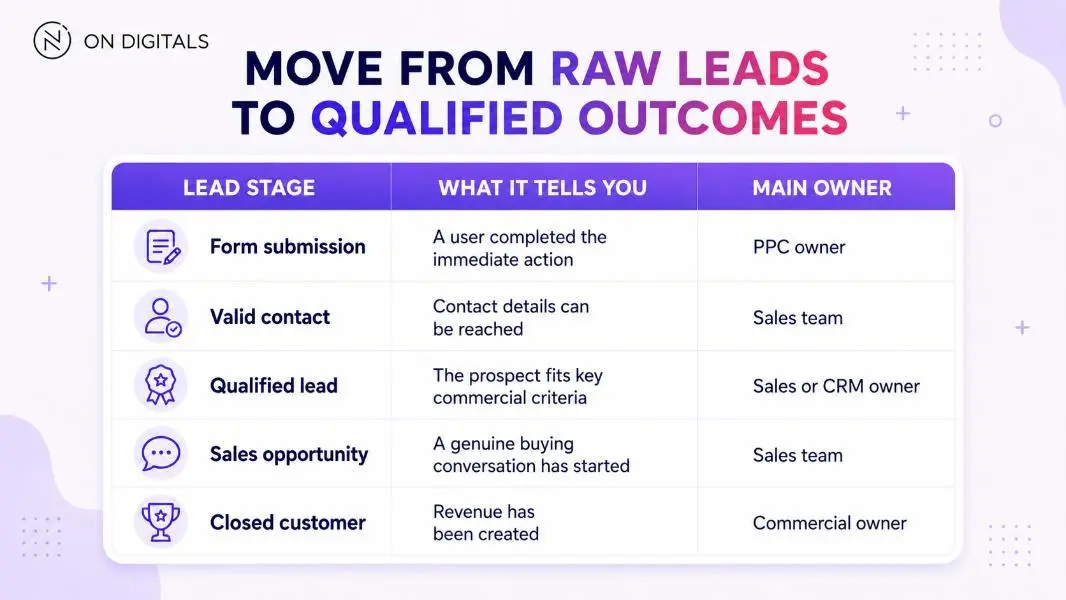 Track lead quality beyond raw volume by following each stage from form submission to qualified outcomes and revenue.
A B2B campaign may bring in 100 forms during a month. Sales might find that only 20 belong to the target market. Ten may be suitable for a meeting. Two may become opportunities. This path gives the business a more useful picture than a headline cost-per-lead figure.
Enhanced conversions for leads can improve measurement for lead-generation campaigns by combining hashed first-party data with conversion imports. The PPC owner, CRM owner, and technical team should agree on how those outcomes are validated before they influence bidding.
Use the Google Ads Strategy Loop to prioritise account work
A useful strategy needs an order. The Google Ads Strategy Loop gives teams a practical sequence for planning, launching, reviewing, and scaling activity.
| Stage | Core question | Output |
| Value | Which outcome creates commercial value? | Qualified lead, purchase value, pipeline, repeat revenue |
| Signal | Which conversion represents that outcome? | Primary goal, secondary diagnostics, CRM feedback |
| Route | Which campaign role should create the result? | Search capture, discovery, expansion, remarketing |
| Test | Which assumption needs evidence? | Offer, query theme, page, audience signal, creative angle |
| Scale | Which route should expand next? | Budget, geography, use case, product group, post-click improvement |
| Govern | Which automated feature needs review? | Bidding, URL expansion, assets, exclusions, recommendations |
This framework stops teams from jumping directly to budget expansion.
For example, a software company may define sales-accepted leads as the most useful outcome. Search campaigns can capture demand around a specific use case. Once the account produces reliable lead-quality feedback, AI Max may become a controlled expansion test. The team can then review search terms, landing-page paths, and CRM status before choosing whether additional reach deserves more budget.
Build clean inputs before expanding reach
Automation can process large volumes of signals. It cannot repair vague offers, weak landing pages, or unclear business priorities.
The account needs clean inputs before it expands responsibly.
Map keyword themes to the right landing-page template
Search campaigns work best when the user journey remains consistent from query to page.
| Search intent | Suitable ad message | Suitable destination |
| High-intent service search | Availability, location, proof, clear next step | Relevant service page |
| Product-model search | Product specification, price context, shipping | Product detail page |
| Category comparison | Key differentiator, buying guide, product range | Category or comparison page |
| B2B problem search | Business challenge, outcome, specialist proof | Use-case page |
| Brand search | Brand value, current offer, direct access | Brand or campaign page |
A broad homepage may work for branded traffic. High-intent non-brand searches often require a more relevant destination because the visitor already has a specific question.
Message match means more than repeating a keyword. The page should answer the question that created the search, then make the next action easy to understand.
Someone searching for “warehouse management software for cold storage” expects relevant industry context. A generic software overview may contain useful information, while still missing the reason that person clicked.
Use first-party data to improve the signal
First-party data can support better campaign decisions when it is collected with clear consent and used through a reliable process. Customer lists, CRM stages, product data, website behaviour, and offline revenue outcomes can all become useful inputs.
The first task is deciding which data deserves operational attention.
| Data source | Strategic use | Review question |
| CRM lead status | Identify qualified outcomes | Which lead stages should influence bidding? |
| Purchase value | Optimise around revenue contribution | Which orders create useful margin? |
| Customer list | Support retention or re-engagement | Which customers need a new offer? |
| Website behaviour | Identify stronger intent signals | Which page actions indicate meaningful interest? |
| Product feed | Support product visibility | Are titles, stock, price, and availability accurate? |
| Call records | Improve lead-quality review | Which calls become genuine sales opportunities? |
Teams often collect this information without connecting it to campaign decisions. A monthly CRM review can close that gap. It gives the PPC owner clearer evidence about which search themes, pages, and offers create useful outcomes.
Create a controlled match-type strategy
Match types should reflect the account’s current level of certainty. Exact match can help maintain control around proven high-intent themes. Phrase match can support related searches when the intent remains close. Broad match can help discover additional demand when conversion signals and review processes are strong enough.
| Account condition | Match-type approach | Why it fits |
| New account with limited conversion evidence | Start with tighter keyword themes | Helps establish relevant search coverage |
| Search campaigns with proven lead quality | Add phrase coverage around validated themes | Expands demand while retaining review clarity |
| Mature account with strong conversion feedback | Test broad match under controlled bidding | Can surface related demand beyond the keyword list |
| Lead quality remains unclear | Limit expansion until CRM feedback improves | Broad reach can amplify weak signals |
| High-value brand terms need protection | Apply deliberate exclusions or controls | Helps reduce unwanted overlap |
Before opening a validated campaign to wider query coverage, compare broad match vs phrase match and decide how much search control the account currently needs.
Broad match should be treated as an expansion method rather than a default setting. It needs active search-term review, useful conversion signals, and a landing-page map that can support a wider range of customer needs.
Negative keyword maintenance remains important as coverage expands. Search behaviour shifts over time, while new offers or seasonal language can introduce irrelevant traffic. Use search term filters to isolate recurring query patterns before adding negatives or changing coverage.
Choose campaign roles instead of chasing formats
Campaign types should follow the buyer journey and the quality of available data. A search-first account may become stronger with Performance Max or AI Max after the team validates conversion quality. A creative-led brand may start with Demand Gen because customers need to understand the offer before they search for it.
Search campaigns for existing demand
Search remains valuable when users already express a commercial need. It can support local services, product categories, B2B use cases, high-consideration purchases, and price-led research.
The strongest Search structure reflects real commercial differences. Separate campaigns may make sense when a service has a different margin profile, target market, geography, or landing-page route.
An emergency plumbing campaign should not follow the same decision model as a bathroom-renovation campaign. The first requires urgent call handling. The second may need project proof, consultation forms, and a longer sales cycle.
Where the decision sits between active intent and visual reach, compare Search Ads vs Display Ads before assigning budget. The two formats can support the same business, while their role in the user journey is different.
Performance Max for validated value signals
Performance Max is a goal-based campaign type that can access Google inventory through a single campaign. It can complement keyword-led Search by helping the account find additional converting customers across Search, Shopping, YouTube, Display, Discover, Gmail, and Maps.
Its broader reach makes preparation especially important.
| Readiness area | What to confirm before launch |
| Conversion goal | Primary actions reflect commercial value |
| Product data | Feed information is accurate when ecommerce is involved |
| Assets | Images, video, headlines, descriptions, plus brand guidance are available |
| Brand controls | Branded traffic treatment is intentional |
| Query controls | Negative keywords or exclusions are reviewed where needed |
| Reporting rhythm | Channel, asset, plus conversion contribution will be reviewed regularly |
A dedicated Performance Max guide provides a deeper view of PMax controls and reporting. Within the wider strategy, the priority remains the same: give the campaign a reliable conversion signal before expanding reach.
Performance Max works best when the business knows what it wants Google to optimise toward. A weak form-completion goal can create more form completions. A sales-qualified signal gives the campaign a stronger direction.
AI Max for Search expansion
AI Max can help Search campaigns reach relevant queries beyond the existing keyword set. It can also support text customisation and final URL expansion.
This feature works best as a controlled experiment.
| AI Max readiness check | Why it matters |
| Search campaign has stable conversion tracking | Expansion needs a useful optimisation signal |
| Landing pages are technically reliable | Final URL expansion can direct users to different pages |
| Tracking parameters have been tested | Dynamic page selection must preserve measurement |
| Offer details remain current across key pages | Generated assets need accurate source content |
| Search-term review is part of the weekly workflow | New query coverage needs active quality control |
A business with stable Search performance can test AI Max on a defined campaign segment. A separate test campaign may also be appropriate when the account structure supports it. The review should compare qualified outcomes, page paths, search terms, and conversion value.
AI Max should not be treated as a simple reach switch. It changes how the account matches queries and selects page experiences. The test needs a defined hypothesis before it starts.
Demand Gen and video for earlier discovery
Demand Gen can support awareness and consideration when the product benefits from visual explanation. It can reach audiences across YouTube, Discover, Gmail, and selected Google inventory.
Creative capacity becomes a strategic input. One product image rarely supports a durable discovery programme. Teams need several ways to explain the offer from different angles.
| Creative angle | Best used when | Example direction |
| Problem recognition | The audience feels the issue but has not named a solution | “Why manual reporting slows project teams” |
| Product demonstration | The offer becomes clearer when users see it in use | Short workflow video |
| Social proof | Buyers need confidence before acting | Customer outcome or proof point |
| Comparison | The market includes familiar alternatives | “Built for multi-location operators” |
| Offer-led message | A time-sensitive trigger exists | Consultation, trial, seasonal promotion |
A discovery campaign still needs a sensible starting audience. Google Ads audience targeting can help define the initial reach, while downstream commercial action should determine whether the campaign deserves further budget.
Demand Gen can create valuable signals. Click volume alone does not show whether the activity supports growth. Later branded search, assisted conversions, engaged visits, and lead quality can offer a fuller view.
Remarketing and retention activity
Remarketing can support users who have already reached a meaningful point in the journey. A pricing-page visitor may need a different message from someone who only viewed a blog article.
Segmentation matters because broad remarketing can create repetitive messaging. Frequency, asset refresh, exclusion rules, and customer status all deserve review.
Existing customers may need a different strategy again. Retention messaging should account for product lifecycle, prior purchase behaviour, service renewal timing, and the value of the next action.
Govern automation without slowing useful progress
Automation can improve efficiency when the account has clean inputs. It can also create wasted spend when changes happen without commercial context.
A clearer approach is to define which actions can move forward automatically, which changes require review, and which decisions need commercial approval.
Use an automation approval matrix
| Automation area | Default approach | Why |
| Policy fixes for disapproved assets | Review the cause before resubmitting | The issue may involve a claim, offer, or legal requirement |
| Bid-strategy changes | Require PPC and commercial approval | Changes can alter spend behaviour quickly |
| Budget increases | Require commercial approval | Scale depends on economics plus fulfilment capacity |
| AI-generated headlines | Require human review | Claims, pricing, tone, and brand accuracy matter |
| Final URL expansion | Review page mapping first | Users may reach an unintended template |
| Auto-applied recommendations | Enable selectively | Some recommendations can conflict with account strategy |
| Negative keyword additions | Review context before applying | Useful search coverage can be removed accidentally |
Many Google Ads mistakes begin when automation changes faster than the team can verify tracking or approve page updates. Clear approval rules reduce that risk without preventing useful experimentation.
Human review should protect commercial decisions rather than slow down routine account work.
Use exclusions and controls with a purpose
Campaign controls should respond to a clear business need.
Brand exclusions may help separate branded demand from non-brand expansion. Negative keywords can block clearly irrelevant traffic. Placement exclusions can support brand suitability. Final URL controls can protect key page paths.
Overusing controls can limit valuable reach. Loose controls can create avoidable waste. Start with the performance issue, then choose the smallest control that addresses it.
For example, a Performance Max campaign may attract branded queries that the business wants to measure separately. Brand exclusions or negative keywords may create a cleaner view. The decision should account for the value of branded traffic and the role of the existing Search campaign.
Review Performance Max with the right questions
Performance Max reporting becomes more useful when it is tied to a commercial question.
| Review area | Useful question |
| Channel performance | Which inventory contributes to the campaign goal? |
| Asset performance | Which message or format creates stronger response? |
| Search themes | Do they reflect business priorities? |
| Search terms | Is the campaign appearing for relevant demand? |
| Brand controls | Are branded queries handled intentionally? |
| Landing pages | Does traffic reach pages that support the stated offer? |
| Conversion quality | Are downstream outcomes improving with volume? |
Review direction over time rather than isolated metrics. One channel may appear weaker in isolation while still helping the campaign create incremental value. A sharp decline in qualified leads usually deserves more attention than one low-performing asset label.
Turn creative and landing pages into performance levers
Creative and page experience matter more as automation expands reach. Google can test assets at scale, yet the source material still needs a clear offer, useful proof, and consistent messaging.
Build creative systems instead of isolated variants
A useful creative system gives the account several ways to explain the same value proposition.
For a B2B campaign, one asset may focus on the operational problem. Another can emphasise the commercial outcome. A third may provide industry-specific proof. These angles allow the team to learn which message resonates with different buyers.
Ecommerce campaigns can take a similar approach through product use, feature proof, customer context, and urgency. Visual campaigns need a stronger refresh process than Search because audiences may see the same message repeatedly.
Teams that need inspiration can review selected Google Ads examples before developing fresh creative angles for Search, Performance Max, or Demand Gen.
| Component | Review question |
| Headline | Does it address a real buyer concern? |
| Description | Does it add a clear reason to act? |
| Image or video | Does it show the product or problem quickly? |
| Offer | Is the commercial value obvious? |
| Landing page | Does it continue the promise from the ad? |
| CTA | Is the next action right for the buying stage? |
Match each promise to a landing-page route
Landing pages should reflect the intent behind the traffic source. Broad campaigns may need several page paths. Search activity often benefits from a tighter keyword-to-page relationship.
A page issue can reduce performance even when the campaign reaches relevant users. Common friction includes unclear pricing context, weak proof, long forms, slow loading, missing location details, or calls to action that do not fit the buyer’s stage.
The page owner should take part in account reviews. Paid media teams can identify friction, while they may not control the template, offer details, or technical changes needed to resolve it.
Scale through the route that fits the evidence
Campaign scale should come from the next strongest opportunity. Budget expansion is one route. It is not the only route available.
| Scaling route | Use it when | Hold back when |
| Budget expansion | Valuable conversions remain stable and capacity is available | Lead quality remains unclear |
| Horizontal expansion | New use cases, products, regions, or audience segments have evidence | Existing campaigns overlap heavily |
| Conversion-quality upgrade | Lead volume is strong while sales acceptance is weak | CRM cannot classify outcomes |
| Post-click improvement | Relevant traffic reaches a weak page | Traffic quality remains uncertain |
| Creative expansion | Discovery activity needs fresh messaging | The offer itself is unclear |
| New campaign role | The business has an unserved stage in the buyer journey | Existing campaign roles lack measurement |
Increase budget after signal quality is proven
Budget should follow reliable evidence. A campaign may have enough conversion volume to show that the current model is working. It may also have stable qualified-lead rate, viable acquisition economics, and enough sales capacity to handle more demand.
A sudden large increase makes performance harder to interpret because several variables change at once. Controlled increments allow the team to observe whether query quality, CPA, conversion value, and downstream lead quality remain stable.
No universal percentage applies to every account. Search volume, budget level, sales cycle, target CPA, and conversion volume all affect how an increase should be managed.
Expand by use case, geography, or product group
Horizontal scaling gives a business another way to grow without forcing more spend into one campaign.
A SaaS company may create a dedicated campaign for a second industry use case. A local service provider may add another service area after confirming fulfilment capacity. An ecommerce brand may separate a high-margin product group from lower-margin items.
Each expansion needs its own commercial logic. Reusing a generic campaign structure can hide meaningful differences in landing pages, margins, conversion goals, or sales handling.
Improve conversion quality before buying more traffic
Lead volume can make a campaign look healthy while hiding a sales problem. The account may need a stronger qualification form, clearer price context, better audience filtering, a more specific offer, or faster follow-up from sales.
The largest gain may come from improving the percentage of leads that become useful opportunities. This can make the same ad spend more valuable before the business expands reach.
Fix post-click friction before blaming traffic
Traffic can be relevant while the destination page creates friction. A visitor may leave because the offer lacks proof, the form asks too much, or the page does not answer the reason for the search.
Review the user path before concluding that a campaign has reached the wrong audience. Page analytics, session recordings, form abandonment, customer feedback, and sales notes can help identify the next improvement.
Diagnose rising CPA before changing bids
Rising CPA has several possible causes. A bid adjustment may help in some situations. It can also hide the real issue when measurement, traffic quality, or post-click experience has changed.
| Potential cause | What to inspect | Likely next action |
| Conversion tracking issue | Tag status, conversion counts, attribution changes | Validate measurement before changing bids |
| Search-quality decline | Search terms, match types, negatives, query intent | Refine coverage or exclusions |
| Landing-page friction | Page speed, form completion, message match | Improve the destination page |
| Creative fatigue | Asset performance, frequency, message response | Refresh creative angles |
| Competitive pressure | Impression share, auction insights, pricing changes | Review economics and offer position |
| Sales-response issue | Lead contact speed, qualification status, CRM feedback | Improve follow-up before scaling |
| Budget-expansion effect | Changes in CPA after higher spend | Stabilise and reassess the scale route |
When relevance signals appear to weaken, Google Ads Quality Score can support diagnosis without becoming the optimisation target. Review the underlying keyword, ad, and landing-page relationship before making a bid adjustment.
Google describes Quality Score as a diagnostic tool. It can help identify issues around expected click-through rate, ad relevance, or landing-page experience. It does not replace a wider review of conversion quality and commercial outcomes.
A rising CPA may therefore reflect a more complex issue than one score. Review the user journey from query through to qualified outcome before changing the bid target.
Use a weekly, monthly, and quarterly review rhythm
Account management works better when the review rhythm matches the type of decision being made.
| Review period | Focus | Typical decisions |
| Weekly | Delivery accuracy, search terms, asset issues, tracking health | Exclusions, asset updates, page fixes |
| Monthly | Qualified outcomes, campaign contribution, economics | Budget allocation, campaign-role changes |
| Quarterly | Offer priorities, market shifts, data quality, expansion plans | New use cases, geography, funnel investment |
Weekly reviews should stay close to operational issues. Check tracking, policy notices, search terms, campaign overlap, location settings, and page changes.
Monthly reviews should connect the account with commercial feedback. Sales acceptance, order value, pipeline progress, margin context, and fulfilment capacity deserve attention.
Quarterly planning can reassess the wider role of Google Ads. The business may need more demand capture, stronger discovery activity, a new market segment, or a revised conversion model.
FAQ: Google Ads strategy 2026
What is the most important part of a Google Ads strategy in 2026?
The most important part is the conversion signal that guides campaign decisions. Google Ads can optimize bids more effectively when the account receives a meaningful signal. Lead-generation accounts should move beyond raw form volume when sales can identify which enquiries become valuable opportunities.
Should a business optimize Google Ads for leads or revenue?
The best target depends on the business model. Ecommerce accounts can often optimize toward purchase value when revenue tracking is accurate. Service businesses may need qualified calls or booked consultations. B2B teams can benefit from sales-accepted lead or opportunity feedback.
When should AI Max be tested?
AI Max is most suitable when a Search campaign already has reliable tracking, suitable landing pages, and a clear review process for new search terms. Test it with a defined hypothesis, such as finding incremental demand around a validated offer. Review page paths and conversion quality before expanding the setting across the account.
Does broad match still have a role in Google Ads strategy?
Broad match can support discovery when the account has useful conversion signals, active search-term review, and clear negative-keyword hygiene. Tighter match types may suit a newer account or a campaign where lead quality remains uncertain. The better approach depends on how much evidence the business has.
How should Performance Max be evaluated?
Review Performance Max against the campaign’s commercial goal. Channel performance, asset data, search terms, brand controls, plus conversion quality can provide useful context. Compare the campaign with the wider account to assess whether it adds incremental value rather than simply receiving credit for demand that existing activity would have captured.
When should the budget increase?
Increase budget when qualified outcomes remain stable, economics remain viable, and the business can handle additional demand. A campaign with inexpensive raw leads but weak sales acceptance needs a quality improvement before extra spend.
Does Quality Score still matter in Google Ads?
Quality Score can help diagnose issues around expected click-through rate, ad relevance, and landing-page experience. It should not be treated as a standalone KPI or a direct auction input. Use it to identify areas that deserve a deeper review.
How can a business reduce Google Ads waste?
Start by reviewing where waste enters the user path. Search terms may be irrelevant. Landing pages may not match ad promises. A conversion action may reward low-value behaviour. Sales may also reject leads without that feedback reaching the account. Fixing the largest bottleneck usually creates more value than making several small bid changes.
Conclusion
A Google Ads strategy 2026 should give the business a clearer way to decide where each additional dollar goes. Start with the outcome that matters. Feed that outcome back through reliable conversion signals. Assign every campaign a clear role. Review automation through commercial context, then expand through the opportunity that has the strongest evidence.
For businesses that need help connecting Google Ads with qualified lead quality, landing-page performance, and commercial reporting, explore Google Ads services from On Digitals.

NEWEST POSTS
- Advertising Industry In Vietnam: The 2026 Trends, Channels and Market-Entry Strategy
- Best SEO Company in Vietnam: Latest Shortlist For Businesses
- How To Leverage Social Media For Customer Service Like A Pro?
- Social Media Post Tips – 8 Ways To Boost Engagement
- How To Use Social Media for Sales – In-depth Beginner Guide
Read more