
Performance Max Campaigns: How It Works, Strategy, and Optimization Guide in 2026
Vincent
14/08/2025
44
Performance Max has quickly become one of the most important campaign types in Google Ads, especially as automation and AI-driven advertising continue to reshape how digital marketing works in 2026. Instead of relying on manual keyword targeting and isolated campaign structures, advertisers now work with a unified, goal-based system that distributes ads across all Google channels automatically.
However, while Google Ads Performance Max offers powerful scaling potential, it also introduces new challenges around control, transparency, and optimization strategy. Many advertisers struggle to understand how the system actually works, when to use it effectively, and how to improve performance without losing visibility over campaign behavior.
In this guide, we break down exactly how Performance Max works, its core components, advantages and limitations, and most importantly — a practical strategy framework to help you control and optimize performance in a data-driven way in 2026.
What is Performance Max Campaign? (Quick Definition + Business Context)
Performance Max is a goal-based advertising campaign type in Google Ads that uses Google’s AI systems to automatically distribute ads across all available Google inventory based on conversion objectives instead of traditional keyword targeting. In the ecosystem of modern digital advertising, Google Ads Performance Max represents one of the most significant shifts from manual campaign management to fully automated, machine learning–driven optimization.
Unlike traditional campaigns that rely heavily on keyword selection, ad groups, and manual segmentation, Google Ads Performance Max consolidates all targeting decisions into a single AI-powered system. Advertisers only define conversion goals, audience signals, and creative assets, while Google dynamically determines where ads appear and which users are most likely to convert.
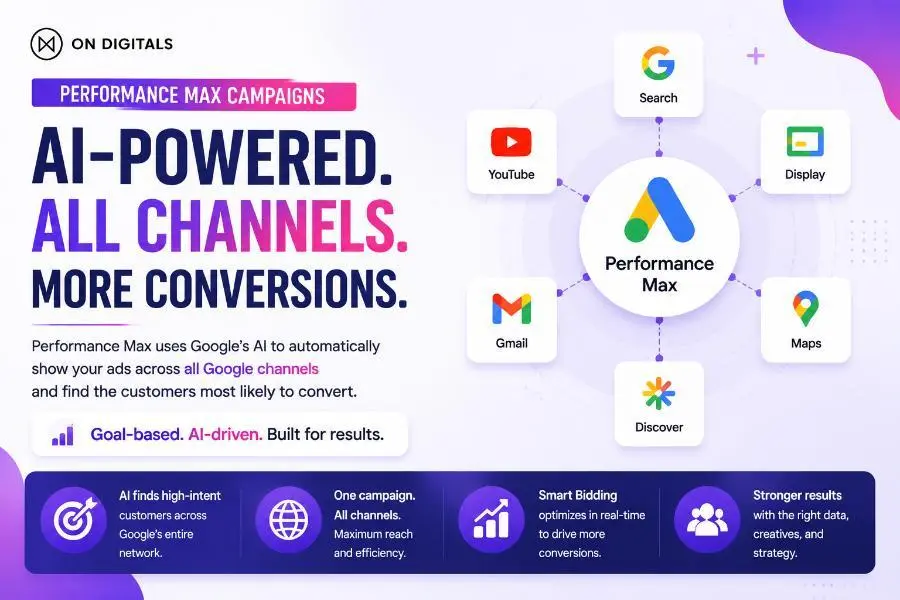
The system was introduced to solve a major challenge in digital marketing: fragmented user journeys across multiple platforms. Today’s users interact with brands across Search, YouTube, Display, Maps, Gmail, and Discover before converting, making isolated campaign optimization inefficient.
According to Google’s official documentation, Google Ads Performance Max was designed to unify all campaign types into one automated performance framework that prioritizes conversion outcomes over manual control
https://support.google.com/google-ads/answer/10724817?hl=en
In 2026, this shift reflects a broader transformation in advertising: from keyword-based bidding to AI-driven intent prediction systems that understand user behavior across channels.
How Performance Max Works (Google AI System Explained)
Google Ads Performance Max operates as a fully automated advertising ecosystem powered by machine learning. Instead of managing separate campaigns for Search, Display, and YouTube, advertisers feed the system inputs, and Google distributes budgets dynamically across its entire inventory.
At its core, Google Ads Performance Max is built on asset-based execution. Advertisers provide creative components such as headlines, descriptions, images, and videos. Google’s AI then assembles these assets into different ad combinations depending on user intent, device type, and contextual signals.
The system distributes ads across:
- Search Network
- YouTube
- Display Network
- Gmail
- Google Maps
- Discover
Smart Bidding is a fundamental engine within Google Ads Performance Max, using strategies like tCPA and tROAS to adjust bids in real time based on conversion probability. This ensures that budget is allocated to users most likely to complete a conversion action.
Google’s API documentation explains that Google Ads Performance Max continuously evolves through a machine learning feedback loop where conversion signals improve future targeting accuracy
https://developers.google.com/google-ads/api/performance-max
The workflow typically follows four steps:
- User interaction signals are collected
- Conversion behavior is analyzed
- AI adjusts bidding and placement decisions
- Performance is continuously optimized
Industry analysis from Channable further highlights that while Google Ads Performance Max improves automation efficiency, it increases dependency on data quality and creative strength
https://www.channable.com/blog/performance-max-campaigns
Key Components of Performance Max
A Google Ads Performance Max campaign is structured around several core components that define how the AI system interprets and distributes ads.
Asset Groups act as the primary structural unit. Each asset group contains creatives, audience signals, and messaging themes aligned with a specific product category or business objective. In Google Ads Performance Max, asset groups essentially replace traditional ad groups.
Audience Signals help guide the AI during the initial learning phase. These signals do not restrict targeting but instead act as directional inputs that help Google Ads Performance Max understand potential customer segments faster.
Creative Assets include text, images, and video formats. One of the strengths of Google Ads Performance Max is its ability to automatically mix and match these assets to generate high-performing ad variations.
Conversion Goals define what success means for the campaign, whether it is purchases, leads, or sign-ups. Without clear conversion definitions, Google Ads Performance Max cannot optimize effectively.
For eCommerce advertisers, product feeds play a critical role by enabling Shopping-style ad generation within Google Ads Performance Max campaigns.
Together, these components create a unified system where advertiser input guides AI decision-making rather than manually controlling targeting or placements.
Benefits of Performance Max Campaigns
Performance Max has quickly become one of the most important campaign types in Google Ads, especially as automation and AI-driven advertising continue to reshape how digital marketing works in 2026. Instead of relying on manual keyword targeting and isolated campaign structures, advertisers now work with a unified, goal-based system that distributes ads across all Google channels automatically.
However, while Google Ads Performance Max offers powerful scaling potential, it also introduces new challenges around control, transparency, and optimization strategy. Many advertisers struggle to understand how the system actually works, when to use it effectively, and how to improve performance without losing visibility over campaign behavior.
In this guide, we break down exactly how Performance Max works, its core components, advantages and limitations, and most importantly — a practical strategy framework to help you control and optimize performance in a data-driven way in 2026.
Google Ads Performance Max
Despite its advantages, Google Ads Performance Max introduces several limitations that advertisers must consider before scaling.
The most widely discussed issue is its “black box” nature. Advertisers have limited visibility into how Google Ads Performance Max distributes traffic across different channels, making analysis more challenging.
Another limitation is reduced control over placements. Since AI determines where ads appear, advertisers cannot manually adjust channel-level distribution within Google Ads Performance Max campaigns.
Search term visibility is also limited compared to traditional Search campaigns, reducing keyword-level optimization opportunities.
A frequently mentioned concern in PPC communities, including Reddit discussions, is brand cannibalization, where Google Ads Performance Max overlaps with existing Search or Shopping campaigns and distorts attribution models.
Additionally, performance is heavily dependent on conversion data quality. Without sufficient or accurate tracking, Google Ads Performance Max cannot optimize effectively, leading to inefficient budget allocation.
When to Use Performance Max Campaigns
Google Ads Performance Max is most effective when used in data-rich environments where conversion signals are strong and consistent.
It is ideal for eCommerce scaling strategies where product feeds and purchase data are available. Many advertisers rely on Google Ads Performance Max to expand product visibility across multiple channels simultaneously.
It also performs well in lead generation campaigns with properly configured conversion tracking systems. In these cases, Google Ads Performance Max can optimize based on real business outcomes.
High conversion volume accounts benefit significantly because machine learning systems within Google Ads Performance Max require sufficient data to operate efficiently.
The system is also suitable for businesses adopting automation-first growth strategies where scalability is more important than manual control.
Finally, Google Ads Performance Max works well in multi-channel marketing environments where consistent brand presence across Google’s ecosystem is required.
Performance Max delivers the strongest results when conversion signals, data quality, and tracking systems are strong enough for AI optimization.
When Not to Use Performance Max
Google Ads Performance Max should not be used in low-data environments where conversion volume is insufficient for AI optimization.
It is also unsuitable for early-stage testing campaigns where advertisers need granular keyword-level control.
Businesses requiring strict brand protection may face challenges due to limited visibility in Google Ads Performance Max campaigns.
Tight-budget campaigns are also not ideal because Google Ads Performance Max distributes spend dynamically across channels without manual allocation control.
Finally, advertisers who require full manual control over keywords, placements, or messaging should consider traditional Google Ads campaign types instead.
Performance Max Strategy Framework
To successfully manage Google Ads Performance Max, advertisers must focus on input quality rather than manual optimization.
Clear conversion goals are the foundation of any successful Google Ads Performance Max strategy. Without them, AI optimization cannot function effectively.
For eCommerce campaigns, optimizing product feeds is essential because it directly influences how Google Ads Performance Max distributes shopping inventory.
Structuring asset groups properly ensures better segmentation of messaging and audience intent within Google Ads Performance Max campaigns.
Audience signals should be used to guide initial learning phases, helping the system understand potential customer segments faster.
High-quality creative assets significantly improve performance because Google Ads Performance Max relies heavily on creative diversity.
Accurate conversion tracking is the most critical factor, as all optimization in Google Ads Performance Max is based on conversion signals.
How to Optimize Performance Max Campaigns
Optimization in Google Ads Performance Max focuses primarily on improving input signals rather than relying on manual bidding adjustments. Since the system is fully powered by machine learning, the quality of data you provide directly influences how effectively Google allocates budget, identifies audiences, and optimizes conversions.
A key priority is conversion tracking quality. Accurate and well-structured conversion data enables better decision-making within Google Ads Performance Max, while poor tracking can significantly reduce optimization efficiency and lead to unstable performance.
Audience signals also play an important role in accelerating the learning phase. Although they do not restrict targeting, strong signals help Google Ads Performance Max understand initial user intent faster, improving early campaign stability and reducing wasted spend during the learning period.
Creative testing is another essential factor, as the system relies heavily on asset combinations. Continuously testing headlines, descriptions, images, and videos ensures that Google Ads Performance Max can identify the most effective variations across different placements.
Finally, reviewing performance insights and adjusting Smart Bidding strategies such as tCPA or tROAS helps align automation with business objectives. This ensures Google Ads Performance Max optimizes not just for conversions, but for efficient and high-quality conversion outcomes.
Common Performance Max Mistakes
One of the most common mistakes in Google Ads Performance Max is launching campaigns without proper conversion tracking. Since the entire system relies on machine learning, inaccurate or missing conversion data prevents Google from optimizing effectively, leading to poor bidding decisions and unstable performance.
Another major issue is using weak or generic creative assets. Because Google Ads Performance Max automatically combines and distributes creatives across multiple placements, low-quality assets significantly reduce engagement and limit the system’s ability to identify high-performing variations.
Ignoring audience signals is also a frequent mistake. While audience signals do not directly control targeting, they play an important role in guiding early-stage learning. Without them, Google Ads Performance Max takes longer to understand user intent, which slows down optimization and increases wasted spend.
Many advertisers also expect full manual control similar to Search campaigns, which creates unrealistic expectations. Google Ads Performance Max is designed as an AI-driven system, meaning control is intentionally reduced in favor of automation and scale.
In addition, insufficient conversion data limits machine learning effectiveness, making it difficult for the system to optimize efficiently. Finally, over-segmenting asset groups can fragment data signals, reducing overall performance efficiency within Google Ads Performance Max campaigns.
Performance Max vs Traditional Campaigns
Compared to traditional Search campaigns, Google Ads Performance Max removes keyword-level control and replaces it with AI-driven intent modeling. Instead of manually selecting keywords and adjusting bids, advertisers rely on Google’s machine learning system to interpret user intent and determine the most relevant search queries, audiences, and placements across channels.
When compared to Shopping campaigns, Google Ads Performance Max extends product visibility beyond the Shopping tab and Search results. It distributes product listings across multiple Google properties such as YouTube, Display, Gmail, and Discover, allowing advertisers to reach users at different stages of the buying journey and not just during high-intent product searches.
In contrast to Display campaigns, Google Ads Performance Max shifts from impression-based targeting to conversion-based optimization. Rather than focusing on visibility or reach metrics alone, the system prioritizes users who are most likely to complete a conversion action, using real-time signals and Smart Bidding strategies.
Overall, Google Ads Performance Max represents a fundamental shift in digital advertising—from manually managed, channel-specific campaigns to a unified AI-driven distribution system that automatically allocates budget, placements, and audiences based on conversion probability and machine learning insights.
Advanced Insights for Performance Max in 2026
In 2026, Google Ads Performance Max continues to evolve into an AI-first advertising system where keyword dependency is significantly reduced.
Creative assets are becoming one of the strongest performance drivers.
First-party data is increasingly critical for optimization accuracy in Google Ads Performance Max.
Ultimately, performance is determined by data quality, conversion signals, and creative strength rather than manual control.
FAQ: Performance Max Campaigns
What is Performance Max campaign?
It is a Google Ads AI-driven campaign type that optimizes across all Google inventory based on conversion goals.
Is Performance Max better than Search campaigns?
It depends on objectives. Google Ads Performance Max is better for scaling, while Search offers more control.
How long does Performance Max take to optimize?
Performance Max typically takes several weeks to fully optimize, depending on the conversion volume and the quality of data provided. Since Google Ads Performance Max relies on machine learning, the system needs enough time and sufficient conversion signals to stabilize performance and make accurate bidding decisions.
Why is Performance Max not performing well?
When Performance Max is not performing well, it is usually due to weak conversion tracking, insufficient data volume, or poor-quality creative assets. In many cases, the issue is not the campaign type itself but the lack of strong input signals that allow Google Ads Performance Max to optimize effectively.
Can you control placements in Performance Max?
Placements in Performance Max cannot be directly controlled. The system is fully automated, meaning Google determines where ads appear across Search, YouTube, Display, Gmail, Maps, and other inventory based on conversion probability and AI-driven optimization logic.
Final Strategy Insights & Takeaways
Google Ads Performance Max is not a traditional campaign type but an AI-driven distribution system that automates advertising across Google’s ecosystem.
Success depends more on data quality and creative strength than manual optimization. Advertisers who adopt strategy-first thinking achieve significantly better results with Google Ads Performance Max. In 2026, hybrid strategies combining Google Ads Performance Max with Search and Shopping campaigns remain the most effective approach for sustainable growth.

NEWEST POSTS
- Advertising Industry In Vietnam: The 2026 Trends, Channels and Market-Entry Strategy
- Best SEO Company in Vietnam: Latest Shortlist For Businesses
- How To Leverage Social Media For Customer Service Like A Pro?
- Social Media Post Tips – 8 Ways To Boost Engagement
- How To Use Social Media for Sales – In-depth Beginner Guide
Read more