
How To Improve Google Search Ranking? A Comprehensive Guide
Vincent
13/07/2023
38
Improving Google ranking means helping Google crawl, index, trust, and serve your pages for local search intent. This is a tactic to implement the best SEO strategies. In the AI search era, this also means preparing content for AI Overviews, Google AI Mode, local results, specific-language queries, mobile performance, E-E-A-T signals, and measurable business outcomes.
Choose the right ranking path
The best way to improve Google ranking depends on the type of business and search intent.
A local clinic needs Google Business Profile and reviews. A B2B company needs service pages, thought leadership, and lead tracking. An ecommerce brand needs category pages, product data, images, and merchant signals.
For foreign businesses entering Vietnam, this first decision prevents wasted SEO work.
|
Business type |
Ranking priority |
What to improve first |
|
Local service business |
Maps, local pack, service pages |
Google Business Profile, reviews, location pages |
|
B2B/ SaaS company |
Service pages, comparison queries, guides |
Vietnam-specific landing pages and content clusters |
|
Ecommerce brand |
Category/ product pages, images, product data |
Technical SEO, Merchant Center, category copy |
|
Publisher/ content site |
Topic authority and freshness |
Original content, internal links, author signals |
|
New market-entry brand |
Trust and local relevance |
About page, local proof, bilingual content |
How Google search ranking works in the era of AI?
Google Search works through crawling, indexing, and serving results. Google explains that it uses automated crawlers to discover and analyze pages during indexing, then serves results relevant to a user’s query.
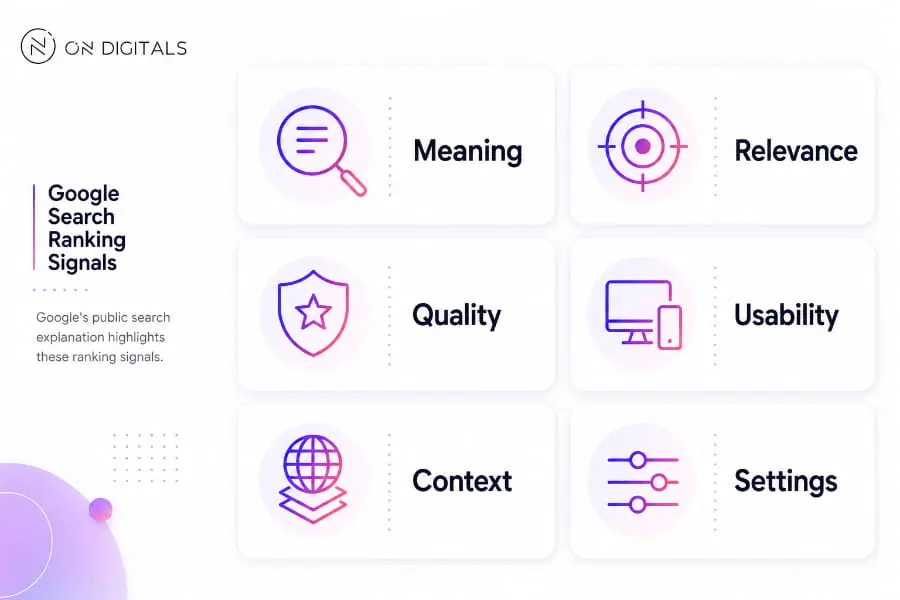
For ranking Google’s public search explanation highlights signals
This is important for Vietnam because language, location, and user intent can change the results a foreign brand sees.
Currently, there is an extra visibility layer: AI Overviews and AI Mode.
Google’s official generative AI search guide says SEO best practices remain relevant because these features are rooted in Google’s core search ranking and quality systems. The same guide explains retrieval-augmented generation and query fan-out, where Google can run related searches to build a more complete AI answer.
Practical takeaway: Improving Google ranking now means improving three things at once:
- Classic organic rankings;
- AI citation readiness;
- Conversion quality.
How to improve your Google search ranking?
1. Fix crawlability and indexation before changing content
You cannot improve Google search ranking if Google cannot crawl or index the right pages.
This means checking technical SEO including sitemap quality, canonical tags, language versions, internal links, and whether your most important service or product pages are indexable.
This is especially important for international websites that add Vietnam pages after the main global site is already built. A common mistake is publishing a /vietnam/ or /vi/ section but leaving it disconnected from the main navigation.
2. Build Vietnam-specific pages, not copied global pages
Foreign businesses should create pages that match local intent, language, and proof to improve Google ranking in Vietnam.
A translated global page is rarely enough because Vietnamese users may search differently, compare different competitors, trust different signals, and expect local examples.
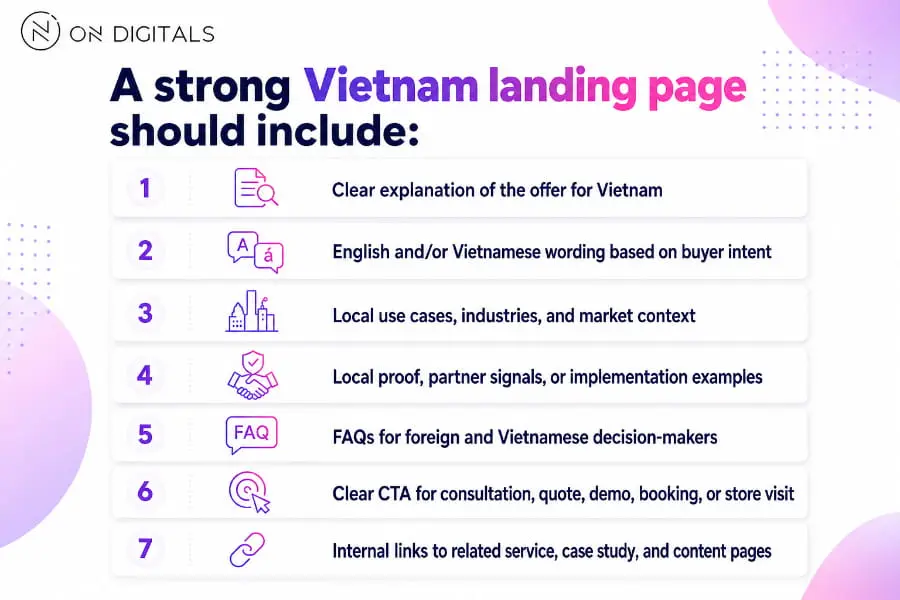
A strong Vietnam landing page should include these elements
3. Improve content quality with E-E-A-T
Google’s automated ranking systems are designed to prioritize helpful information created to benefit people, not content created mainly to manipulate rankings.
E-E-A-T itself is not a specific ranking factor, but its systems use a mix of factors that can identify content demonstrating experience, expertise, authoritativeness, and trustworthiness.
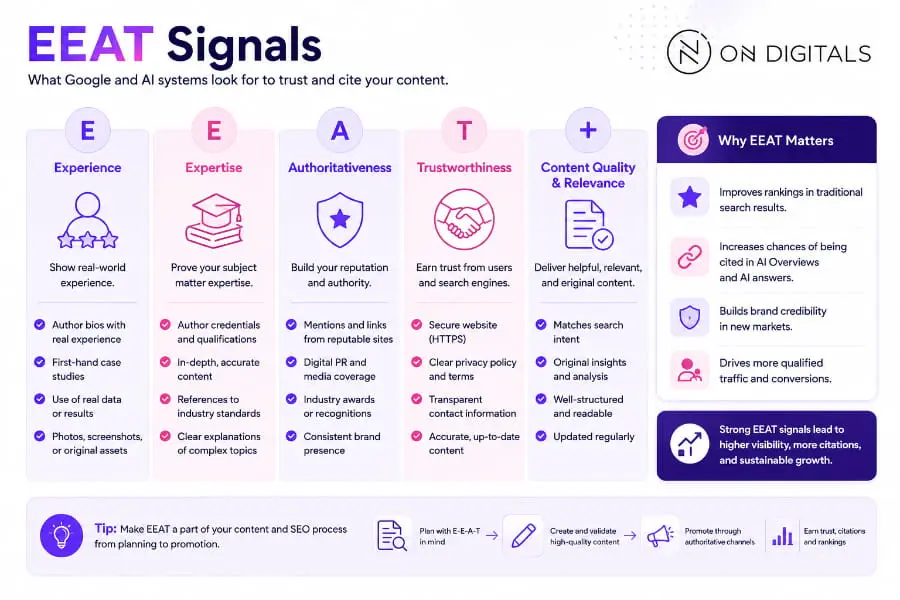
Content quality and EEAT signals
4. Optimize pages for AI Overviews and Google AI Mode
To improve Google search ranking, optimize for both classic results and generative AI Search. Google says AEO and GEO are terms used online, but from Google Search’s perspective, optimizing for generative AI Search is still optimizing for the search experience.
The best AI-ready pages are not written for bots. They are clear, useful, source-backed, and easy to extract.
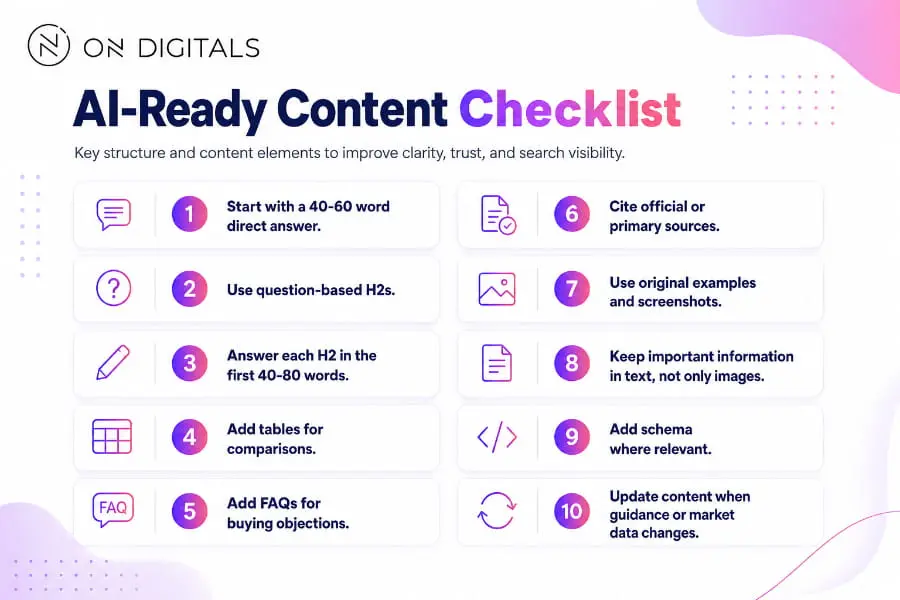
AI-ready content checklist
Google’s AI Search guide also says you might not need llms.txt, special AI markup, content chunking, AI-only rewriting, inauthentic mentions, or overfocus on structured data to appear in generative AI features. Structured data can still support rich-result eligibility, but it is not a special AI Overview shortcut.
5. Improve on-page SEO with intent
On-page SEO helps Google and users understand what each page is about. For brands, the goal is to make every page match one clear search intent and one business action.
Google’s SEO Starter Guide explicitly says Google does not use the keywords meta tag, warns against keyword stuffing, and says keywords in the domain or URL path alone have hardly any ranking effect beyond breadcrumbs.
6. Build topic clusters instead of isolated blog posts
A foreign business should improve Google search ranking by building topical authority, not by publishing disconnected articles. Topic clusters help Google understand your expertise around a subject and help users move from learning to buying.
Each cluster should link back to the relevant service page and to related supporting articles. This creates a clear path for both users and crawlers.
7. Improve local ranking if you serve customers in specific cities
If your business has a physical location or local team in Vietnam, local SEO must be part of the ranking strategy. Local results are mainly based on relevance, distance, and prominence, and there is no way to request or pay Google for a better local ranking.
For a foreign company, local SEO also supports trust. A verified local presence can reduce the risk that Vietnamese users see the brand as distant or unproven.
8. Improve page experience
Page experience matters, especially on mobile. Core Web Vitals focus on loading, interactivity, and visual stability.
The current recommended thresholds are LCP within 2.5 seconds, INP of 200 milliseconds or less, and CLS of 0.1 or less, measured at the 75th percentile across mobile and desktop.
For the Vietnam market, mobile experience matters because many discovery journeys happen on mobile and social platforms before users return to Google.
Do not fix Core Web Vitals while ignoring weak content, no local proof, unclear offer, or broken conversion tracking. Page experience supports ranking and conversion, but it cannot compensate for a page that does not satisfy search intent.
9. Earn backlinks, reviews, and mentions from relevant sources
Backlinks and mentions help Google and users understand whether other sources trust your business. For foreign businesses in Vietnam, the best authority signals are usually local and industry-relevant, not random high-DR links.
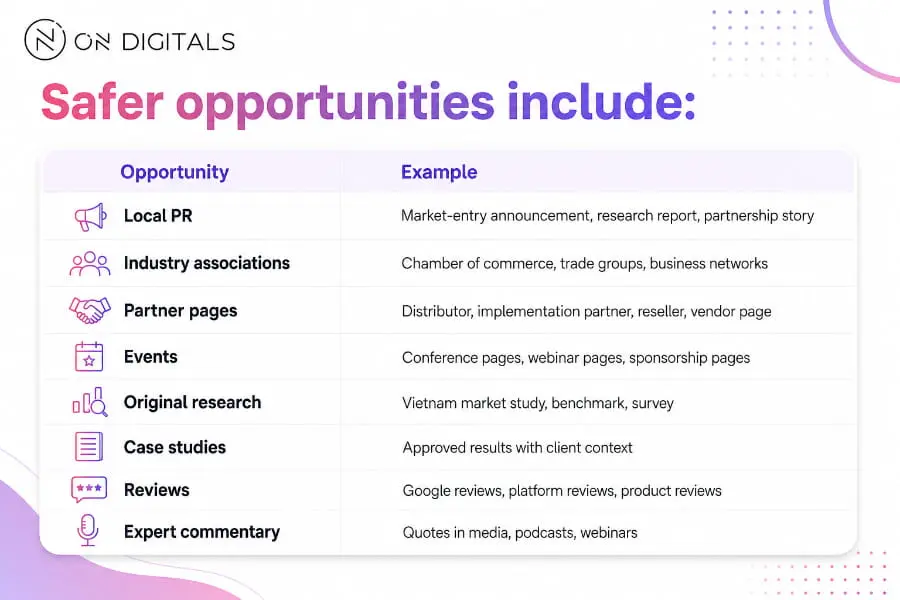
Backlinks authority signals
Avoid buying cheap backlinks or creating artificial mentions. Google’s AI Search guide also warns that seeking inauthentic mentions is not helpful because generative AI features depend on core ranking and spam systems.
10. Diagnose ranking problems with Google Search Console
Use Search Console to diagnose whether the problem is visibility, ranking, click-through rate, or conversion. Google’s Search Console documentation defines impressions, clicks, average position, and CTR, and explains that AI Overview links count as clicks when clicked and impressions only when scrolled or expanded into view.
Use this workflow:
|
GSC pattern |
Likely issue |
Action |
|
Low impressions |
Google does not see enough relevance or indexation |
Improve crawlability, content depth, internal links |
|
High impressions, low CTR |
Snippet or intent mismatch |
Rewrite title, meta, intro, and page angle |
|
Good CTR, poor position |
Page has intent fit but lacks authority/depth |
Improve content, backlinks, internal links |
|
Position improves, clicks flat |
SERP features or AI Overview reduce click opportunity |
Track SERP layout and AI citations |
|
Traffic grows, leads do not |
Wrong intent or weak conversion path |
Improve CTA, form, proof, service page alignment |
|
English page ranks, Vietnamese does not |
Localization gap |
Create native Vietnamese content and internal links |
This diagnostic layer is where most generic “ranking tips” fail. They tell you what to do, but not how to know which problem you actually have.
How long does it take to improve Google search ranking?
Most SEO improvements take weeks to months, not days. Technical fixes and title changes can show early movement if Google recrawls quickly, but competitive rankings in Vietnam usually require sustained work across content, internal links, backlinks, trust signals, page experience, and conversion quality.
A realistic timeline:
|
Timeline |
What can improve |
|
0-30 days |
Crawl/ indexation fixes, title/meta rewrites, GSC setup |
|
1-3 months |
Long-tail impressions, early ranking movement, CTR tests |
|
3-6 months |
Topic cluster growth, stronger service-page rankings, early leads |
|
6-12 months |
Competitive keywords, authority gains, conversion-led SEO |
|
12+ months |
Brand search, topical authority, durable organic demand |
Avoid any SEO partner promising guaranteed #1 rankings in a few weeks. Google’s own documentation says it does not accept payment to rank a site higher and does not guarantee crawling, indexing, or serving.
What not to do when trying to improve Google search ranking?
The fastest way to waste SEO budget is to chase shortcuts that Google has already warned against or that do not address user intent. Do not prioritize:
|
Myth or shortcut |
Better approach |
|
Meta keywords |
Ignore them; Google does not use the tag |
|
Keyword stuffing |
Use natural, intent-led copy |
|
Exact-match domain tricks |
Build a brand users remember |
|
Changing publish dates without updates |
Refresh only when content actually changes |
|
Writing to a fixed word count |
Match depth to intent |
|
Buying cheap backlinks |
Earn relevant local and industry links |
|
Creating many thin city pages |
Build useful local pages with real value |
|
Adding schema and expecting ranking jumps |
Use schema to clarify content |
|
llms.txt as an AI visibility shortcut |
Focus on crawlability, content, and trust |
Google’s Starter Guide and helpful content guidance specifically warn against meta keywords, keyword stuffing, domain-keyword overfocus, artificial freshness, and search-engine-first content.
Frequently asked questions (FAQs)
How can I improve my Google search ranking?
Improve your Google search ranking by fixing crawlability, matching search intent, building useful content, adding internal links, improving mobile page experience, earning relevant links, and measuring results in Search Console. For Vietnam, add local proof, Vietnamese-language content where needed, and Google Business Profile if you serve local customers.
How do I improve Google search ranking for a new Vietnam website?
Start with Google Search Console, sitemap submission, indexation checks, service pages, local market content, internal links, author and business trust signals, and conversion tracking. Do not begin with mass blog publishing before the site is crawlable, measurable, and clear to users.
Does AI Overview change how to improve Google ranking?
Yes. SEO fundamentals still matter, but content should now be clearer, more source-backed, and easier to cite. Google says AI Overviews and AI Mode are rooted in core Search ranking and quality systems, so improving technical SEO, helpful content, and trust still supports AI visibility.
Is E-E-A-T a Google ranking factor?
E-E-A-T itself is not a specific ranking factor. Google says its systems use a mix of factors that can identify content demonstrating experience, expertise, authoritativeness, and trustworthiness. Treat E-E-A-T as a quality and trust framework, not a switch or score.
Can I pay Google to rank higher organically?
No. Google says it does not accept payment to crawl a site more frequently or rank it higher. Paid ads can appear in Google results, but organic ranking is determined separately by Google Search systems.
How often should I update SEO content?
Update SEO content when the information changes, the SERP changes, Search Console data shows declining performance, or new evidence improves the page. Do not change dates just to appear fresh; Google’s helpful content guidance warns against changing dates without substantial content updates.
Final Takeaway
Improving Google search ranking is not about one tactic. It is a system including technical access, localized intent, helpful content, AI-ready structure, and measurement.
The biggest opportunity now is to combine what the top ranking official guides often lack: local market understanding, real implementation experience, Search Console evidence, and a clear path from ranking to qualified demand.
For deeper improvement, SEO services at On Digitals would be an effective solution for businesses.

NEWEST POSTS
- Advertising Industry In Vietnam: The 2026 Trends, Channels and Market-Entry Strategy
- Best SEO Company in Vietnam: Latest Shortlist For Businesses
- How To Leverage Social Media For Customer Service Like A Pro?
- Social Media Post Tips – 8 Ways To Boost Engagement
- How To Use Social Media for Sales – In-depth Beginner Guide
Read more