
Insights
A Complete Guide to Crafting a Powerful Personal Branding Statement That Stands Out
On Digitals
05/01/2026
35
In a fast-paced professional world, making a strong first impression is essential, and a clear personal branding statement helps you communicate your value instantly. Many people struggle to express what sets them apart, but creating a personal branding statement becomes easier with the right structure and practice.
This guide provides practical insights and personal branding statement examples to help you craft an authentic message that resonates with your audience and reflects your true professional identity.
Personal branding statement (PBS) defined
Before diving into the how-to, let’s establish exactly what is a personal branding statement and why it matters for your career trajectory.
The Definition
A Personal Branding Statement (PBS) is a concise declaration that captures your professional essence in one to two powerful sentences.
Think of it as your professional DNA compressed into a memorable snippet that communicates three critical elements:
- Who you are.
- Who you serve.
- The unique value you deliver.
Unlike a job title or a lengthy bio, your PBS cuts through the noise to deliver immediate clarity about your professional identity.
A personal branding statement briefly defines your identity, audience, and value
The Power of a Personal Branding Statement
The brilliance of a well-crafted personal branding statement lies in its simplicity. When someone reads your statement, they should instantly:
- Understand your expertise.
- Recognize whether you’re relevant to their needs.
- Remember something distinctive about you.
Example: Instead of saying “I’m a marketing professional with experience in various industries,” a strong PBS might read:
“I help tech startups transform complex products into compelling stories that drive 300% growth in customer acquisition.”
Differentiating PBS from Brand Positioning
It’s crucial to differentiate between a personal branding statement and Personal Brand Positioning. While they’re related concepts, they serve different purposes in your professional toolkit:
| Aspect | Personal Branding Statement (PBS) | Personal Brand Positioning |
| Nature | The tactical, front-facing expression of your brand. | The broader strategic framework. |
| Purpose | The short, memorable elevator pitch version. | Encompasses long-term vision, values, visual identity, and comprehensive experience. |
| Application | Appears on your LinkedIn headline, resume summary, or business card. | The foundation and architecture of your professional “house.” |
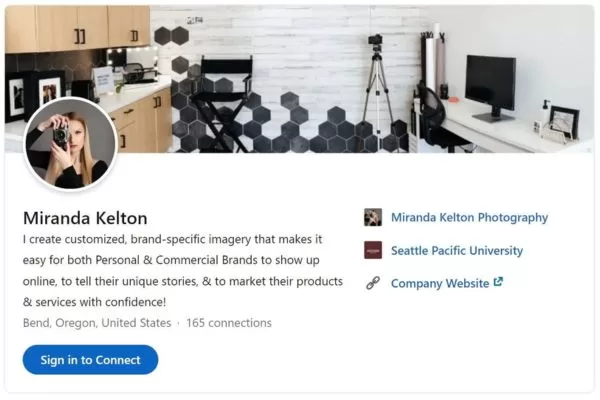
A personal branding statement is the expression; brand positioning is the strategy
Why your PBS matters in the digital age
A strong personal branding statement helps you approach opportunities more strategically by acting as both a magnet for the right connections and a filter that removes misaligned ones in today’s attention-scarce economy.
- 3–5 Second Rule: A personal branding statement must capture attention instantly, as recruiters and LinkedIn users make decisions within seconds.
- Targeted Visibility: A clear personal branding statement helps you get discovered by the right recruiters, clients, and partners by highlighting your value and audience.
- Differentiation: In a crowded market, a strong personal branding statement sets you apart by showcasing your unique skills, methods, or professional perspective.
- Credibility & Professionalism: A polished personal branding statement demonstrates confidence, self-awareness, and strategic clarity, boosting your professional image.

A strong personal branding statement boosts visibility and impact
Essential structure of an effective personal branding statement
Creating a compelling personal branding statement doesn’t require complex formulas or marketing jargon. The most powerful statements follow a straightforward structure that anyone can adapt to their unique situation and goals.
The Core Formula
At its core, an effective PBS follows this proven formula:
“I help [Target Audience] achieve [Specific Result/Value] through [Your Unique Skill/Approach].”
This framework ensures you hit all the essential components while maintaining the brevity and clarity that makes statements memorable. Let’s break down each element to understand how they work together to create impact.
1. Identity and Expertise
This component forms the foundation of your statement, answering the fundamental question: “Who are you professionally?”
- Rather than simply stating a job title, effective statements communicate your role within the broader context of value creation.
- Example: Instead of “I’m a graphic designer,” you might position yourself as “a visual storyteller” or “a brand identity architect.”.
This framing immediately elevates your positioning from a task-executor to a strategic contributor.

Define who you are professionally and the value you create
2. Target Audience
This element specifies exactly who benefits from your expertise.
- Precision matters tremendously here. Vague statements about helping “everyone” or “businesses” fail to resonate with anyone specifically.
- The most magnetic PBS clearly names the audience segment you serve, whether that’s “B2B SaaS founders,” “mid-career professionals transitioning to leadership,” or “e-commerce brands scaling beyond seven figures.”
- This specificity not only attracts your ideal clients or employers but also positions you as a specialist rather than a generalist.
3. Core Value and Impact
This represents the heart of your statement – the tangible transformation or benefit you deliver.
- This isn’t about listing services or activities, but about articulating outcomes and results.
- Strong statements move beyond “I provide marketing services” to “I help companies increase customer lifetime value by 40%.”
- The difference lies in focusing on the destination (the result) rather than the process.

Focus on the core value and impact you deliver, not the tasks you perform
4. Unique Proposition
This component answers the critical question: “Why you instead of someone else?”
- It captures your distinctive advantage, whether that’s an unconventional methodology, a rare combination of expertise, a proven track record in a specific niche, or an innovative approach that sets you apart.
- For a personal branding statement for sales professionals, this might highlight a consultative selling philosophy or expertise in a particular vertical.
- For technical roles, it might emphasize cutting-edge skills or cross-functional abilities.
Step-by-step guide to writing your PBS
Now that you understand the framework, let’s walk through the practical process of how to write a personal branding statement that authentically represents your professional value. This systematic approach ensures you create a statement grounded in genuine strengths rather than aspirational fluff.
Step 1: Deep Reflection (Strengths & Expertise)
The foundation of any powerful personal branding statement begins with honest self-assessment. This isn’t the time for modesty or exaggeration – it’s about identifying the genuine skills, experiences, and qualities that define your professional capabilities.
- Conduct a Comprehensive Inventory: Create three columns: Technical Expertise, Interpersonal Strengths (Soft Skills), and Measurable Accomplishments.
- Technical Expertise: List specific tools, methodologies, certifications, and domain knowledge you’ve mastered.
- Interpersonal Strengths: Capture qualities like communication style, problem-solving approach, or collaboration methods that colleagues consistently praise.
- Accomplishments: Document concrete results you’ve driven – revenue generated, efficiency gained, problems solved, or innovations implemented.
- Analyze Your Unique Work Style: How do you tackle challenges differently than your peers? Do you bring an analytical rigor to creative work? A human-centered approach to technical problems? A systems-thinking lens to tactical execution? These distinctive approaches often represent your most differentiating qualities because they’re hardest to replicate.
- Gather External Perspectives: Review past performance feedback, LinkedIn recommendations, or directly ask trusted colleagues and mentors what they see as your standout strengths. Often, the qualities others value most about your work are ones you take for granted because they come naturally to you.

Begin with an honest assessment of your strengths, expertise, and achievements
Step 2: Identify Your Target Audience
Clarity about who you serve transforms a generic statement into a magnetic one. This step requires specificity and strategic focus.
- Define Your Ideal Professional Audience: Ask: Who needs what you offer most urgently? Who can afford your services or meets your career goals? Who do you genuinely enjoy serving?
- For personal branding statement for resume purposes, this audience might be hiring managers in specific industries or company sizes.
- For consultants or entrepreneurs, it’s your ideal client profile.
- Research Their Pain Points, Aspirations, and Language: Browse LinkedIn groups where your audience congregates, read industry publications they follow, and note the challenges they discuss repeatedly. The language they use to describe their problems should influence how you articulate your solutions.
- Create Audience Personas: Build hypothetical personas that capture demographic details, professional goals, current challenges, and decision-making criteria. This exercise helps you move from abstract concepts to a concrete understanding of who you’re speaking to through your statement.

Identify the specific audience your statement should speak to
Step 3: Define Your Unique Value Proposition
Your Unique Value Proposition answers the crucial question: “What makes you the right choice?” This step separates forgettable statements from memorable ones.
- Identify Your Distinctive Advantage: Examine the intersection of three factors: (1) what you do exceptionally well, (2) what your target audience desperately needs, and (3) what competitors aren’t adequately providing. Your sweet spot lies where all three overlap.
- Consider Types of Differentiation: Perhaps you combine expertise in seemingly unrelated fields – like a data scientist with a theater background who brings storytelling to analytics. Maybe you’ve developed a proprietary process or framework that delivers faster results. Possibly your experience in a particular niche gives you insights others lack.
- Test Your Uniqueness: Ask: “Could someone else in my field make this same claim?” If yes, dig deeper until you find the element that’s genuinely distinctive. For a personal branding statement for sales professionals, this might be a consultative selling methodology or specialization in a specific product category or customer segment.
Define the unique value that sets you apart from others in your field
Step 4: Draft, Refine, and Test
With your foundation in place, it’s time to translate insights into a polished statement through iterative refinement.
- Start by Writing Multiple Versions: Write multiple drafts without self-editing. Create variations that emphasize different aspects – one focused on results, another on your unique approach, a third on your philosophy or values. Don’t worry about perfection; prioritize getting diverse options on paper.
- Apply the Structural Formula: Apply the formula: [I help] [target audience] [achieve specific result] [through unique approach].
- Example: “I help overwhelmed executives reclaim 15+ hours weekly through systems that automate decision-making without sacrificing strategic oversight.”
- Refine for Clarity and Impact: Read each version aloud. Does it flow naturally? Could a middle-schooler understand it? Does it create a visual image or emotional resonance? Cut any jargon, unnecessary adjectives, or vague language.
- Test Your Statements: Test your statements with members of your target audience and trusted advisors. Ask them: “What do you think I do after reading this?” “Does this sound like me?” “What stands out as most memorable?” Their feedback reveals whether your statement communicates what you intend.
- Create a Personal Branding Statement Template: You might need a LinkedIn version, a resume version, and a networking conversation version. While the core message remains consistent, slight adjustments in length or emphasis can optimize effectiveness for each platform.

Draft multiple versions, refine for clarity, and test your statement with real audiences
Common mistakes and effective application
Even with the right framework, certain pitfalls can undermine your personal branding statement’s effectiveness. Understanding these mistakes and knowing how to deploy your statement strategically maximizes its impact across professional contexts.
Top Mistakes to Avoid
| Mistake | Explanation & Remedy |
| 1. Drowning in Generalities | This is the most common error in creating a personal branding statement. Statements like “I’m a passionate professional dedicated to excellence” communicate absolutely nothing distinctive.
Instead, specificity creates memorability. Example: “I architect customer onboarding experiences that reduce churn by 35% in the first 90 days” paints a clear picture of concrete value. |
| 2. Length Violations | Cramming everything into your PBS dilutes its power. The discipline of compression forces you to identify what truly matters most. If your statement exceeds two sentences or 50 words, you’ve likely included nice-to-have details rather than must-know essentials. Remember, your PBS serves as the opening hook, not the entire story. |
| 3. Authenticity Gaps | Occur when professionals craft statements aspirationally rather than factually. Writing about expertise you’re still developing or results you’ve only achieved once creates cognitive dissonance. Your statement should reflect where you are now, not where you hope to be in five years. |
| 4. Inconsistency Across Platforms | When your LinkedIn headline claims one expertise, your resume summary suggests different priorities, and your website describes yet another focus, audiences wonder who you really are. While minor adaptations are fine, your core message should remain consistent across all touchpoints. |
| 5. Missing Calls to Action (CTA) | Leaving audiences without direction by failing to guide them toward the logical next interaction (e.g., visiting your portfolio, downloading a resource, scheduling a conversation). |

Avoid being generic, long, inconsistent, or inauthentic, and always give a clear next step
Optimizing Across Platforms (Where to Use)
Strategic placement amplifies your personal branding statement’s effectiveness by ensuring it reaches audiences at high-intent moments.
| Platform | Optimal Placement | Impact |
| Headline and About section. | The headline is prime real estate for a condensed PBS (max 220 characters), ensuring discoverability through keyword searches. The About section should open with your full statement, immediately orienting visitors to your core value proposition. | |
| Resume | Professional Summary or Objective section. | This statement sets the tone for everything that follows, providing context for your experience chronology and helping reviewers immediately assess your fit for the role. This is your personal branding statement for resume placement. |
| Networking and Communication | Email Signature and Answer to “What do you do?”. | Having a polished, authentic response that follows your PBS framework creates instant professionalism. The confidence that comes from clarity makes you more memorable in crowded networking environments. |
| Professional Website/Portfolio | Homepage and About Page. | Web visitors often skim content, so placing your statement where eyes naturally land first increases the likelihood of message absorption. |
| Other Touchpoints | Business Cards, Speaker Bios, Podcast Introductions, Conference Presentations. | Each touchpoint reinforces your brand through consistent messaging, strengthening the audience’s understanding of your professional identity and increasing recall when relevant opportunities arise. |
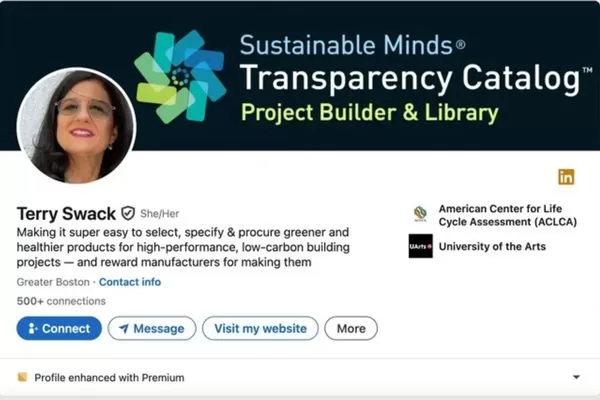
Use your personal branding statement across major platforms for maximum impact
10 Personal branding statement examples (Across fields)
Seeing how professionals across industries apply these principles brings the concepts to life. These personal branding statement examples demonstrate the versatility of the framework while highlighting industry-specific nuances.
Type 1: Transformative & Visionary Professionals (Leaders/Innovators)
| Example | Analysis: Why It Works |
| Example 1: “I guide Fortune 500 executives through digital transformation initiatives that position legacy businesses for exponential growth in emerging markets.” | Clearly identifies a senior audience (Fortune 500 executives), names a specific challenge (digital transformation), and hints at the unique value (positioning for emerging markets, not just modernization). |
| Example 2: “I architect organizational cultures where psychological safety and performance excellence coexist, enabling teams to innovate without fear.” | The distinctiveness lies in addressing the apparent tension between safety and excellence, suggesting a sophisticated understanding of organizational dynamics that leaders value. |
Transformative professionals drive innovation and strategic growth
Type 2: Results-driven & Metric-focused (Sales/Marketing)
| Example | Analysis: Why It Works |
| Example 1: “I help B2B SaaS companies shorten sales cycles by 40% through content strategies that turn prospects into educated buyers before the first call.” | This personal branding statement for sales professionals immediately quantifies value (40% reduction) and explains the mechanism (content-driven education), making it instantly credible and results-oriented. |
| Example 2: “I architect email campaigns that turn abandoned carts into loyal customers, averaging 28% recovery rates for e-commerce brands selling $500+ products.” | Specificity about both the problem (cart abandonment), solution (email campaigns), audience (e-commerce with premium products), and results (28% recovery) creates immediate relevance for the right prospects. |
Results-driven professionals deliver measurable growth through targeted strategies
Type 3: Freelancers & Consultants (Focusing on Quick Solutions)
| Example | Analysis: Why It Works |
| Example 1: “I transform bloated, unclear messaging into conversion-focused copy that makes complex B2B services feel accessible and valuable.” | This statement appeals to the common pain point of messaging complexity while promising both process efficiency (transformation) and business outcomes (conversion-focus). |
| Example 2: “I design website experiences for service providers that convert 35% of visitors into qualified leads without relying on aggressive sales tactics.” | By addressing both the positive outcome (lead conversion) and the negative to avoid (aggressive tactics), this statement resonates with consultants seeking sophisticated approaches. |
Freelancers and consultants highlight fast, clear solutions that drive meaningful results
Type 4: Job Seekers & Career Changers (Emphasizing Potential)
| Example | Analysis: Why It Works |
| Example 1: “I bring analytical rigor from six years in financial modeling to creative problem-solving in UX design, creating data-informed experiences that users love.” | Career changers need statements that bridge their past and future, showing how previous expertise enhances rather than contradicts their new direction. |
| Example 2: “I help early-stage startups build financial infrastructure that scales from prototype to Series A without requiring a full-time CFO.” | This statement positions a professional seeking to grow with companies, making them attractive to resource-constrained startups that need expertise without executive overhead. |
Career changers emphasize transferable strengths for their new path
Type 5: Deep Specialist/Technical Roles (Industry Specialist)
| Example | Analysis: Why It Works |
| Example 1: “I secure cloud infrastructure for healthcare companies navigating HIPAA compliance, preventing breaches while maintaining system performance.” | Technical specialists benefit from naming their niche (healthcare), specific expertise (cloud security + HIPAA), and balancing concerns (security without sacrificing performance). |
| Example 2: “I translate complex regulatory requirements into practical compliance strategies for fintech companies expanding into new international markets.” | This statement combines technical depth (regulatory knowledge) with business value (international expansion enablement), appealing to companies with specific growth challenges. |
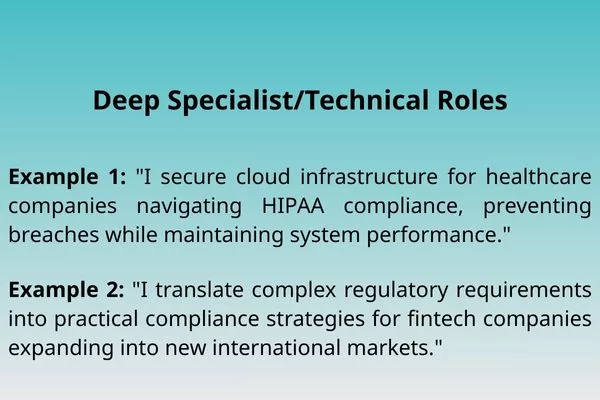
Technical specialists showcase niche expertise that solves complex industry challenges
These personal branding statement examples demonstrate that effectiveness comes from specificity, clarity about audience and value, and authentic representation of distinctive capabilities. Notice how each avoids generic claims, quantifies impact where possible, and creates a clear mental image of the professional’s work.
Frequently asked questions (FAQs)
As you refine your personal branding statement, these common questions often arise. Addressing them helps ensure your statement serves your professional goals effectively.
Should I have different statements for different goals?
Strategic variations of your personal branding statement work well when targeting different audiences, as long as your core identity stays consistent. Create one master statement and a few tailored versions that highlight different angles of the same value. Avoid making too many versions, which can blur your professional identity and suggest multiple separate brands.
Is a PBS the same as an elevator pitch?
A personal branding statement and an elevator pitch are related but serve different purposes. Your personal branding statement is a short written expression of your core value, used on profiles and resumes for quick clarity. An elevator pitch is meant for spoken situations and expands on your statement with brief context, examples, or a call to action. Think of the statement as the headline and the pitch as the headline with a short introduction, both aligned with the same brand message.
A personal branding statement is written; an elevator pitch is spoken
How long should a personal branding statement be?
The ideal personal branding statement is one to two short sentences, about 30 to 50 words, because brevity creates clarity, improves memorability, and fits modern attention spans. A concise statement communicates your core value quickly on LinkedIn, resumes, or in conversation. If you struggle to keep it short, you may be trying to express too many ideas or speak to too many audiences, which often signals a need for clearer positioning.
Conclusion
A strong personal branding statement is more than a line of text. It reflects your professional promise, attracts the right opportunities, and supports a career built with intention. This guide has shown what is a personal branding statement, why it matters, and how to write a personal branding statement that expresses your unique value. With clear structure, practical advice, and personal branding statement examples, you can create versions for different needs, including a personal branding statement for resume use or networking. As you grow, continue creating a personal branding statement that evolves with your skills and goals. Regular refinement ensures clarity, strengthens your identity, and helps others understand and remember what you offer.
Visit the On Digitals website now to dive into our expert news and analysis on the latest trends in Marketing, Digital, and Technology. If your business is seeking a professional partner to drive breakthrough growth through effective digital campaigns, explore our comprehensive range of services. Access our services page today: On Digitals —We are here to turn your vision into tangible results. Contact us to start your digital transformation journey!
Related posts:
Read more