
Pinterest SEO Guide for The New Market Entry
Vincent
11/06/2023
14
Pinterest SEO is the process of optimizing Pins, boards, profiles, and website metadata so users can discover a brand through visual search and recommendations. For the Vietnam market, this process works best when visual demand and localized keywords are built upon a core understanding of SEO and how search engines categorize digital assets. By aligning visual inspiration with a brand’s broader market-entry goals, businesses can capture high-intent audiences long before they are ready to buy.
Is Pinterest SEO worth it?
Pinterest SEO can be useful when the product is visual and aspirational.
It is usually stronger for fashion, beauty, home decor, travel, education, food, weddings, lifestyle, ecommerce, and design-led products than for urgent B2B services or low-visual categories.
Vietnam is a highly connected market. DataReportal’s Digital 2026 report stated Vietnam had 85.6 million internet users and 79.0 million active social media user identities at the end of 2025.
That does not mean Pinterest should become the first channel for every market-entry plan.
Pinterest is most useful when a brand needs to validate visual demand, build evergreen inspiration content, support Google image visibility, and create mid-funnel discovery before the user is ready to buy.
Practical takeaway: Use Pinterest SEO as a visual search and market-learning layer, not as a replacement for local SEO, paid media, ecommerce marketplace strategy, or Vietnamese-language content.
How does Pinterest SEO work now?
Pinterest SEO works by helping Pinterest understand what a Pin is about, who it is relevant for, and when it should appear.
Pinterest is not only a social platform. People use it to search, save, compare, and plan. Pinterest users are actively looking for new brands and ideas, and its tools let marketers reach audiences through demographics, interests, keywords, and trends.
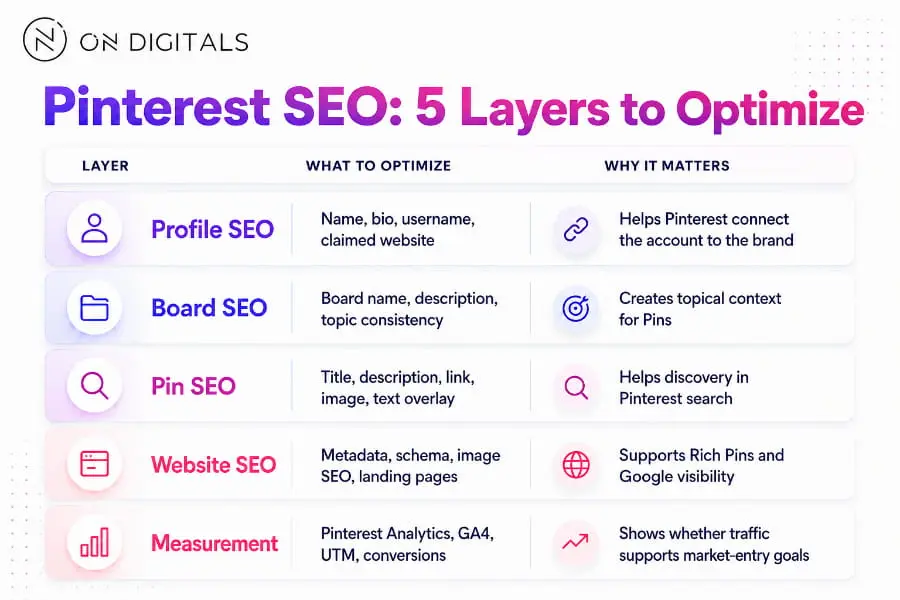
The important shift is that Pinterest SEO should be treated as a search-led content system that connects visual intent, localized demand, website tracking, and business outcomes.
Pinterest SEO vs Google SEO: What is different?
Pinterest SEO is visual-first and planning-led, while Google SEO is usually query-first and page-led.
Google often answers explicit needs such as “Vietnam skincare distributor” or “best hotel in Da Nang.” Meanwhile, Pinterest captures earlier inspiration such as “minimalist home decor,” “Vietnam travel outfit,” or “wedding table ideas.”
For brands, this difference matters because Pinterest may influence demand before users search for a brand directly on Google.
| Criteria | Pinterest SEO | Google SEO |
| Main asset | Pin, board, product image, visual idea | Web page, article, category, service page |
| Search behavior | Inspiration, planning, discovery | Research, comparison, transaction |
| Content format | Vertical images, videos, text overlays | Text, images, structured pages |
| Keyword style | Visual and lifestyle terms | Informational, commercial, local terms |
| Measurement | Saves, Pin clicks, outbound clicks | Rankings, clicks, leads, conversions |
| Best role | Demand discovery and visual inspiration | Demand capture and conversion |
Google’s image SEO documentation also shows why Pinterest and website SEO should work together. Google uses page content, captions, image titles, filenames, alt text, structured data, and metadata to understand images and their landing pages.
For market entry, that means a brand should not upload generic images only to Pinterest.
How to win in Pinterest SEO?
Step 1: Validate whether Pinterest fits your Vietnam market-entry category
A foreign business should validate Pinterest fit before investing in ongoing production. Pinterest is stronger when customers search visually, compare aesthetics, plan life events, or collect inspiration before purchase.
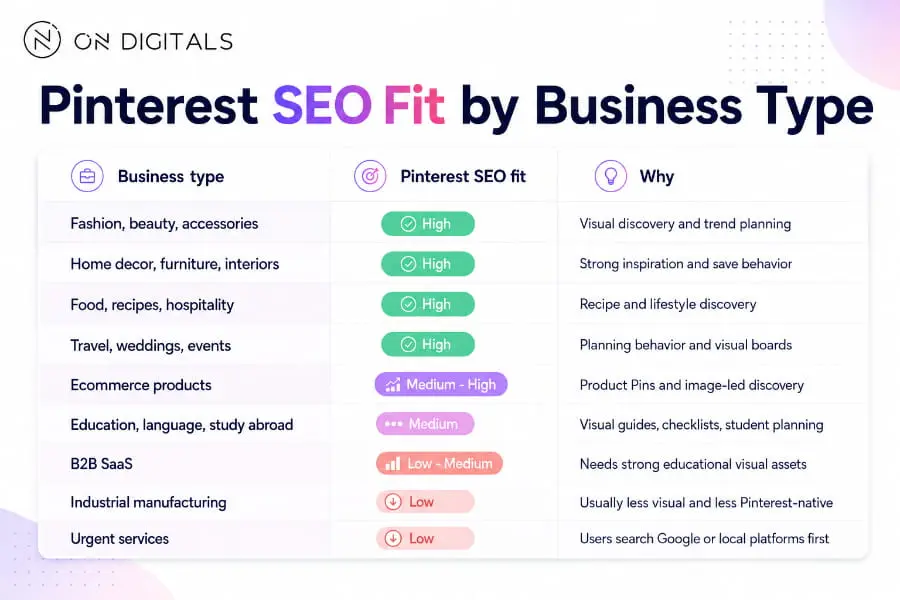
Do not force Pinterest SEO if the audience is not searching visually.
For example, a B2B logistics company entering Vietnam may get more value from Linkedin, Google Search, industry PR, and Vietnamese landing pages. Pinterest may still support employer branding, event visuals, or infographics, but it should not be the primary acquisition channel.
Step 2: Research Pinterest keywords with Vietnam intent
Pinterest keyword research should combine Pinterest Trends, Pinterest autocomplete, competitor boards, Google Search data, and local Vietnamese market language. The goal is to understand how users describe visual needs before they search for a brand.
Pinterest Trends shows up to two years of search and shopping trends across different regions and countries. It can also show seasonal behavior, demographic data, related searches, and weekly, monthly, or yearly trend changes.
For Vietnam market entry, organize keywords into four groups:
| Keyword group | Example | Use case |
| English inspiration terms | “Vietnam travel outfits” | Foreign tourists or expats |
| Vietnamese localized terms | “phong cách tối giản” | Local demand validation |
| Product-category terms | “linen dress”, “ceramic dinnerware” | Ecommerce and catalog Pins |
| Planning terms | “wedding decor ideas”, “study abroad checklist” | Boards and guides |
A foreign brand should not assume English-only Pinterest SEO is enough.
Many Vietnam-based users search in Vietnamese, while tourists, expats, and regional shoppers may search in English. The safest approach is to test both languages with separate boards, Pins, and landing pages when the business case supports it.
Step 3: Set up the account and website correctly
A Pinterest SEO setup should start with a business account, claimed website, and clear profile positioning. Without this foundation, a brand may publish Pins but struggle to connect performance to website traffic, saves, and conversions.
Pinterest says claiming a website gives insight into how often content is shared on Pinterest and links the brand profile to Pins saved from that website. The platform supports three claim methods: HTML tag, HTML file, or DNS TXT record.
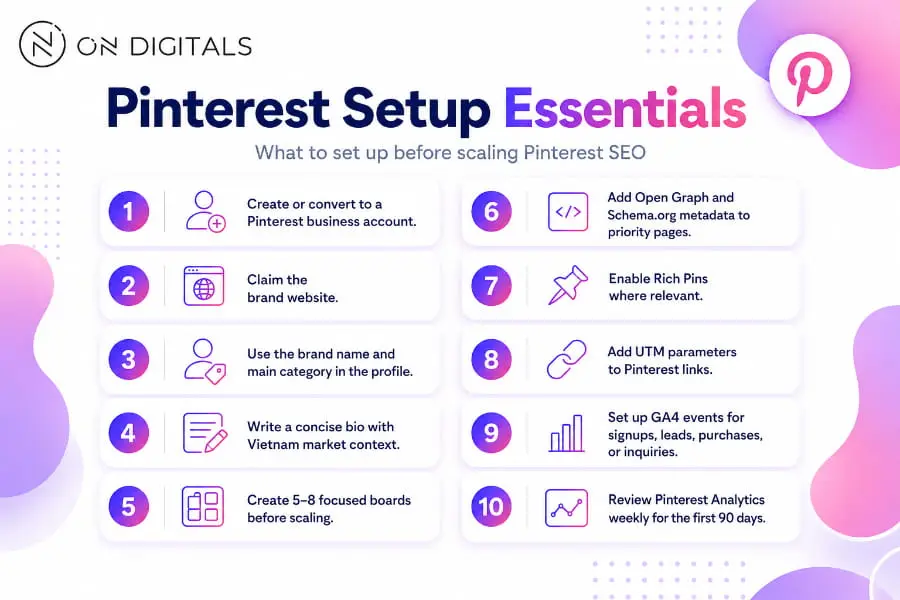
Pinterest Analytics is a useful tool showing paid and organic published content performance.
Step 4: Use Rich Pins and website metadata
Rich Pins help Pinterest pull structured information from a website into a Pin. They are especially useful for foreign brands because they keep key information tied to the source website, such as article title, author, price, availability, and product details.
Pinterest currently supports Recipe, Article, and Product Rich Pins.
- Article Rich Pins add headline, description, and author.
- Product Rich Pins include up-to-date pricing, availability, and product information.
Pinterest says Rich Pins sync from the site and may take up to 24 hours to update.
For market entry, Rich Pins matter because they connect Pinterest visibility with the brand’s owned website. This helps avoid a common problem like visual content gains saves, but users cannot clearly identify the source, product, price, or next step.
Use Rich Pins for:
| Content type | Best Rich Pin format | Example |
| Blog or guide | Article Rich Pin | “Vietnam home decor trends 2026” |
| Product page | Product Rich Pin | Skincare, fashion, furniture, accessories |
| Food or drink | Recipe Rich Pin | Localized recipes or ingredients |
| Travel content | Article Rich Pin | Itineraries, packing guides, hotel guides |
Rich Pins do not guarantee traffic. They improve clarity, metadata consistency, and source attribution.
Step 5: Create Pins that match Pinterest’s current creative standards
Pinterest Pins should be mobile-first, branded and useful. The recommended standard image ad format is a 2:3 aspect ratio or 1000 × 1500 pixels.
Pin titles can be up to 100 characters, with the first 40 most likely to show, and descriptions can be up to 500 characters.
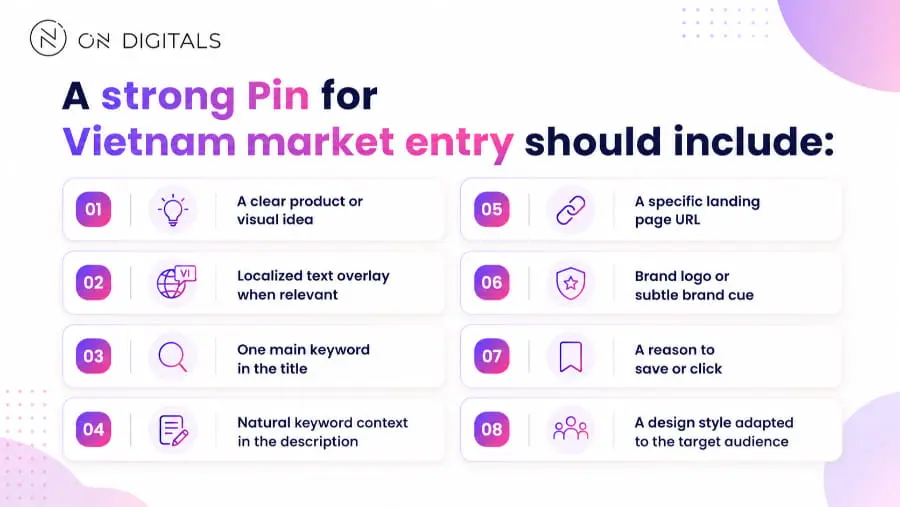
Example Pin structure:
| Element | Example |
| Image | Product in a Vietnamese home, café, hotel, or lifestyle setting |
| Text overlay | “Minimalist Home Decor Ideas for Vietnam Apartments” |
| Title | Vietnam Apartment Decor Ideas |
| Description | “Explore space-saving minimalist decor ideas for modern apartments in Ho Chi Minh City and Hanoi.” |
| Link | Localized guide, collection page, or product category page |
| UTM | utm_source=pinterest&utm_medium=organic&utm_campaign=vietnam_market_entry |
Avoid creating the same Pin repeatedly because that behavior may be flagged as spam.
Step 6: Build boards around search intent, not internal categories
Pinterest boards should reflect how users search and save, not how the brand organizes products internally. A foreign brand entering Vietnam should build boards around lifestyle use cases, local occasions, product categories, and planning moments.
Weak board structure:
- Products
- Blog
- New arrivals
- Campaigns
- Inspiration
Stronger board structure:
| Board name | Why it works |
| Vietnam Apartment Decor Ideas | Local + visual use case |
| Minimalist Skincare Routine | Category + planning behavior |
| Travel Outfits for Vietnam Weather | Location + practical need |
| Vietnamese Wedding Inspiration | Local event intent |
| Small Space Furniture Ideas | Problem-led search intent |
Each board should have a keyword-rich description, consistent Pin quality, and a clear connection to one landing page or topic cluster on the website.
Step 7: Measure Pinterest SEO with ROI
Pinterest SEO should be measured with a full funnel, impressions show discovery, but they do not prove market-entry success.
Use this measurement framework:
| Stage | Pinterest metric | Website metric | Business question |
| Discovery | Impressions | New users | Are people seeing the idea? |
| Interest | Saves | Engaged sessions | Is the idea useful enough to keep? |
| Consideration | Pin clicks | Product/ guide views | Are users exploring details? |
| Action | Outbound clicks | Leads, signups, purchases | Does Pinterest drive action? |
| Learning | Top boards, demographics | GA4 source/medium | Which audience and visuals work? |
Pinterest Tag can track events such as page visits, category views, signups, leads, checkout, add-to-cart, contact, appointment scheduling, and custom events.
For organic Pinterest SEO, GA4 and UTM tracking are still important. Use separate UTMs for organic Pins, paid Pins, influencer Pins, and seasonal trend campaigns. Without clean tracking, Pinterest may look like “low conversion traffic” even when it supports assisted discovery.
Step 8: Use Pinterest as a Google Image SEO multiplier
Pinterest can support Google SEO when the same visual asset is connected to an optimized website page, descriptive image metadata, and a useful landing page. The goal is not to “rank a Pin instead of a website.” The goal is to create consistent visual signals across Pinterest, Google Images, and the brand’s owned website.
Google’s image SEO documentation recommends using descriptive filenames, titles, alt text, relevant surrounding text, structured data, and representative images. It also warns against keyword-stuffed alt text.
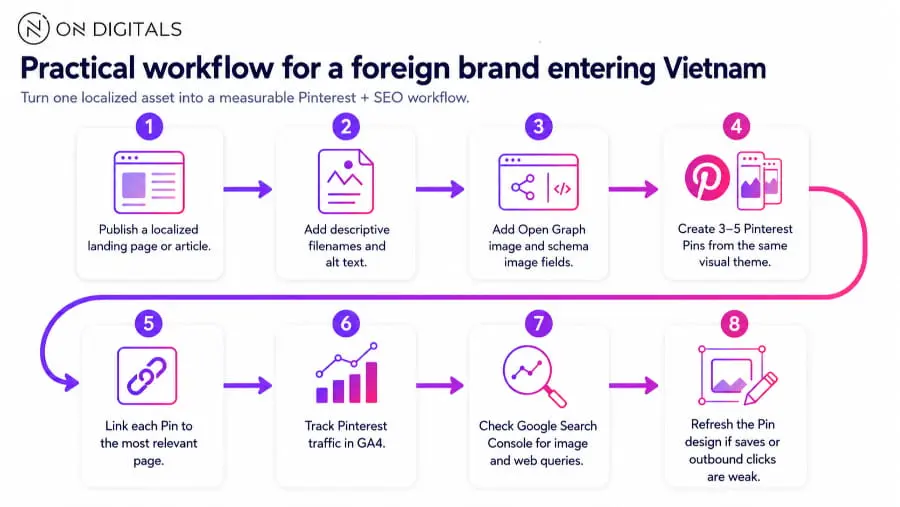
Example:
| Website asset | Pinterest asset | Google SEO benefit |
| “Vietnam Wedding Decor Guide” | 5 vertical Pins by theme | More visual entry points |
| Product collection page | Product Pins with metadata | Stronger image-product context |
| Travel packing guide | Seasonal board and Pins | More long-tail discovery |
| Interior design case study | Before-after Pins | Stronger visual proof |
Pinterest SEO is strongest when it supports a broader search ecosystem.
What still works in Pinterest SEO, and what should be deprioritized?
Pinterest SEO in 2026 is not about chasing outdated tricks. The work that still matters is keyword-led visual content, fresh original Pins, focused boards, claimed websites, Rich Pins, and measurement. Tactics like mass repinning, duplicate Pins, and hashtag-first optimization should be deprioritized.
| Tactic | Verdict | What to do instead? |
| Keyword-rich Pin titles | Still useful | Put the main phrase early and naturally |
| Board optimization | Still useful | Build boards around user intent |
| Rich Pins | Still useful | Add clean metadata to site pages |
| Fresh original Pins | Still useful | Publish weekly original content |
| Duplicate Pins | Risky | Create new visual angles and copy |
| Group boards | Not a core strategy | Use only if engagement is proven |
| Hashtag-first optimization | Deprioritize | Use natural keywords in titles and descriptions |
| Keyword stuffing | Avoid | Write useful, readable descriptions |
| Random viral trends | Avoid | Use trends only when category-relevant |
Pinterest still allows descriptions that include hashtags when creating a Pin, but hashtags should not replace keyword research, board relevance, and useful descriptions.
90-day Pinterest SEO experiment for Vietnam market entry
Brands should test Pinterest SEO for 90 days before making it a major channel. The goal is to gather market evidence.
Days 1-15: Setup and baseline
- Create or audit the business account.
- Claim the website.
- Set up Pinterest Analytics.
- Add UTM rules.
- Confirm GA4 conversion events.
- Create 5–8 boards.
- Prepare 20–30 Pin templates.
- Localize keyword sets in English and Vietnamese.
Days 16-45: Publish and compare
- Publish 3–5 fresh Pins per week.
- Test English vs Vietnamese overlays.
- Test product-only vs lifestyle images.
- Test guide Pins vs product Pins.
- Link to localized landing pages.
- Track saves, Pin clicks, and outbound clicks.
Days 46-90: Optimize and decide
- Identify top 20% Pins by saves and outbound clicks.
- Create new variants from winning topics.
- Pause low-fit boards.
- Compare Pinterest traffic against Google, Meta, TikTok, and direct traffic.
- Check whether Pinterest visitors convert, subscribe, browse products, or return later.
- Decide whether to scale, keep as a support channel, or stop.
This experiment creates the first-party Experience signal that competitor content often lacks. Your uploaded competitor insight also identifies first-party testing, screenshots, before-after data, and transparent methodology as the strongest E-E-A-T differentiator for this SERP.
Pinterest SEO playbooks by industry
Pinterest SEO should change by category. A foreign brand entering Vietnam should not use the same playbook for beauty, SaaS, education, and industrial products.
| Industry | Pinterest SEO angle | Best assets |
| Beauty and skincare | Routines, ingredients, skin concerns, product textures | How-to Pins, product Pins, routine boards |
| Fashion | Outfits for weather, occasions, travel, work | Style boards, lookbooks, seasonal Pins |
| Home decor | Small spaces, apartment living, local aesthetics | Before-after Pins, mood boards |
| Food and beverage | Recipes, gift sets, hosting, local pairings | Recipe Pins, product Pins |
| Travel and hospitality | Itineraries, packing, destination inspiration | Guide Pins, boards by city |
| Education | Study plans, checklists, career paths | Infographics, guide Pins |
| B2B SaaS | Frameworks, templates, diagrams | Visual guides, checklist Pins |
| Manufacturing | Usually low fit | Use only for catalogs, use cases, or trade-show visuals |
For B2B and industrial brands, Pinterest may still work as a supporting channel if the brand can turn expertise into visual frameworks, buying guides, comparison charts, or templates. But it should not receive the same priority as Search, Linkedin, PR, or industry partnerships.
When Pinterest SEO is not worth it?
Pinterest SEO is not worth heavy investment when the product has weak visual appeal, the audience does not plan or save ideas, the website cannot convert, or the brand has no capacity to produce original creative assets consistently. It is also weak when leadership expects fast revenue from a channel that usually compounds over time.
Do not prioritize Pinterest SEO if:
- The category is urgent or low-visual.
- The audience mainly buys through sales teams.
- The website has no localized landing pages.
- The team cannot produce original visuals.
- There is no GA4 or UTM tracking.
- The product needs heavy compliance review.
- Pinterest Trends shows little category demand.
- The business needs leads immediately this month.
A balanced Vietnam market-entry strategy may use Pinterest for inspiration and visual discovery while using Google Search, YouTube, TikTok, Meta, Zalo, Linkedin, ecommerce marketplaces, and PR for other parts of the funnel.
Frequently Asked Questions (FAQs)
What is Pinterest SEO?
Pinterest SEO is the process of optimizing a Pinterest profile, boards, Pins, image content, website metadata, and linked landing pages so users can discover the brand through Pinterest search and recommendations. It includes keyword research, visual design, board structure, Rich Pins, fresh content, and performance tracking.
Is Pinterest SEO useful for entering Vietnam?
Pinterest SEO can be useful for Vietnam market entry when the brand sells visual, lifestyle, ecommerce, travel, beauty, fashion, home, food, education, or design-related products. It should be validated with Pinterest Trends, GA4, UTM tracking, and localized content tests before becoming a core acquisition channel.
Should Pinterest content be in English or Vietnamese?
Foreign brands should test both when relevant. English can work for tourists, expats, regional shoppers, and international education or travel searches. Vietnamese can work better for local consumers. The best setup is usually separate boards, Pin copy, and landing pages by language and audience intent.
Do hashtags help Pinterest SEO?
Hashtags can be included in Pin descriptions, but they should not be the main Pinterest SEO strategy. Brands should prioritize natural-language keywords in Pin titles, descriptions, board names, profile copy, image text overlays, and website metadata. Hashtags should be treated as optional context, not a ranking shortcut.
How long does Pinterest SEO take?
Pinterest SEO usually needs several weeks to show early engagement and several months to prove business value. A 90-day test is a practical minimum for foreign brands entering Vietnam because it gives enough time to compare visuals, languages, boards, topics, saves, outbound clicks, and website behavior.
Can Pinterest help Google SEO?
Pinterest can support Google SEO when visual assets are connected to optimized landing pages, descriptive filenames, alt text, structured data, and useful surrounding content. Google uses page metadata, image context, alt text, and structured data to understand images, so Pinterest should support a broader visual SEO system.
Final takeaway
Pinterest SEO is not a universal growth channel for every foreign business entering Vietnam. It is a strong support channel when the audience searches visually, saves ideas, compares aesthetics, and needs inspiration before purchase.
The strongest approach is not to copy another Pinterest checklist. Build a 90-day test with localized keywords, fresh original Pins, claimed website data, Rich Pins, GA4 tracking, and a clear decision rule. If Pinterest drives saves, outbound clicks, qualified sessions, or assisted conversions, scale it. If not, keep it as a lightweight visual discovery channel or shift budget to channels with stronger local demand.

NEWEST POSTS
- Advertising Industry In Vietnam: The 2026 Trends, Channels and Market-Entry Strategy
- Best SEO Company in Vietnam: Latest Shortlist For Businesses
- How To Leverage Social Media For Customer Service Like A Pro?
- Social Media Post Tips – 8 Ways To Boost Engagement
- How To Use Social Media for Sales – In-depth Beginner Guide
Read more