
Keyword Search Volume: How to Check and Use It
Vincent
12/06/2023
49
Keyword search volume is an estimate of how often people search for a keyword within a set period, usually a month. It helps SEO and PPC teams understand demand before choosing a page, campaign, or content brief. Search volume should stay separate from keyword difficulty, CPC etc. because each metric answers a different planning question in the whole keyword research strategy.
What is keyword search volume?
Keyword search volume shows how often a search term is searched in a specific market during a selected time range. Because the number changes with the exact query being checked, the team should define the right target keyword before comparing volume across tools. Most SEO tools display monthly search volume, while Google Keyword Planner helps advertisers discover keyword ideas, review demand, get bid estimates etc. through Google Ads.
The number should be treated as an estimate. It does not mean the same number of people searched, because one person can search more than once. It also does not guarantee visits, since rankings, snippets, ads, SERP features etc. affect how many users click a result.
For example, a keyword with 10,000 monthly searches may look attractive. If the SERP is full of ads, maps, shopping results etc., the organic click opportunity may be much smaller. Meanwhile, a keyword with 200 searches can still be valuable when it leads to qualified service inquiries.
Search volume vs search traffic
Search volume measures demand around a keyword. Search traffic measures visits after a page appears in search results and earns clicks. Confusing these two metrics can lead to unrealistic SEO forecasts.
| Metric | What it measures | What it does not guarantee |
| Search volume | Estimated demand for a keyword | Visits to your site |
| Impressions | Times your page appears | Clicks |
| Search traffic | Visits from search | Total market demand |
| CPC | Paid click value | Organic ranking ease |
| Keyword difficulty | Ranking effort | Business value |
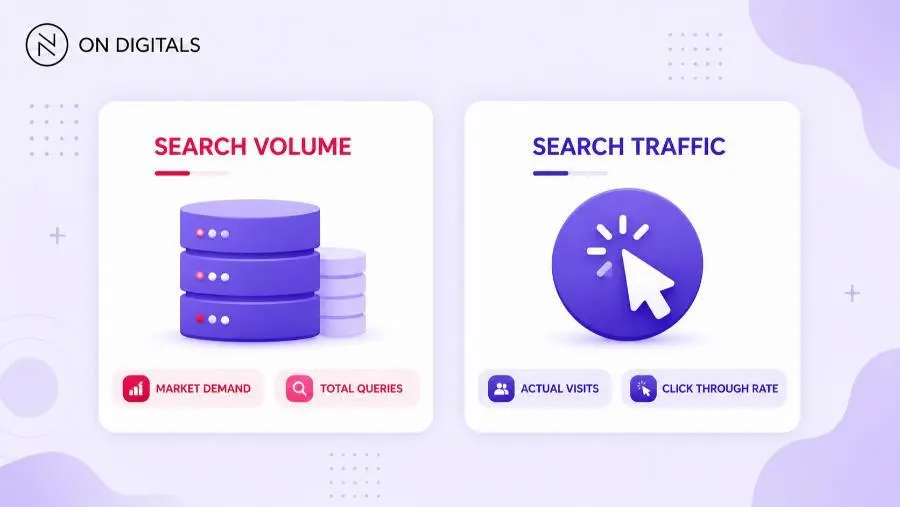
A page can rank for a keyword with strong search volume and still receive limited traffic. The click-through rate may be low because the page ranks below ads, lacks a compelling title, or does not match intent closely enough.
For a service page, traffic is only one part of the decision. A low-volume keyword such as “technical SEO audit agency” may bring fewer visitors, but those users can be closer to conversion than a broad keyword like “SEO.”
Why keyword search volume matters in SEO and PPC
Search volume helps teams decide whether a keyword deserves time, budget, or a deeper page. It should be read together with intent and business value, instead of being used as the only filter.
| Use case | How search volume helps |
| Blog planning | Shows whether a topic has demand |
| Service pages | Helps prioritize high-intent terms |
| Ecommerce categories | Reveals product demand by market |
| PPC campaigns | Supports reach and budget planning |
| Local SEO | Shows city or country-level interest |
| Content refreshes | Helps decide which pages deserve updates |
For SEO, search volume can guide content briefs and page priority. A content team may use it to decide whether a keyword deserves a standalone guide or a short FAQ section inside an existing page.
For PPC, volume helps estimate reach before launching a campaign. Google Keyword Planner supports campaign planning by helping users find keywords, analyze demand changes, estimate bids, then build a plan.
What is a good keyword search volume?
A good keyword search volume depends on the business model, market size, page type, and conversion value. A large ecommerce category may need thousands of monthly searches to justify heavy investment. A B2B service page can work with far lower volume when the lead value is high.
Use this matrix to read volume in context.
| Search volume pattern | What it usually means | Better action |
| High volume with broad intent | Big demand but weak focus | Validate SERP and page type |
| High volume with commercial intent | Valuable but competitive | Build a strong landing page |
| Low volume with clear intent | Smaller demand but stronger fit | Use as long-tail support |
| Seasonal spike | Timing matters | Publish before demand peaks |
| Branded growth | Brand demand is rising | Track awareness and reputation |
| Local volume | Market-specific demand | Build location page if relevant |
High volume can be useful, but it often comes with mixed intent. Before targeting a broad keyword, check what Google already ranks. If the top results are guides, a product page may struggle. If the SERP shows product pages, a long educational article may miss the user path.
Low volume deserves a closer look when the intent is specific. A keyword like “enterprise CRM migration consultant” may have limited searches, while the business value can be strong enough to justify a dedicated page.
Seasonal and evergreen search volume
Search volume can change throughout the year. Seasonal keywords rise during specific periods, while evergreen keywords keep demand across longer timelines.
| Keyword type | Example | Planning note |
| Seasonal | “tax filing deadline” | Prepare before peak demand |
| Evergreen | “what is keyword search volume” | Maintain and refresh regularly |
| Event-driven | “black friday laptop deals” | Match publication timing |
| Local seasonal | “raincoat shop ho chi minh” | Check market and weather patterns |
Google Trends is useful for checking direction, seasonality, and regional interest. It does not replace exact monthly volume, but it helps teams understand whether interest is rising, declining, or tied to a specific season.
For content teams, seasonal volume affects production timing. A page published after peak demand may still rank later, but the business window can be missed. For evergreen topics, refresh schedules matter more than launch timing.
How to check monthly search volume
The fastest way to check search volume is to use a keyword tool, choose the right country or market, then compare the keyword with related terms. The exact number may vary by tool, so focus on direction and decision quality rather than one perfect figure.
Use Google Keyword Planner
Keyword Planner is useful for PPC planning and keyword discovery. It can show demand ranges, related ideas, forecast estimates etc. inside a Google Ads workflow.
A simple process:
- Enter a seed keyword.
- Choose the target country or location.
- Review average monthly searches.
- Compare related keyword ideas.
- Check forecast or bid estimates when planning ads.
- Export useful terms for SEO or PPC review.
Keyword Planner is especially useful when paid search is part of the plan. For SEO-only work, combine the volume estimate with live SERP review.
Use a keyword volume checker
SEO tools can show monthly volume together with metrics such as trend, CPC, SERP features etc. These tools are useful when you want to compare many keyword ideas quickly.
When using a checker, record:
| Field | Why it matters |
| Keyword | Shows the exact phrase |
| Location | Changes demand by market |
| Monthly volume | Estimates search demand |
| Trend | Shows timing or direction |
| CPC | Suggests paid value |
| Difficulty | Estimates ranking effort |
| SERP type | Confirms page format |
Avoid mixing numbers from different tools without context. Tool databases, update frequency, keyword grouping logic etc. can make volume estimates differ.
Use Search Console for existing queries
Google Search Console does not show total market search volume. It shows impressions and clicks for queries where your site appeared. That makes it useful for existing pages.
Use Search Console when:
| Situation | What to check |
| Page has impressions but low clicks | Improve title or intent match |
| Query appears often on one page | Add stronger section coverage |
| Query does not fit the page | Adjust targeting or internal links |
| Old page loses impressions | Check freshness or SERP changes |
Search Console is best for your own visibility data. Keyword tools are better for market-level demand.
How to use search volume in keyword decisions
Search volume becomes useful when it helps a team choose the right action. A keyword with demand should still pass intent, page fit, and business value checks.
Use this workflow.
Keyword idea
↓
Check volume by market
↓
Check trend and seasonality
↓
Review intent and SERP type
↓
Compare difficulty and CPC
↓
Map to page or campaign
Read volume with intent
Intent decides whether a keyword deserves a blog post, service page, category page, comparison page etc. Volume only shows that people search. It does not tell you what page Google expects.
| Intent | Better page type | Volume interpretation |
| Informational | Blog guide or resource page | Demand for learning |
| Commercial | Comparison or solution page | Demand for evaluation |
| Transactional | Product or service page | Demand near purchase |
| Local | Location page | Demand tied to market |
| Branded | Brand or review page | Demand tied to reputation |
A broad informational keyword may have strong volume but weak conversion value. A lower-volume commercial keyword may deserve more attention because the user is closer to action.
Read volume separately from difficulty and CPC
This article should stay focused on search volume. Difficulty and CPC are supporting metrics, not the main topic.
| Metric | Main question |
| Search volume | How much demand exists? |
| Keyword difficulty | How hard might ranking be? |
| CPC | How valuable is a paid click? |
| Intent | What does the user expect? |
| Page fit | Which asset should target it? |
After search demand is clear, use a separate SEMrush keyword difficulty check to estimate ranking effort before assigning budget to a new page or refresh.
This separation prevents keyword planning from becoming messy. Volume tells you whether people search. Difficulty tells you how competitive the SERP may be. CPC gives a paid-search value signal.
Map volume to page priority
Different page types should use volume differently.
| Page type | How to interpret volume |
| Blog guide | Volume supports demand, but t raffic depends on clicks |
| Service page | Lower volume can still be valuable when lead quality is high |
| Category page | Mid-to-high volume can justify stronger internal links |
| PPC campaign | Volume helps estimate reach |
| Local page | City-level demand matters more than global volume |
For example, a local dental clinic may not need a keyword with national search volume. A city-specific term with clear intent can drive better leads than a broad health keyword.
How to find local search volume
Local search volume shows demand in a specific country, city, or region. It matters when the service area is limited or when language and culture change search behavior.
A keyword may show large global demand but weak local value. Another keyword may look small in global data while performing well in the target city.
Use local volume for:
| Use case | Example |
| Service pages | “seo agency vietnam” |
| Store pages | “running shoes district 1” |
| Local campaigns | “dentist near me” |
| Regional content | “tax consultant ho chi minh” |
| Market entry | Compare demand across countries |
When local volume is low, check nearby variations and SERP intent before rejecting the topic. Some local terms have strong conversion value even when monthly searches look modest.
Common mistakes when using search volume
Search volume can mislead when it is treated as a promise instead of an estimate.
| Mistake | What happens | Better approach |
| Treating volume as traffic | Forecast becomes inflated | Apply CTR and ranking assumptions |
| Choosing high volume only | Page targets broad intent | Check SERP type first |
| Ignoring local markets | Wrong country data guides planning | Set location before analysis |
| Forgetting seasonality | Content misses peak demand | Check trends before publishing |
| Comparing tools blindly | Data looks inconsistent | Use one primary source |
| Ignoring business value | Traffic grows without leads | Prioritize qualified intent |
A keyword with 50,000 searches may look exciting, but the page can still fail when the intent is too broad. Meanwhile, a keyword with 300 searches can be stronger if it supports a high-value service path.
Keyword search volume FAQ
How do I check keyword search volume?
Use Google Keyword Planner, an SEO keyword checker, or a keyword research platform. Choose the correct market first because volume changes by country, city, language etc.
What is a good search volume?
A good volume depends on business value and page type. A blog topic may need broader demand, while a service keyword can be useful with lower volume if it attracts qualified leads.
Is search volume the same as traffic?
Search volume is demand. Traffic is the number of visits your site receives. Rankings, snippets, ads, SERP features etc. affect how much demand turns into visits.
Why do tools show different search volume?
Keyword tools use different databases, update cycles, grouping methods etc. Treat the number as a planning estimate. Use one main tool for consistency, then validate important keywords with SERP review.
Can low-volume keywords be worth targeting?
Yes. Low-volume keywords can be valuable when intent is specific and business value is strong. They often work well for service pages, comparison content, local pages, or bottom-funnel support.
Final thoughts
Keyword search volume shows demand, but it should not carry the whole keyword decision. Read the number beside intent, location, seasonality, page type, and business value. Use difficulty and CPC as supporting metrics after the demand question is clear.
For this URL, keep the focus on volume. Use it to decide whether demand exists, then connect to separate metrics only when the next decision needs them. That makes the page cleaner for users and helps the keyword metrics cluster avoid intent overlap.

NEWEST POSTS
- Advertising Industry In Vietnam: The 2026 Trends, Channels and Market-Entry Strategy
- Best SEO Company in Vietnam: Latest Shortlist For Businesses
- How To Leverage Social Media For Customer Service Like A Pro?
- Social Media Post Tips – 8 Ways To Boost Engagement
- How To Use Social Media for Sales – In-depth Beginner Guide
Read more