
How To Choose SEO Tools? A Comprehensive Guide For Businesses
Vincent
04/03/2023
28
SEO tools serve as the backbone for data-driven growth, allowing teams to transform raw search data into actionable insights. However, these tools are only effective when they are aligned with clear SEO performance metrics that track organic visibility and conversion contribution. This guide moves beyond simple feature lists to explain how these tools actually function and how to build a practical stack tailored to your reporting needs without paying for redundant features.
How should a business choose SEO tools?
Rather than chasing the most popular names in the industry, a business should prioritize tools based on specific use cases. Start by identifying the daily decisions your team needs to make, whether it’s fixing technical errors or refining keyword targeting. Once those “jobs” are clear, you can build a stack that provides reliable data while keeping costs and ownership manageable.
Use this order before buying any tool:
1. Define the SEO jobs your team must complete each month.
2. Separate free first-party data from paid third-party estimates.
3. Choose one main platform only when it reduces workflow friction.
4. Add specialist tools for technical audits, forecasting, or AI visibility when needed.
5. Check limits, seats, credits, exports, integrations, and renewal terms.
6. Test the tool with real website data before committing to a long contract.
The strongest SEO tool stack is rarely the one with the most features. Instead, it is the leanest set of tools that your team can use consistently to make better decisions.
What is an SEO tool?
An SEO tool is software designed to streamline search performance, whether it’s used for crawling a website to find errors or tracking how keyword rankings shift over time. These tools also assist in analyzing backlinks and connecting SEO activity directly to business outcomes.
It is crucial to remember that tools do not replace strategy. While they provide the data and workflows, the quality of the results depends on how people interpret that data to prioritize fixes that actually impact revenue.
For example, Google Search Console can show which queries already bring impressions. In contrast, a dedicated crawler might reveal deep-seated indexability issues, while a rank tracker monitors visibility across specific locations. An all-in-one platform can help teams compare keywords, backlinks, and competitors in one place.
How do SEO tools work?
SEO tools work by collecting data from different sources and turning it into reports, scores, alerts, or recommendations. While some platforms rely on direct first-party data from Google, others maintain proprietary databases by crawling the web and estimating search demand based on SERP behavior.
That difference matters because not every number has the same meaning.
| Data source | Common tools | What it is useful for | What to watch |
| First-party Google data | Google Search Console, Google Analytics 4, Google Business Profile | Real impressions, clicks, traffic, conversions, local activity | Limited history, sampling, attribution setup |
| Third-party keyword databases | Semrush, Ahrefs, Moz, Similarweb, SE Ranking | Keyword discovery, competitor research, market sizing | Search volume and traffic are estimates |
| Website crawlers | Screaming Frog, Sitebulb, Lumar | Technical SEO audits, internal links, indexability, templates | Needs correct crawl settings and interpretation |
| Rank trackers | AccuRanker, SE Ranking, Semrush, Ahrefs | Visibility monitoring by keyword, location, device | SERPs fluctuate; rankings alone do not prove business impact |
| AI visibility tools | Profound, Peec AI, OtterlyAI, Semrush AI features, Ahrefs Brand Radar | Tracking brand or content visibility in AI answers | New category; methodology differs by vendor |
A practical rule of thumb is to treat first-party data as the absolute source of truth for your performance. Meanwhile, third-party tools are better suited for estimating market opportunities or uncovering gaps left by your competitors.
SEO tool categories: what each type is for?
Choosing the right software becomes much easier when you group tools by the specific “job” they perform. A business doesn’t need to subscribe to every category on day one; it should instead focus on the categories that address its current SEO bottlenecks.
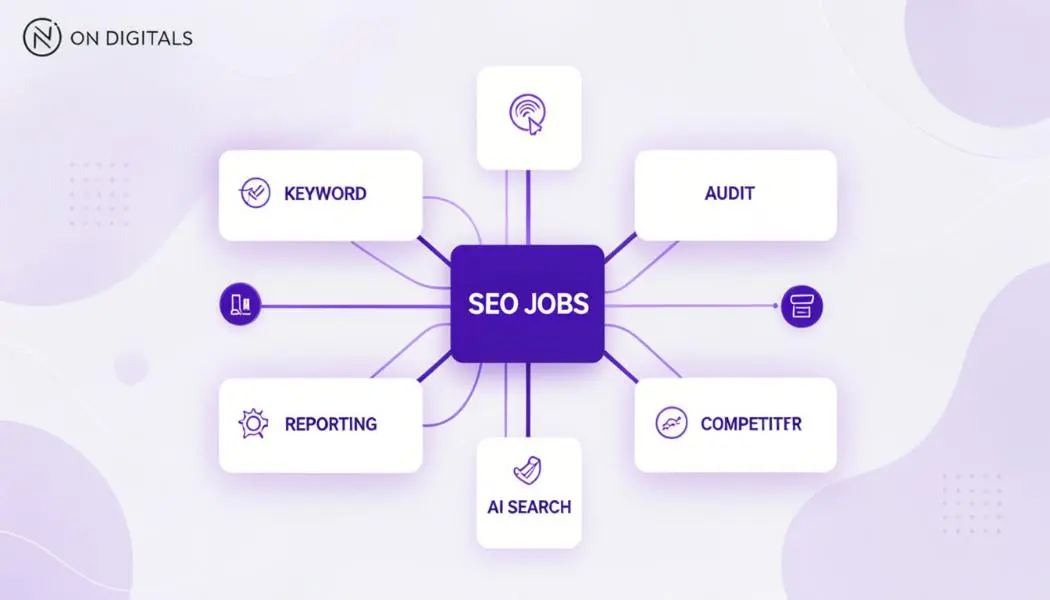 Group SEO tools by function to solve the business bottlenecks that matter most.
Keyword research tools
Keyword research tools help teams find search topics, estimate demand, group queries, and understand how users express intent. They are useful when a business needs to plan content, build category pages, expand service pages, or compare market demand.
| Keyword research tool | Use in this section |
| Semrush | Keyword and competitor research |
| Ahrefs | Keyword and competitor research |
| Moz Keyword Explorer | Keyword discovery |
| Google Keyword Planner | Directional keyword ideas |
| AlsoAsked | Question discovery |
| AnswerThePublic | Search question ideas |
| Keywords Everywhere | Browser-based keyword data |
Use these tools to answer strategic questions: Which topics have enough demand to justify the investment? Or, which keywords should map to a service page rather than a blog post?
SEO audit tools
An SEO audit tool helps identify technical and content issues that may affect a website’s visibility in search engines. Beyond just finding errors, these tools evaluate if pages are properly understood by crawlers and highlight where the user experience can be improved. For complex sites, a structured technical SEO audit turns raw crawl data into a prioritized fix list.
This category is especially useful for large websites, ecommerce catalogs, multilingual sites, and websites that have gone through migrations.
| SEO audit tool | Use in this section |
| Screaming Frog | Website crawling |
| Sitebulb | Technical audit visualization |
| Lumar | Enterprise crawling |
| Deepcrawl | Enterprise crawling |
| Semrush Site Audit | Platform-based site audit |
| Ahrefs Site Audit | Platform-based site audit |
| Google Search Console | Indexing and search issue checks |
| PageSpeed Insights | Page experience checks |
| Lighthouse | Performance diagnostics |
| Rich Results Test | Structured data validation |
SEO reporting tools
SEO reporting tools help teams turn performance data into clear updates for stakeholders. They can combine rankings, Google Search Console data, Google Analytics 4 traffic, conversions, backlinks, technical issues, and revenue indicators in one reporting view.
| SEO reporting tool | Use in this section |
| Looker Studio | Custom dashboards |
| Google Search Console | Search performance data |
| Google Analytics 4 | Traffic and conversion behavior |
| AgencyAnalytics | Client reporting |
| Whatagraph | Automated marketing reports |
| DashThis | Dashboard reporting |
| Semrush Reports | SEO platform reports |
| Ahrefs | SEO research reports |
| SE Ranking | Rank and SEO reports |
A useful SEO report should go beyond rankings and explain what the data actually means. The focus should be on how SEO performance contributes to qualified traffic, conversions, and business growth rather than on keyword positions alone.
For B2B and ecommerce teams, this is where SEO reporting becomes more than a traffic dashboard. It becomes a way to decide what to fix next.
Competitor analysis tools
Competitor analysis tools help teams understand which domains rank, which pages earn traffic, which backlinks support authority, and which topics competitors cover. They are useful when a business needs to enter a new market, defend an existing category, or build a content cluster.
| Competitor analysis tool | Use in this section |
| Ahrefs | Competitor keywords and backlinks |
| Semrush | Competitor keywords, backlinks, and traffic research |
| Similarweb | Market and channel estimates |
| Moz | Domain and link research |
| SpyFu | Competitor keyword research |
| SE Ranking | Competitor and rank tracking workflow |
| BuzzSumo | Content and PR angle research |
The best SEO tool for competitor site analysis depends on the job:
| Competitor job | Better tool type | Why it helps |
| Find competitor keywords | Ahrefs, Semrush, SE Ranking | Shows ranking pages, estimated traffic, and keyword gaps |
| Compare backlink profiles | Ahrefs, Majestic, Semrush | Helps evaluate authority and link opportunities |
| Estimate traffic channels | Similarweb, Semrush Traffic Analytics | Useful for market-level comparison |
| Review content topics | Ahrefs Content Explorer, Semrush Topic Research, BuzzSumo | Helps identify content angles and linkable assets |
| Analyze SERP intent | Manual SERP review plus rank tracking | Prevents tool data from hiding search intent |
However, you should never simply copy a competitor’s output. Instead, use these insights to understand the landscape so you can build a plan around your own unique service offer and audience.
SEO forecasting tools
SEO forecasting tools estimate how traffic, clicks, leads, or revenue may change if rankings improve, content is published, technical issues are fixed, or investment increases. They are useful for planning budgets and setting expectations with management.
Forecasting can be done with spreadsheets, Google Search Console exports, Google Analytics 4 data, keyword tools, or specialist platforms. Some teams also use SEOmonitor, Similarweb, Semrush, Ahrefs, and Looker Studio models to support forecasting.
A practical SEO forecast should be scenario-based. Instead of promising one number, show conservative, realistic, and upside scenarios. Each scenario should state the assumptions behind it, such as ranking movement, click-through rate, conversion rate, and content velocity.
Forecasting is helpful, but it should not become a guarantee. Search demand, competitor activity, algorithm changes, and implementation speed can all change the result.
Content optimization tools
Content optimization tools help writers and editors understand what topics, entities, questions, headings, and related terms may help a page satisfy search intent. They are useful for content briefs, refreshes, and cluster planning.
| Content optimization tool | Use in this section |
| Clearscope | Content briefs and term coverage |
| Surfer SEO | Content optimization workflow |
| Frase | Briefs and question research |
| MarketMuse | Content planning and optimization |
| NeuronWriter | Content scoring and entity support |
| Semrush SEO Writing Assistant | Writing support inside Semrush |
| AlsoAsked | Question and topic discovery |
Use these tools as guidance, not as writing rules. If every competitor article repeats the same entities, a content tool may push your draft toward sameness. The stronger approach is to combine entity coverage with original examples, decision frameworks, and On Digitals business context.
Backlink and digital PR tools
Backlink tools help teams evaluate link quality, monitor earned mentions, find broken-link opportunities, and understand how authority supports rankings. They are useful for competitive markets where content quality alone may not be enough.
| Backlink / PR tool | Use in this section |
| Ahrefs | Backlink research |
| Semrush | Backlink research and monitoring |
| Majestic | Link index analysis |
| Moz Link Explorer | Link metrics and discovery |
| BuzzStream | Outreach workflow |
| Pitchbox | Outreach workflow |
| Google Alerts | Mention monitoring |
A backlink tool should help you find patterns, not just count links. Look for pages that attract links naturally, industries that cite useful data, and gaps where your brand can publish assets worth referencing.
Rank tracking tools
Rank tracking tools monitor keyword positions by location, device, search engine, or SERP feature. They help teams see whether important pages are gaining or losing visibility.
| Rank tracking tool | Use in this section |
| AccuRanker | Dedicated rank tracking |
| SE Ranking | Rank tracking with broader SEO features |
| Semrush Position Tracking | Rank tracking inside Semrush |
| Ahrefs Rank Tracker | Rank tracking inside Ahrefs |
| Advanced Web Ranking | Advanced ranking reports |
| Nightwatch | Location and segment-based tracking |
Rank tracking is useful, but it should not be the only performance signal. A page can gain rankings without generating qualified traffic. Another page can lose one keyword but gain more valuable long-tail clicks. Always compare rank tracking with Google Search Console and conversion data.
AI Search and GEO tools
AI Search and GEO tools track how brands, pages, and entities appear in AI-generated answers. This category is growing because Google AI Overviews, AI Mode, ChatGPT Search, Perplexity, and other answer engines can influence discovery before a user reaches a website.
| AI Search / GEO tool | Use in this section |
| Profound | AI visibility tracking |
| Peec AI | AI answer visibility tracking |
| OtterlyAI | AI Search monitoring |
| Semrush AI features | Platform-based AI visibility checks |
| Ahrefs Brand Radar | Brand visibility and mention tracking |
| Manual prompt testing frameworks | Custom validation when tools are not enough |
This category is still new, so teams should be careful with methodology. Check what each tool tracks, which prompts it uses, how often data updates, and whether it can separate brand mentions from page-level citations.
For Search and AI Marketing, AI visibility data is useful when it supports content decisions. It should not replace core SEO work such as crawlability, entity clarity, structured data, and useful page content.
How to build an SEO tool stack by business situation
The right SEO stack depends on your team’s size, budget, website complexity, and decision speed. A blogger, an in-house ecommerce team, and an agency do not need the same setup.
Use the framework below as a starting point, then adjust based on your market and workflow.
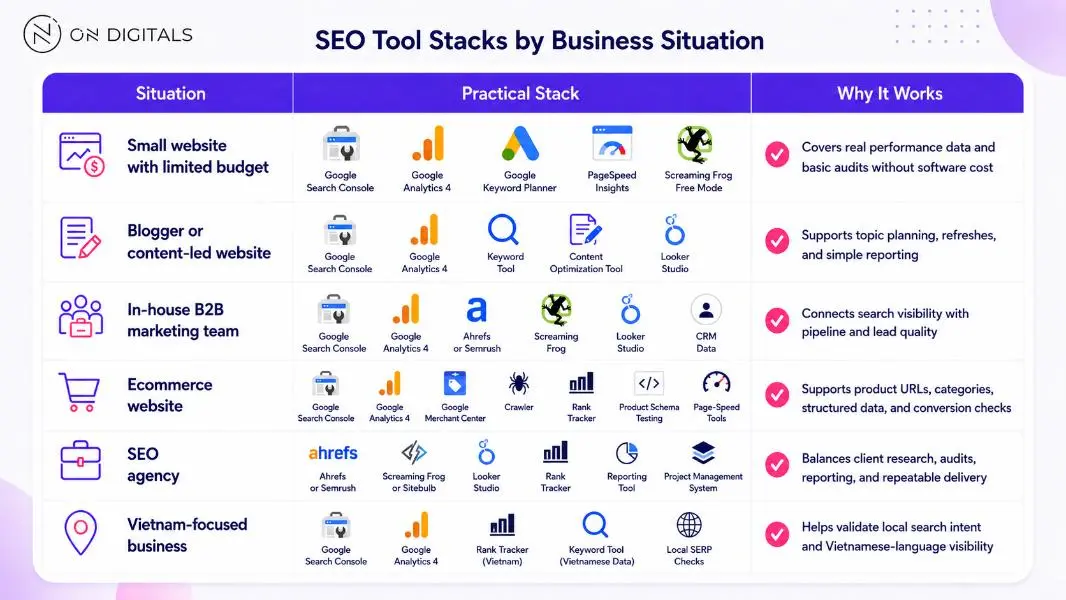 Depending on its size, team structure, and budget, each business requires an SEO stack with a different level of complexity.
Avoid buying tools only because they are popular in global SEO discussions. Start with the jobs your team actually performs, then choose tools that reduce manual work.
Example SEO tool stacks by budget
Budget matters because many SEO tools look affordable at the first tier but become expensive when you add seats, projects, credits, exports, or AI visibility features. Before choosing a platform, estimate the total cost of using it at your real workflow level.
Free or low-cost starter stack
A free starter stack can work for small websites, early-stage blogs, or teams that need to understand search basics before investing in paid tools.
Suggested stack:
| Tool / component | Role in starter stack |
| Google Search Console | Queries, pages, indexing, and Core Web Vitals |
| Google Analytics 4 | Traffic and conversion behavior |
| Google Keyword Planner | Directional keyword ideas |
| PageSpeed Insights and Lighthouse | Page experience checks |
| Rich Results Test | Structured data validation |
| Screaming Frog free mode | Small crawls |
| Looker Studio | Basic reporting |
This stack is enough to answer the first questions: what pages are visible, what issues block search engines, and which pages deserve attention next.
Content growth stack under a modest budget
A content-led team usually needs better keyword discovery, competitor context, and editorial workflow. One paid keyword platform can be enough if the team uses it well.
Suggested stack:
| Tool / component | Role in content growth stack |
| Google Search Console and GA4 | Performance base |
| Ahrefs, Semrush, SE Ranking, or Moz | Keyword and competitor research |
| Content optimization tool | Briefs and refreshes |
| Screaming Frog or Sitebulb | Technical checks |
| Looker Studio | Reporting |
The goal is not to buy every content tool. Choose one research platform, then make sure the team has a clear process for briefs, updates, internal links, and performance review.
Agency or advanced in-house stack
An agency or mature in-house team needs repeatable audits, cross-client reporting, competitor analysis, and workflow control. The stack should save time across projects, not only produce more data.
Suggested stack:
| Tool / component | Role in agency or advanced in-house stack |
| All-in-one SEO platform | Research and competitor analysis |
| Dedicated crawler | Technical audits |
| Rank tracker | Priority markets and devices |
| Looker Studio or reporting platform | Stakeholder updates |
| Google Search Console and GA4 | Property-level performance data |
| Project management and documentation tools | Delivery quality |
| Specialist tools | AI visibility, log files, or enterprise crawling when needed |
This stack should have clear ownership. If no one uses a tool weekly, reconsider whether it belongs in the stack.
Ecommerce SEO stack
Ecommerce teams need tools that can handle product URLs, category templates, structured data, page speed, and Merchant Center issues. The stack should help the team protect revenue pages, not only publish more content.
Suggested stack:
| Tool / component | Role in ecommerce SEO stack |
| Google Search Console and GA4 | Product and category performance |
| Merchant Center | Product feed diagnostics |
| Crawler | Category, product, canonical, and internal-link checks |
| Rich Results Test and Schema Markup Validator | Product and Offer data validation |
| PageSpeed Insights, Lighthouse, and Chrome DevTools | Template performance |
| Keyword or competitor platform | Category demand and product-led queries |
| Rank tracker | Monitoring priority categories |
For ecommerce, tool choice should support template decisions. If the team cannot audit products, variants, filters, and categories at scale, the stack is incomplete.
How to compare SEO tools before buying
Avoid relying solely on feature lists and instead put the software through a short test on your actual website. A tool might look impressive in a demo but could prove to be slow, limited, or unnecessarily expensive when applied to your real-world workflow.
Use this evaluation checklist:
| Evaluation area | What to check | Why it matters |
| Data quality | Compare tool data with Google Search Console, GA4, and known business data | Prevents blind trust in estimates |
| Use case fit | Test the tool on your real SEO workflow | Shows whether the tool solves your actual problem |
| Market coverage | Check your country, language, device, and SERP location | Important for Vietnam and multilingual SEO |
| Workflow speed | Test exports, filters, dashboards, crawl setup, and collaboration | Saves time during monthly work |
| Cost structure | Review seats, credits, projects, API limits, add-ons, and renewal terms | Prevents budget surprises |
| Reporting value | Check whether reports explain decisions, not only numbers | Helps management understand SEO priorities |
| Integration | Review GA4, GSC, Looker Studio, Sheets, CRM, and API options | Connects SEO work to business outcomes |
| Support and training | Check documentation, onboarding, and response quality | Reduces adoption risk |
Run the test with a real website, one competitor set, and one reporting deadline. That is the fastest way to reveal whether the tool fits your team.
Why SEO tools show different numbers
SEO tools often show different search volume, traffic, backlink, and ranking numbers because they use different databases and estimation models. This does not mean one tool is always wrong. It means each number should be used for the right decision.
For example, Ahrefs and Semrush may estimate different organic traffic for the same competitor. Google Search Console may show lower or higher clicks because it reports your actual site data. A rank tracker may show one position, while Search Console averages impressions across locations, devices, and SERP layouts.
Use this rule of thumb:
- Use Google Search Console to evaluate your own search performance.
- Use GA4 to understand user behavior and conversions after the click.
- Use third-party tools to estimate competitor visibility and topic opportunity.
- Use crawlers to diagnose technical issues inside your website.
- Use rank trackers to monitor priority keywords over time.
- Use forecasting tools to model scenarios, not promises.
If two tools disagree, do not average the numbers blindly. Ask what each tool measures, how fresh the data is, and whether the decision depends on exact accuracy or directional insight.
Cost traps: what to check before paying for SEO tools
SEO software can quickly become a major expense if you overlook usage limits. What starts as a simple monthly subscription can quickly grow in cost as the business expands its SEO operations and reporting needs.
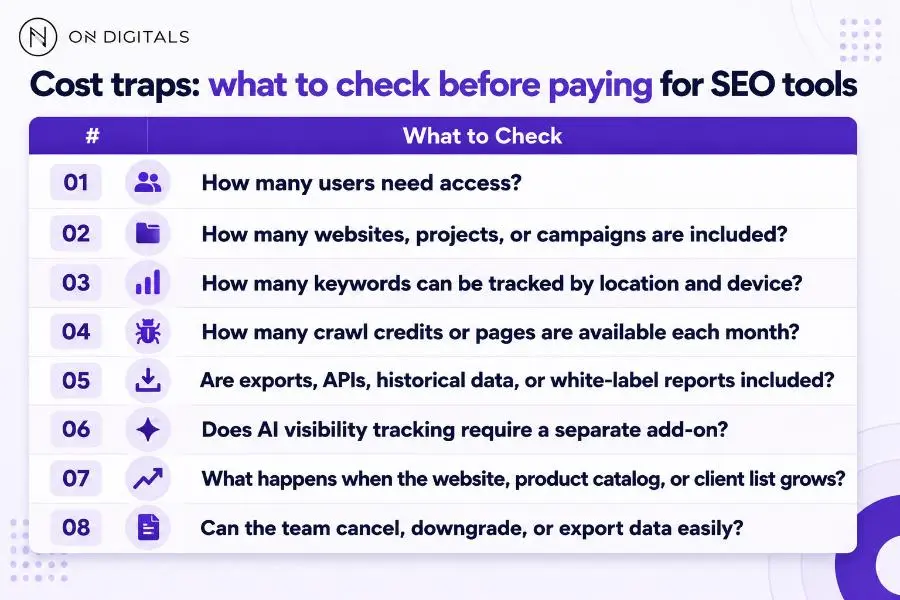 Before paying for an SEO tool, check these 8 potential cost traps.
The most expensive mistake isn’t necessarily buying a premium tool; it’s paying for overlapping platforms that answer the same questions while leaving critical gaps in your strategy.
How to avoid tool overlap and lock-in
Tool overlap happens when a team pays for several platforms that perform the same core job. This often happens with all-in-one SEO suites because each platform includes keyword research, competitor analysis, site audits, backlinks, and reporting.
To avoid overlap, choose one primary tool for each major job:
| SEO job | Choose one primary owner | Add a specialist only when |
| Keyword and competitor research | Ahrefs, Semrush, Moz, SE Ranking, or Similarweb | You need stronger market or channel data |
| Technical audits | Screaming Frog, Sitebulb, Lumar, or platform audit tool | Website scale requires deeper crawling |
| Reporting | Looker Studio, AgencyAnalytics, Whatagraph, or platform reports | Stakeholders need automated client-ready dashboards |
| Rank tracking | AccuRanker, SE Ranking, Semrush, Ahrefs, or Nightwatch | Location/device tracking is business-critical |
| AI visibility | Profound, Peec AI, OtterlyAI, or platform AI features | AI answer presence affects brand discovery |
Lock-in becomes a risk when the tool owns your workflow, data history, and reporting format. Reduce that risk by exporting key data, documenting dashboards, and keeping important source data in Google Search Console, GA4, Sheets, or your CRM.
SEO tools for Vietnam and multilingual markets
Businesses targeting Vietnam should evaluate local market coverage before choosing an SEO tool. A platform may perform well for English-language or U.S. search data but provide less reliable insights for Vietnamese keywords, local SERPs, and regional competitors. Beyond data quality, factors such as tracking flexibility, language support, pricing, billing, and customer support can also affect long-term usability. Even with a strong toolset, manual SERP reviews remain important because search results often vary by location, language and device, especially for service pages, ecommerce categories, and bilingual content.
What are SEO reporting tools and what should they show?
SEO reporting tools collect search performance data and present it in dashboards, scheduled reports, or stakeholder summaries. A useful report should show what changed, why it matters, and what action the team should take next.
A strong SEO report usually includes:
- Organic clicks, impressions, CTR, and average position from Google Search Console.
- Organic sessions, engagement, and conversions from GA4.
- Landing page performance by template or business role.
- Technical issues that affect indexation or user experience.
- Priority keyword movement, especially for commercial pages.
- Content updates, new pages, and internal-link improvements.
- Revenue, leads, assisted conversions, or CRM quality when available.
Avoid reports that only show more charts. Decision-makers need context. If organic clicks increased but qualified leads did not, the report should explain which pages changed and what the team will adjust.
What is an SEO audit tool and when do you need one?
An SEO audit tool scans a website to find technical, content, and on-page issues that may affect search performance. You need one when the website has many pages, repeated templates, migration risk, indexation problems, or unclear technical ownership.
Audit tools are particularly useful for evaluating a website’s technical health, including crawling and indexing, site structure, internal linking, metadata consistency, page experience, and other issues that may affect search visibility.
The tool can find issues, but prioritization still matters. Fix problems that affect important pages first, especially service pages, product categories, revenue pages, and pages already receiving impressions.
How to use SEO forecasting tools responsibly
SEO forecasting tools help teams estimate potential outcomes before investing in content, technical fixes, or link acquisition. They are useful for planning, but they should be presented as scenarios rather than promises.
A responsible SEO forecast should be based on historical performance, realistic growth assumptions, implementation capacity, and potential risks. Rather than predicting a single outcome, it should present a range of scenarios and clearly explain the factors behind them.
Forecasting is most useful when it improves decision-making. If a forecast helps a team choose between technical cleanup, content expansion, or conversion optimization, it is doing its job.
How to test SEO tools before recommending them
A transparent test method helps teams avoid biased tool recommendations. Instead of relying only on vendor demos or affiliate lists, test tools against the same website, competitor set, and reporting need.
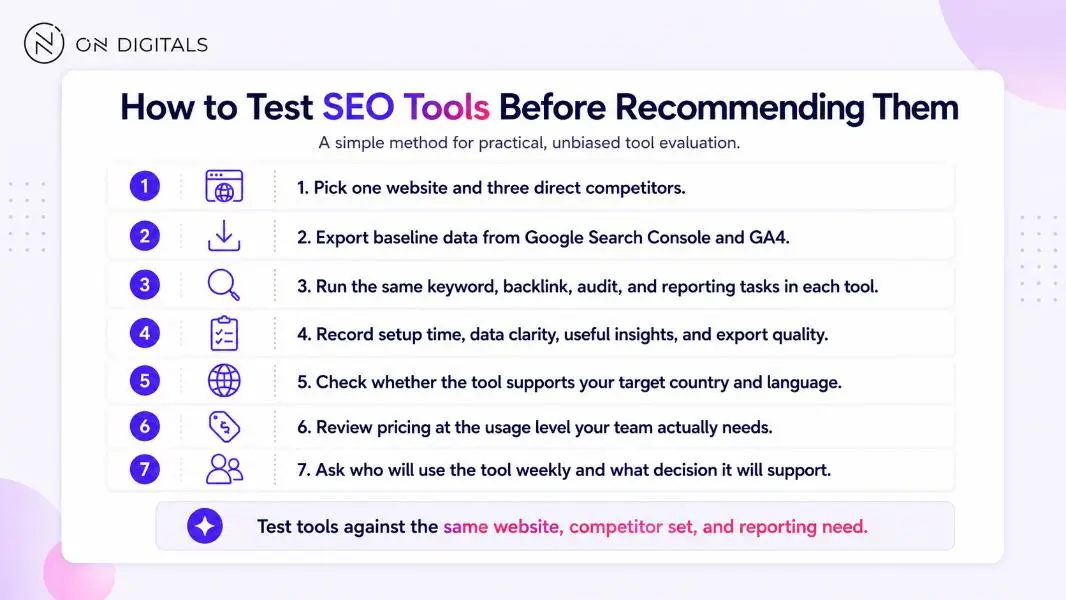 Test SEO tools with the same website, competitor set, and reporting need to make tool recommendations more practical and unbiased.
This method is not as flashy as a ranking list, but it is more useful for business teams. It shows which tool fits the work instead of which tool has the loudest marketing.
FAQ about SEO tools
What is the best SEO tool for competitor site analysis?
The best SEO tool for competitor site analysis depends on the task. Ahrefs and Semrush are strong for competitor keywords and backlinks. Similarweb can help with market-level traffic estimates. A manual SERP review is still needed to understand search intent.
Are free SEO tools enough?
Free SEO tools can be enough for small websites or early SEO work. Google Search Console, GA4, PageSpeed Insights, Rich Results Test, and basic crawlers cover many essentials. Paid tools become useful when the team needs competitor research, larger audits, reporting automation, or faster workflows.
Should a business use Ahrefs and Semrush together?
Some advanced teams use both, but many businesses do not need both at the same time. If the tools answer the same questions for your team, choose one primary platform and spend the saved budget on technical audits, content production, reporting, or implementation.
Do SEO tools help with AI Search?
Some newer tools track AI Search visibility across Google AI Overviews, AI Mode, ChatGPT Search, Perplexity, and other answer environments. These tools can support Search and AI Marketing, but they should not replace core SEO fundamentals such as crawlable content, structured data, entity clarity, and useful answers.
Final takeaway
SEO tools are valuable only when they help teams make clearer, faster decisions. They can reveal hidden technical flaws or competitor movements, but they are not a magic bullet. Regardless of how advanced the software is, it cannot replace human judgment, strategic thinking, or the hard work of implementation.
Before signing up for another platform, ask one practical question: Will this tool help us make a specific decision better or faster? If the answer is unclear, the tool is likely just adding cost without improving your performance.
For businesses that need a clearer Search and AI Marketing workflow, On Digitals can review your current SEO tool stack, reporting setup, technical audit process, and growth priorities before recommending the next step.

NEWEST POSTS
- Advertising Industry In Vietnam: The 2026 Trends, Channels and Market-Entry Strategy
- Best SEO Company in Vietnam: Latest Shortlist For Businesses
- How To Leverage Social Media For Customer Service Like A Pro?
- Social Media Post Tips – 8 Ways To Boost Engagement
- How To Use Social Media for Sales – In-depth Beginner Guide
Read more