
The Future of SEO with AI: How Search Will Change in Current Digital Marketing Landscape
Vincent
24/07/2025
26
The future of SEO is a shift from ranking individual pages to building searchable, citable, conversion-ready digital ecosystems. Keeping up-to-date with trends is the foundation for best SEO strategies. For B2B brands, SEO’s future means combining AI-aware content, technical foundation, topic authority, data tracking, and clear internal links across search and answer engines.
The future of SEO is not the end of SEO
The future of SEO is not about replacing traditional search optimization; it is about expanding into a broader visibility system.
According to Google's AI Optimization Guide, foundational SEO remains the ultimate bedrock for visibility in the era of generative AI. Websites should continue prioritizing a clear technical structure and crafting people-first content. These core elements are essential for a site to be cited within both generative AI search experiences and standard Google Search results.
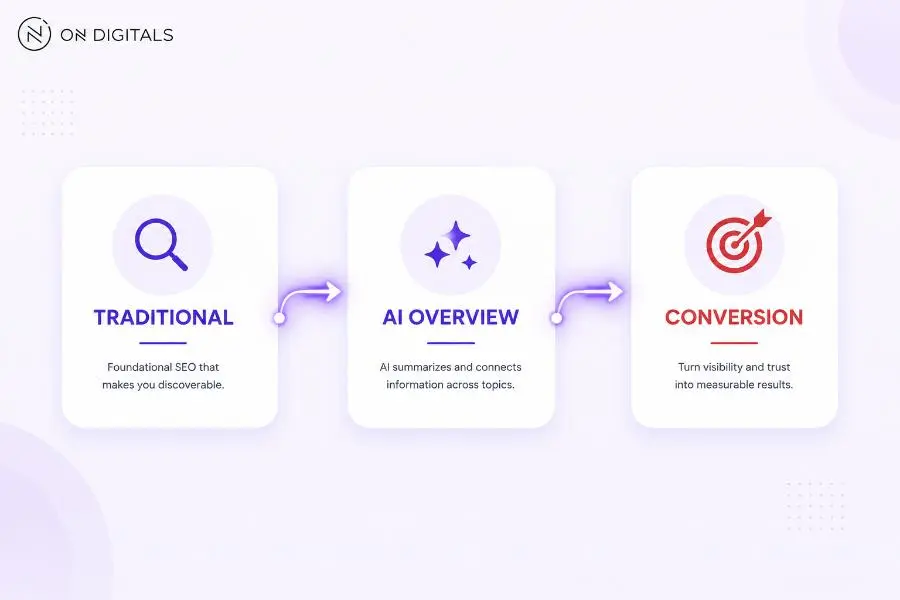 The future of SEO is no longer just about search rankings, but about creating a seamless ecosystem that connects traditional search, AI Overviews, and real-world conversions.
Search behavior has evolved because users now expect summaries and follow-up questions. Google’s AI Overviews and AI Mode use query fan-out to issue related searches across subtopics before generating a response.
This requires more strategic SEO. A page can no longer rely only on a target keyword, a title tag, and a few backlinks. It must answer the main query, cover related subtopics, support claims with clear details, and fit naturally into a larger topic cluster.
AI and the future of SEO: From keyword matching to answer selection
In traditional SEO, a page could perform well by using the right technical and on-page structure; thus, earning authority. However, AI-powered search raises another question: can content be extracted without losing its meaning?
That is why future-ready content should include:
- Direct answers near the top of each section
- Clear definitions for technical concepts
- Comparison tables for decision-making queries
- FAQ answers that work as standalone passages
- Original examples from projects, markets, or workflows
- Consistent entities such as Google Search Console, GA4, CRM, AEO, GEO, and B2B lead quality
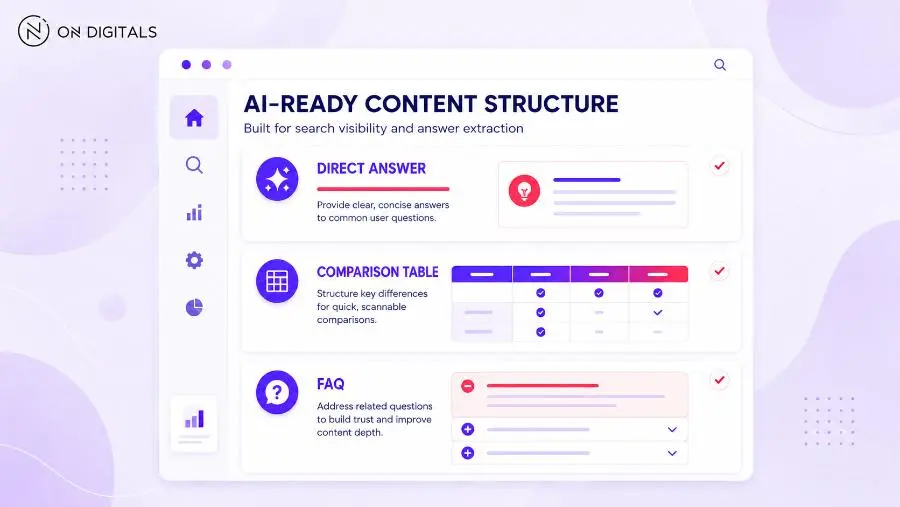 SEO content in the AI era needs to be structured into clear information modules so that answer engines can easily extract and cite the content.
Google also states that the same foundational SEO best practices apply to AI features without extra technical requirements. This point means SEO with AI is about making every important page easy for humans, crawlers, and AI systems to understand.
What will still matter in the SEO future?
AI changes how search results are presented, but it does not remove the need for a strong website foundation.
A 4-week study of mobile site data from 37 retail, travel, luxury, and lead generation brands across Europe and the US in 2025 still shows that even a 0.1-second improvement in mobile site speed can increase conversion rates by 8%, proving that technical health is still the #1 priority.
|
SEO area |
Why it still matters |
Future-ready update |
|
Search engines must crawl, render, index, and understand pages |
Audit JavaScript, canonicals, sitemaps, schema, page speed, and index coverage | |
|
Content quality |
Users and AI systems need useful, original answers |
Add firsthand experience, examples, definitions, and comparison logic |
|
Topic authority |
One page rarely covers an entire search journey |
Build pillar-spoke clusters with clear internal links |
|
E-E-A-T |
Trust helps users evaluate sources |
Add author context, process details, case examples, and accurate references |
|
Measurement |
Traffic alone may not show full SEO value |
Track impressions, clicks, conversions, assisted leads, AI referrals, and brand mentions |
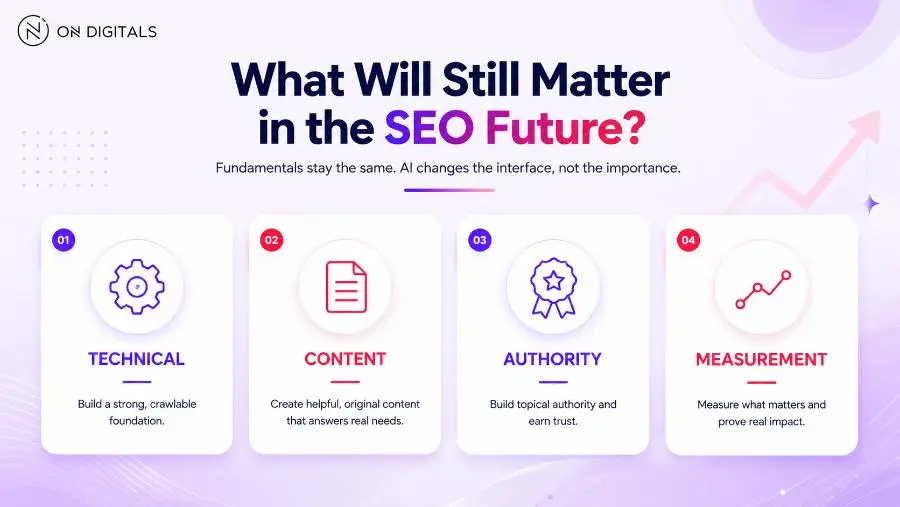 No matter how AI algorithms evolve, the four core pillars including Technical, Content, Authority, and Measurement remain the backbone of every SEO strategy.
Google’s people-first content guidance remains highly relevant.
Its automated ranking systems are designed to prioritize helpful information made for people, not for manipulating rankings. Google also asks whether content provides original information, insightful analysis, and substantial value compared with other search results.
How to build a future-proof SEO strategy?
A future-proof SEO strategy connects content, technical health, authority, and business outcomes. Instead of starting with isolated keywords, teams should map search demand to user intent, funnel stage, competitive difficulty, content format, internal link role, and measurable conversion goals.
A practical workflow looks like this:
- Map the search journey
Group queries by informational, commercial, and transactional intent.
For example, in this article, “future of SEO” and “AI and the future of SEO” are educational, while “future of SEO in digital marketing” has a stronger business strategy angle.
- Build topic clusters
Use the pillar page to explain a broad SEO strategy, while spoke pages for deeper topics.
- Create answer-ready sections
Each H2 should begin with a direct answer to support readers and answer extraction.
- Strengthen technical access
Ensure important content is fulfilling all required standards related to technical, on-page and off-page SEO. Avoid hiding key information inside images, tabs, or scripts that are hard to render.
- Measure business impact
Track relevant SEO performance metrics. Rankings are useful, but they are not represent the final goals.
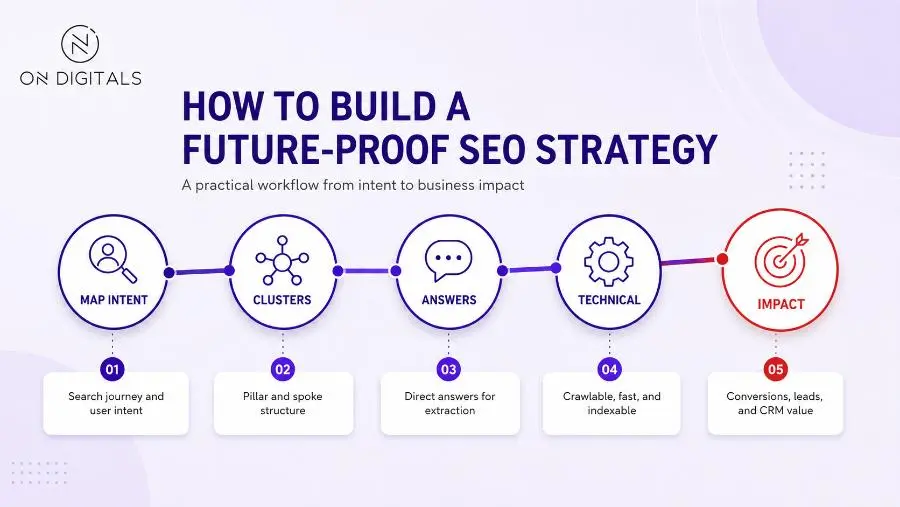
The 5-step process for building a sustainable SEO strategy starts from understanding search intent to optimizing technical structure and measuring business results.
This is where SEO becomes part of wider digital marketing. Organic visibility should support paid media learning, social content, and CRM nurturing. For example, SEO keyword data can inform Google Ads landing pages, Linkedin thought leadership, etc.
SEO forecasting: How to plan with data?
SEO forecasting should combine search demand, behavior, AI visibility, and performance data. A useful SEO forecasting model includes:
- Current impressions and clicks from Google Search Console
- Landing page sessions and conversions from GA4
- Keyword ranking trend by topic group
- SERP feature presence, including AI Overviews when visible
- Content freshness and update frequency
- Competitor content velocity and backlink growth
- Lead quality by CRM status or sales feedback
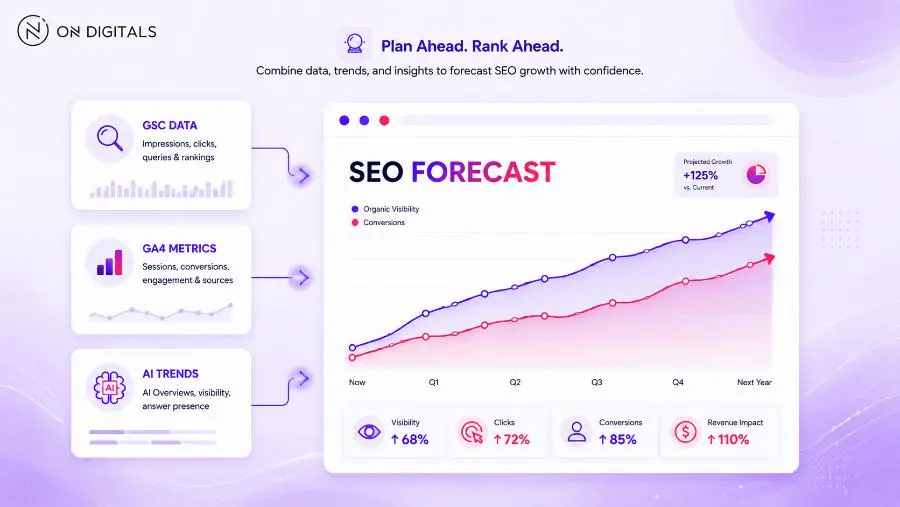 Modern SEO forecasting models require tightly integrated data from Search Console, GA4, and AI response trends.
Google recommends using Search Console and Google Analytics together because they show different parts of the user journey. Search Console focuses on what happens before users arrive from Google Search, while Google Analytics shows what users do after they arrive.
This matters because the future of SEO in digital marketing will be judged less by raw traffic and more by qualified contribution. A blog may lose some temporary clicks when AI answers appear, but still influence other aspects like brand image and conversion driven.
A strong forecast should include three scenarios:
- Conservative: rankings improve slowly, CTR is affected by AI answers, conversions grow mainly from refreshed pages.
- Realistic: technical fixes, content updates, and internal links improve visibility across several topic groups.
- Aggressive: the brand gains topical authority, earns mentions, improves conversion paths, and expands visibility across search and AI surfaces.
How to use AI in SEO without weakening quality?
AI can support SEO efficiently, but can not replace human intuition. The best use of AI is to speed up workflow, not to mass-produce low-value pages.
Google’s guidance says generative AI can be useful for researching topics and structuring original content. However, using AI or similar tools to generate many pages without adding value may violate spam policies on scaled content abuse.
For On Digitals-style B2B SEO, AI should be used in controlled steps:
- Use AI to cluster keywords and identify content gaps.
- Use human review to validate intent and business relevance.
- Use agency experience to add examples and practical recommendations.
- Use editors to check tone, accuracy, duplication, and claims.
- Use SEO QA to review title, H1, schema, links, and conversion paths.
This keeps the content useful. It also prevents the website from becoming a collection of generic AI-written articles that say the same thing as competitors.
The future of SEO is integrated growth
The future of SEO is not about isolated organic traffic. SEO will work more closely with paid media, content marketing, PR, social media, etc. Search visibility will become one part of a broader demand-generation system.
For example, a B2B company entering Vietnam may use SEO to capture long-term demand, Google Ads to test high-intent keywords, Linkedin Ads to reach decision-makers, and CRM data to measure lead quality. SEO content can then support sales teams with comparison pages and case-study-style proof.
This approach also helps with AI search. Answer engines are more likely to surface brands that have consistent and useful information across the web.
OpenAI also describes ChatGPT search as a way to get timely answers with links to relevant web sources, and it became available to everyone in supported regions without sign-in in February 2025.
As search spreads across more AI-driven interfaces, brands need stronger content ecosystems. The goal is not only to rank for one keyword, but to become a reliable source for a topic.
A practical roadmap for SEO teams preparing for the future
SEO teams can prepare for the next stage of search by auditing their current content and rebuilding it around intent, authority, and measurement. The priority is to improve Google ranking of existing pages before creating large volumes of new content.
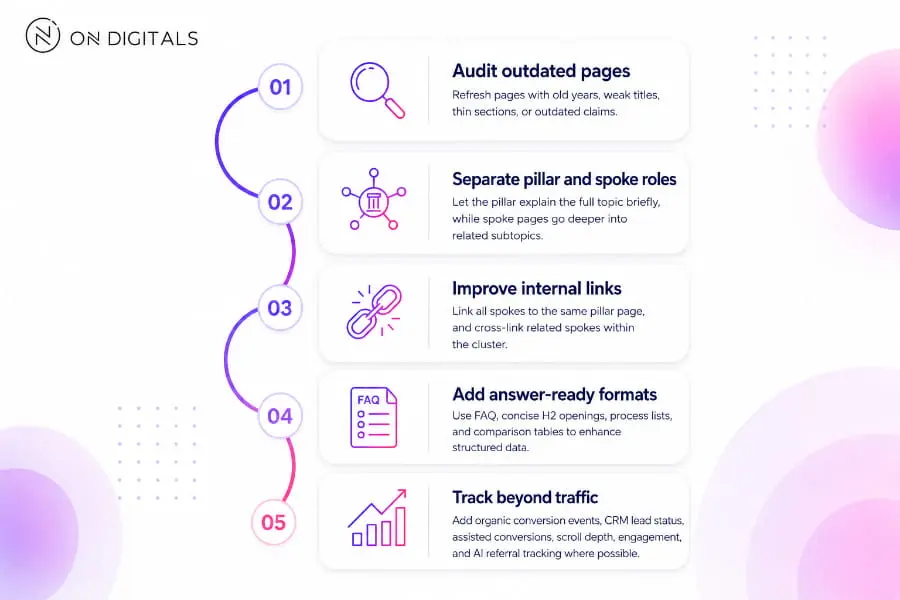
SEO future preparing roadmap
This roadmap keeps SEO practical. Before chasing further updates for answer search engines, your technical and on-page foundation must be ensured through SEO auditing.
Frequently Asked Questions (FAQs)
What is the future of SEO?
The future of SEO is a broader form of search visibility across Google, AI Overviews, AI Mode, ChatGPT search, video platforms, social search, and answer engines. Websites still need technical SEO, helpful content, authority, and internal links, but they also need clear answers, entity coverage, and measurable business outcomes.
Will AI replace SEO?
AI will not replace SEO, but it will change how SEO is planned and measured. SEO teams must optimize for both traditional search rankings and AI-driven answer selection. This means content should be useful for users, easy for search engines to crawl, and structured enough for AI systems to summarize or cite.
How should businesses prepare for the future of SEO with AI?
Businesses should refresh outdated content, build topic clusters, improve technical SEO, add original insights, and track conversions from organic search. They should also monitor AI search surfaces, brand mentions, and referral traffic from tools such as ChatGPT or Perplexity where analytics data is available.
What is SEO forecasting future trends?
SEO forecasting future trends is the process of estimating future organic performance using search demand, rankings, impressions, CTR, seasonality, SERP changes, competitor activity, and conversion data. A useful forecast should include conservative, realistic, and aggressive scenarios rather than relying only on keyword volume.
Why is the future of SEO important in digital marketing?
The future of SEO matters in digital marketing because organic search influences paid media, content planning, brand authority, lead generation, and sales enablement. SEO data can reveal customer questions, competitor gaps, market demand, and content opportunities that support the whole digital strategy.
Key Takeaways
The future of SEO is not about choosing between classic SEO and AI search. Strong brands will need both. They will keep technical foundations clean, publish helpful content, build authority, and measure business outcomes while adapting their content for AI-driven discovery.
For B2B companies, this shift creates an opportunity. Many competitors will chase tools and shortcuts. A better approach is to build a search ecosystem that is crawlable, credible, structured, and aligned with revenue. That is how SEO remains valuable in the AI era.
ODs Bot audit note — 2026-05-26
Verdict tổng: Good / Gần publish-ready sau chỉnh nhẹ
Điểm tổng: 793/1000
Avr. Mark: 79.3
Recommendation: Keep + update slug/redirect plan. Bài đã chuyển tốt từ `seo in 2025` sang evergreen `future of SEO`, phù hợp vai trò Spoke trong cluster Strategy. Cần hoàn thiện E-E-A-T, internal links thật và CTA/service mapping.
Điểm theo 10 dimension
– Keyword Coverage: 93/100 — `future of SEO`, `SEO future`, AI/future variations xuất hiện tự nhiên ở title, meta, slug, H1/GEO/body.
– Content Structure: 88/100 — mở bài có GEO rõ, H2 trả lời trực tiếp, có table, workflow, roadmap, FAQ. Cần set format heading/table thật trong Doc.
– GEO Citability: 84/100 — nhiều đoạn có thể trích dẫn độc lập về AI search, answer engines, forecasting và measurement.
– AEO Citability: 82/100 — entity tốt: AI Overviews, AI Mode, ChatGPT search, GSC, GA4, CRM, AEO/GEO. Cần thêm source attribution/hyperlink rõ cho Google/OpenAI.
– E-E-A-T Signals: 68/100 — có nguồn và lập luận cập nhật hơn row khác, nhưng vẫn thiếu author/reviewer, last updated, methodology note và ví dụ dự án riêng.
– Brand Differentiator: 72/100 — kết nối SEO với paid media, CRM, B2B, Vietnam market và digital strategy khá tốt. Có thể tăng bằng một đoạn On Digitals workflow cụ thể.
– Non-Commodity Content: 76/100 — có góc nhìn integrated growth, forecasting scenario, AI workflow; cần thêm ví dụ thực tế hoặc insight riêng để vượt bài trend thông thường.
– Internal Linking Quality: 70/100 — đã map pillar/spoke trong nội dung nhưng cần hyperlink thật đến pillar `best SEO strategies`, SERP analysis, SEO competitor analysis, SEO Services/Search and AI Marketing.
– Technical SEO On-page: 76/100 — title/meta/slug hợp lý; cần quyết định redirect từ `/seo-in-2025/` sang slug evergreen nếu triển khai thật.
– Walk-the-Talk: 84/100 — bài dạy answer-ready content và bản thân có direct answer, FAQ, table, roadmap. Trừ điểm vì thiếu formatting/hyperlink/source block thật trong Doc.
Nhận xét chính
Bài xử lý đúng vấn đề stale year của URL cũ. Angle evergreen `future of SEO` tốt hơn `SEO in 2025`, có đủ AI/AEO/GEO, forecasting, technical foundation và business measurement. Đây là spoke có giá trị riêng, không overlap quá mạnh với pillar vì tập trung vào tương lai SEO và AI search.
Cần bổ sung trước publish
1. Thêm block E-E-A-T: author/reviewer, last updated 2026, method note về nguồn tham chiếu Google Search Central/OpenAI/GSC/GA4.
2. Gắn hyperlink thật cho nguồn Google/OpenAI và internal links.
3. Thêm CTA mềm: “Talk to On Digitals about preparing your SEO roadmap for AI-driven search.”
4. Nếu đổi slug, cần note redirect 301 từ `/seo-in-2025/` sang `/future-of-seo/` hoặc `/the-future-of-seo/` sau khi SEO lead duyệt.
5. Format bảng/heading thật trong Google Doc.
Publish recommendation
Có thể publish sau khi chỉnh nhẹ. Nếu hoàn thiện source, E-E-A-T, hyperlink và redirect note, bài có thể đạt khoảng 840–870/1000.

NEWEST POSTS
- Advertising Industry In Vietnam: The 2026 Trends, Channels and Market-Entry Strategy
- Best SEO Company in Vietnam: Latest Shortlist For Businesses
- How To Leverage Social Media For Customer Service Like A Pro?
- Social Media Post Tips – 8 Ways To Boost Engagement
- How To Use Social Media for Sales – In-depth Beginner Guide
Read more