
AI in PPC Advertising: Improve Campaign Efficiency With Control
Vincent
22/08/2025
17
AI in PPC advertising can speed up recurring work and surface performance patterns that are difficult to spot manually. Its value varies across paid advertising channels, since each platform offers different automation, creative, and reporting controls. The outcome still depends on clean conversion signals and a clear human-review process.
Used with sensible controls, AI can improve campaign efficiency while keeping budget decisions and brand standards under active management.
How Can AI in PPC Make Your Campaigns Smarter and Faster?
AI is already built into many paid advertising workflows. It can support bidding, asset testing, audience expansion, reporting, and campaign recommendations. The strongest use cases often involve repetitive tasks or large datasets that would take significant time to review manually.
Its role becomes more useful when the account has a clear objective. An ecommerce campaign may optimize toward profitable revenue. A lead-generation campaign may need to prioritise qualified enquiries instead of every completed form.
AI in PPC saves time on repeatable work
Ad platforms can test combinations of creative assets, adjust bids during auctions, and identify performance changes faster than a manual review process. Google explains that Responsive Search Ads test different combinations of headlines and descriptions over time, while individual assets should still make sense on their own and in combination.
AI can also help PPC teams with early-stage work, such as:
- Grouping keyword ideas into themes
- Producing first-draft ad variations
- Summarising search-term patterns
- Flagging changes in spend or conversions
- Creating reporting notes for review
A prompt should provide enough context for the output to be useful. Broad instructions often produce generic copy that needs substantial editing.
Basic prompt:
Write some Google Ads copy for my service.
More useful prompt:
Create five Google Search ad headline options for [service]. Keep each headline within the platform character limit. Target users searching for [commercial intent]. Avoid unsupported claims, price promises, and competitor references. Use a professional tone and include one CTA variation.
The first output should be treated as a working draft. Review it against the landing page, actual offer terms, relevant ad policies, and the brand’s tone before uploading anything into the account.
During longer campaigns, testing fresh variations can also reduce the risk of ad fatigue caused by repeatedly showing audiences the same message.
Can AI in PPC improve conversions and ROI?
AI can improve efficiency when the system receives accurate conversion data and a meaningful optimisation target. It does not automatically understand profit margins, sales quality, repeat purchase value, or the commercial importance of different leads.
Google Ads Smart Bidding uses Google AI to optimize for conversions or conversion value at auction time. Advertisers choose the goal through strategies such as Target CPA, Target ROAS, Maximise Conversions, or Maximise Conversion Value. Google’s Smart Bidding documentation also notes that certain strategies rely on historical conversion data to perform and evaluate results effectively.
Before setting a Target ROAS strategy, clarify the ROAS target that fits your economics. Margin, fulfilment costs, and repeat-purchase behaviour can materially change the number that makes commercial sense.
A campaign can become more efficient when:
- Conversion tracking reflects genuine business value
- Primary conversions are selected carefully
- Targets fit the account’s economics
- Budget limits are realistic
- Performance is reviewed over a meaningful period
For example, a lead-generation campaign may optimize toward completed forms while the sales team finds that many submissions are low quality. Feeding qualified-lead data back into the measurement setup can make the optimisation target more useful over time.
Which AI in PPC Tools Should You Use?
The best AI option depends on the task, campaign scale, and level of control needed. Built-in platform tools are often a practical place to start because they operate directly within the account. Third-party tools can help with research, workflow automation, reporting, or cross-channel analysis.
Built-in AI tools: Google, Microsoft, and Meta
Google Ads offers several AI-powered capabilities across Search, Performance Max, bidding, creative assets, and reporting. Performance Max uses Google AI across bidding, budget optimisation, audiences, creative assets, and attribution based on the conversion goals and inputs supplied by the advertiser. Google’s Performance Max overview explains that the campaign type can access inventory across Search, YouTube, Display, Discover, Gmail, and Maps.
Microsoft Ads and Meta also provide automation features for bid optimisation, audience delivery, recommendations, and creative variations. Exact capabilities can change frequently, so teams should check the current platform documentation before enabling a new feature.
|
PPC task |
AI can help with |
Human review should confirm |
|
Ad copy ideation |
Generate angles, headlines, and first drafts |
Accuracy, tone, offer terms, compliance |
|
Keyword analysis |
Cluster themes and surface query patterns |
Intent fit, commercial relevance, negatives |
|
Bid management |
Adjust bids based on auction signals |
Conversion quality, target economics, budget limits |
|
Reporting |
Detect anomalies and summarise trends |
Attribution logic, commercial context, action priority |
|
Landing-page review |
Highlight possible friction or test ideas |
UX choices, legal claims, final implementation |
Should you look beyond platform tools?
Third-party tools may be useful when a team manages multiple advertising channels or needs more structured workflows around research, reporting, creative reviews, or alerting.
The tool should solve a specific problem. A business running a small Google Ads account may benefit more from improving conversion tracking than from buying several AI subscriptions. A larger team may need a platform that helps standardise reporting across Google Ads, Meta, LinkedIn, or other channels.
Before adding a tool, ask:
- Which recurring task is consuming too much time?
- What data will the tool access?
- Does the output need human approval before use?
- Can the team explain how success will be measured?
- Will the tool improve a process that already has reliable inputs?
How AI in PPC Changes Your Reporting Game
AI can help teams identify unusual changes in performance, such as a sudden rise in cost, lower conversion rate, or a drop in impression share. It can also summarise large reporting datasets into faster starting points for analysis.
Those summaries should not replace investigation. A reporting tool may flag that CPA increased, while the underlying cause could be a landing-page issue, a product availability problem, a tracking error, or a competitor entering the auction.
What to review before trusting an AI recommendation
|
Signal |
AI may identify |
Human review should investigate |
|
Spend increase |
Budget or bidding shift |
Whether conversion quality changed too |
|
Conversion decline |
Performance anomaly |
Tracking setup, page issues, sales follow-up |
|
New query trend |
Search demand opportunity |
Relevance, intent, negative-keyword need |
|
Creative variation |
Higher engagement signal |
Brand fit, policy safety, downstream conversion value |
|
Audience expansion |
New delivery opportunity |
Whether leads or sales remain commercially valuable |
A useful reporting rhythm combines leading and lagging indicators. Click-through rate, search-query changes, and spend pacing can show early movement. Qualified leads, revenue, pipeline value, and repeat purchases provide a clearer view of longer-term business impact.
AI search may also influence query behaviour and future advertising surfaces. Rather than assuming it will reduce PPC performance across every account, monitor changes in search terms, CTR, CPC, and conversion quality as the market evolves.
Some performance changes may also reflect seasonal PPC performance rather than an AI decision. Compare results with a relevant historical period before changing strategy or judging an automated campaign based on a short-term outcome.
The Real Challenges of AI in PPC
AI can make campaign management faster, while its output still reflects the goals, data, and constraints supplied to it. Weak inputs can create poor decisions at scale.
Where human oversight remains essential
Human oversight matters most when campaign decisions affect brand reputation, customer trust, legal obligations, or commercial profitability.
AI can draft creative variations quickly. It cannot independently verify whether a price is current, whether an offer is available, or whether a claim is appropriate for a regulated industry. A healthcare advertiser, financial service, or legal business may need more intensive review before generated copy is approved.
Use a simple review gate before launch:
- Confirm the claim appears on the landing page.
- Check that pricing, promotion terms, and availability are current.
- Review tone against brand standards.
- Confirm the creative meets platform and local advertising rules.
- Record who approved the final version.
What is the black box problem?
Many automated campaign types provide less visibility into every individual decision than a manually segmented account. This can make it harder to explain why a bid changed, why a certain asset was shown, or which audience signal contributed to performance.
Google provides reporting, experiments, bid strategy statuses, simulators, and alerts for Smart Bidding. These tools can help advertisers understand performance trends and test changes. They do not remove the need to review the business impact of automated decisions. Google’s Smart Bidding guidance recommends measuring performance over longer periods with sufficient conversion data.
Campaign automation should therefore have guardrails:
- Set appropriate budget limits
- Review search terms regularly
- Keep negative keywords current
- Check generated assets before they run
- Review automatic recommendation settings
- Compare performance with a relevant baseline
Keep AI focused on what matters to the business
AI optimises toward the objective configured in the account. If the primary conversion is a low-value action, the system may find more of that action without improving the business result.
A stronger setup can distinguish between:
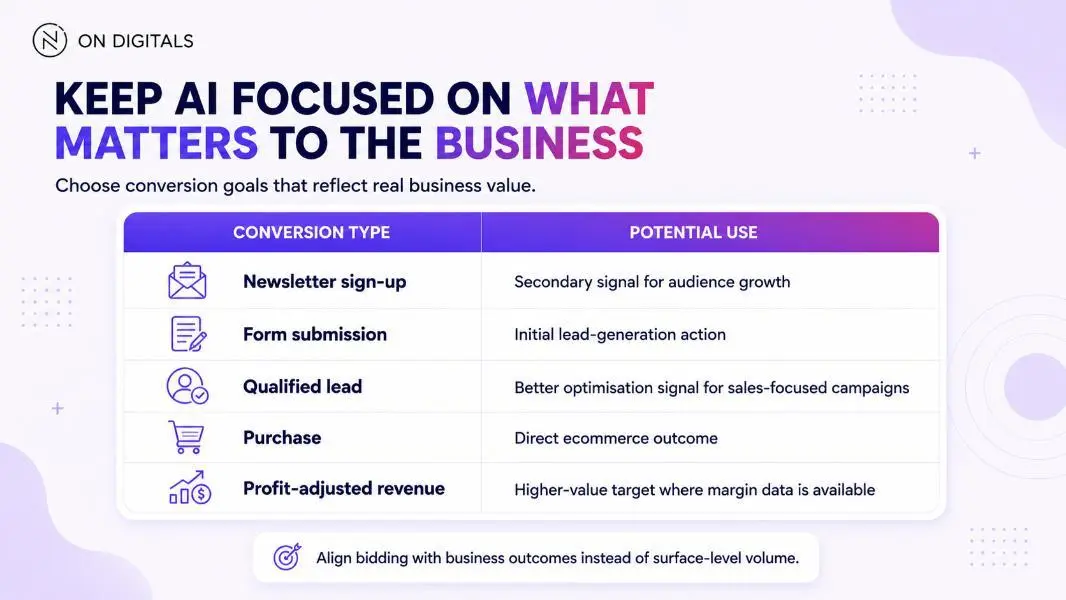 Choose conversion goals that reflect real business value, from newsletter sign-ups to profit-adjusted revenue.
This setup helps align bidding with business outcomes instead of surface-level volume.
Protect customer and account data when using AI tools
Treat external AI tools as part of the business’s wider data-governance process. Keep personally identifiable information out of public prompts. Names, email addresses, phone numbers, customer IDs, or unredacted CRM exports should not be pasted into a tool without confirmed approval and appropriate safeguards.
Before connecting an AI product to advertising or analytics data, review:
- Access permissions
- Data retention settings
- Vendor privacy terms
- Team approval process
- Account-level security controls
This matters especially for regulated industries and businesses handling sensitive customer information.
How to Get Started With AI in PPC
A gradual pilot gives the team time to understand how AI affects performance before it becomes part of every workflow.
Run a 30-day AI pilot before scaling
Choose one campaign with stable conversion tracking and a clear commercial objective. Avoid testing several major changes at once, as that makes it difficult to understand what caused the result.
Week 1: Validate conversion actions, budget limits, landing pages, and baseline metrics.
Week 2: Use AI for a controlled task, such as generating new RSA assets or summarising search-term themes.
Week 3: Review performance, creative quality, query relevance, and conversion quality.
Week 4: Decide whether to keep, refine, pause, or expand the test.
The purpose of a pilot is to create a reliable learning process. A strong result may justify a broader rollout, while weak performance can reveal gaps in data, tracking, offer quality, or campaign structure.
Steps for smooth AI in PPC adoption
Before expanding automation, confirm that the account is ready.
- Conversion tracking has been checked
- Primary conversions represent real business value
- Budget limits are defined
- Brand and compliance rules are documented
- Search-term reviews follow a regular schedule
- Auto-applied recommendations require approval
- Performance has a meaningful baseline for comparison
Built-in tools are often the simplest starting point because the team can test them within existing account workflows. As confidence grows, external AI tools can support reporting, research, creative production, or cross-channel management.
FAQs About AI in PPC
Is AI replacing human PPC managers?
AI can reduce time spent on repetitive account tasks. PPC managers remain responsible for strategy, measurement design, brand standards, conversion quality, and commercial decisions.
How do I know whether AI is improving lead quality?
Review more than form volume. Compare qualified-lead rate, contact rate, booked appointments, pipeline value, or closed revenue where that data is available. A higher conversion count is less useful when lead quality falls.
Should I enable auto-applied recommendations in Google Ads?
Enable them only when the account has clear approval rules and the team understands the potential effect of each recommendation type. Review settings regularly so generated assets, bidding changes, or campaign recommendations do not go live without appropriate oversight.
Can I upload customer lists or CRM exports into a public AI tool?
Keep personally identifiable customer data out of public prompts unless the business has confirmed that the tool, agreement, permissions, and security controls are suitable for that use. Redacted or aggregated data is usually safer for analysis tasks.
Does Performance Max provide enough detail for every PPC account?
Performance Max can be useful for advertisers with clear conversion goals and high-quality inputs. Some businesses may still need separate campaign structures where tighter control, reporting detail, or channel-specific testing is important.
What data should be fixed before testing Smart Bidding?
Start with accurate conversion tracking, meaningful primary conversion actions, realistic targets, enough budget for learning, and a reliable baseline. Smart Bidding can then optimize toward a signal that better reflects business value.
Conclusion
AI in PPC advertising can improve efficiency when it is connected to a clear business objective and trusted conversion data. Its strongest role is to speed up analysis and support better auction-time decisions, while people remain responsible for commercial judgement.
For teams that need support applying these controls across search campaigns, bidding, and measurement, On Digitals provides Google Ads management support.

NEWEST POSTS
- Advertising Industry In Vietnam: The 2026 Trends, Channels and Market-Entry Strategy
- Best SEO Company in Vietnam: Latest Shortlist For Businesses
- How To Leverage Social Media For Customer Service Like A Pro?
- Social Media Post Tips – 8 Ways To Boost Engagement
- How To Use Social Media for Sales – In-depth Beginner Guide
Read more