
What Is a Good ROAS? Set a Profitable Target Before You Scale
Vincent
02/09/2025
18
A good ROAS depends on the margin behind each conversion and the role a campaign plays in the user path. The right PPC platform can also affect cost, user intent, and the time between a click and commercial value. Before increasing spend, compare ROAS with break-even economics. Then confirm that the conversion value reflects the business outcome created after the click.
What is a good ROAS? The short answer
A good ROAS clears the break-even threshold for your business and supports the outcome the campaign is meant to produce. Ecommerce teams usually need enough attributed revenue to cover product costs, fulfilment, fees, returns, and media spend. B2B teams need a model that reflects qualified leads, sales progression, and expected gross profit.
That means 4x ROAS can be strong for one business while another needs 6x to maintain healthy economics. A retargeting campaign may achieve a higher figure because it reaches people who already know the brand. Prospecting activity often has a lower immediate return because it introduces the offer to colder audiences.
Instead of starting from a generic benchmark, start with the commercial threshold that your campaign needs to clear.
How to calculate ROAS correctly
ROAS means return on ad spend. It compares the conversion value attributed to advertising with the money spent to generate that value.
ROAS = Attributed conversion value ÷ Ad spend
Assume a Google Search campaign spends $5,000 and generates $20,000 in tracked purchase revenue.
$20,000 ÷ $5,000 = 4x ROAS
The campaign produced four dollars in attributed conversion value for every dollar invested in advertising. This figure helps a PPC owner compare campaigns, audience groups, landing pages, and keyword themes. It does not show the final profit after operating costs are included.
|
ROAS ratio |
ROAS percentage |
Meaning |
|
2x |
200% |
$2 in attributed value for each $1 in ad spend |
|
4x |
400% |
$4 in attributed value for each $1 in ad spend |
|
6x |
600% |
$6 in attributed value for each $1 in ad spend |
Conversion value determines how useful ROAS becomes
ROAS can only be as reliable as the value sent into the advertising platform. An ecommerce account may pass transaction revenue. A B2B campaign may use a value based on sales-qualified lead quality.
Google Ads supports conversion values for purchases, leads, and other business outcomes. Conversion values can also reflect revenue or margin, depending on the measurement model. See Google’s guidance on conversion values in Google Ads before assigning value to a campaign goal.
A practical value model may use:
- Purchase revenue
- Margin-adjusted purchase value
- Sales-qualified lead value
- Closed-won revenue
For example, assigning the same $1,000 value to every form submission can make reporting look simple. The model becomes weak when one enquiry has little sales potential while another represents a high-value opportunity. CRM outcomes should guide the value assigned to high-consideration leads.
Calculate break-even ROAS before setting a target
Break-even ROAS is the lowest ROAS that allows an ad campaign to cover its spend after direct variable costs are considered. It should become the starting point for any realistic performance target.
Break-even ROAS = 1 ÷ Pre-ad contribution margin
Pre-ad contribution margin is the revenue left after costs that increase with each sale. It gives a more useful planning view than a broad profit-margin estimate.
|
Cost area |
Example |
|
Product cost |
Manufacturing or wholesale cost |
|
Transaction cost |
Payment processing fees |
|
Fulfilment cost |
Packaging, warehouse handling, delivery support |
|
Return allowance |
Expected refunds or exchanges |
|
Discount impact |
Promotional reduction in realised revenue |
Ecommerce break-even ROAS example
Assume an ecommerce business sells a product for $120.
|
Item |
Amount |
|
Sale price |
$120 |
|
Product cost |
$48 |
|
Fulfilment and payment fees |
$12 |
|
Return allowance |
$6 |
|
Pre-ad contribution |
$54 |
|
Pre-ad contribution margin |
45% |
The break-even ROAS is:
1 ÷ 0.45 = 2.22x
At 2.22x ROAS, the campaign covers advertising spend under this model. An operating target should usually sit above this threshold because cost conditions can change. Returns may rise, auction competition may increase, and product mix may shift toward lower-margin sales.
B2B ROAS should start with qualified-lead value
B2B campaigns often have a long interval between the first conversion and the final sale. A demo request has limited commercial value until the sales team confirms fit and moves the lead through the pipeline.
A useful starting formula is:
Expected gross profit per qualified lead = Gross profit per closed customer × Qualified-lead-to-close rate
Assume an average closed customer generates $30,000 in gross profit. CRM history shows that 15% of qualified leads become customers.
$30,000 × 15% = $4,500 expected gross profit per qualified lead
If paid search produces qualified leads at $900 each, the expected value model suggests:
$4,500 ÷ $900 = 5x ROAS
This is a planning estimate. A monthly review should compare those assumptions with actual sales outcomes. The model may need adjustment when lead quality, close rate, or gross profit changes.
Set an operating target above break-even
Break-even ROAS protects the minimum economics of the campaign. An operating target needs more headroom because performance rarely stays fixed. Conversion rate, return volume, auction pressure, and demand can move during the quarter.
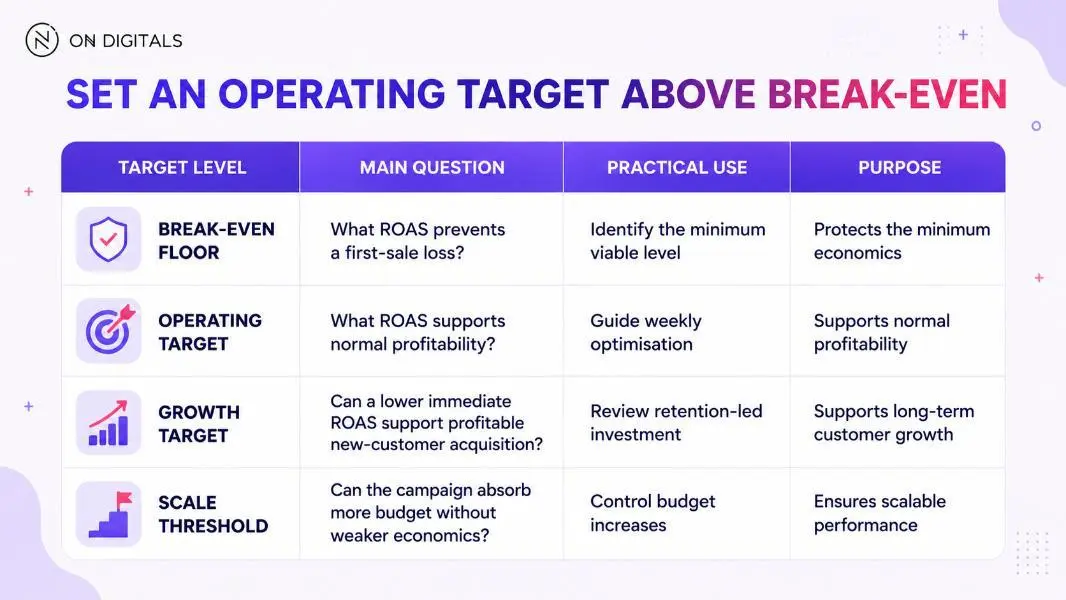 Set ROAS targets above break-even to optimise profit and scale with control.
A new-customer campaign can accept a lower immediate ROAS when repeat purchase is proven through customer data. Retargeting usually deserves a different threshold because the audience already knows the brand. Applying one target across both campaign types can obscure weak acquisition performance.
Seasonality also changes the target-setting context. Peak demand may bring higher conversion volume, although CPC can rise at the same time. Teams planning promotions should account for seasonal PPC budget shifts before judging a campaign against a quiet-month result.
Use ROAS benchmarks as context, not as a target
External benchmarks can be useful when the business conditions are genuinely comparable. They become misleading when campaign role, attribution rules, or customer mix differ.
|
Benchmark check |
Why it matters |
|
Campaign type |
Branded search behaves differently from non-brand acquisition |
|
Customer stage |
Prospecting serves a different purpose from retargeting |
|
Margin model |
A high-margin offer can support different acquisition economics |
|
Attribution window |
Measurement rules can change the reported ROAS |
|
Customer mix |
Repeat buyers can lift blended performance |
|
Market conditions |
Seasonality and auction pressure affect cost and conversion rate |
A 5x benchmark may look attractive, yet it tells you little without the surrounding context. It may come from a retention-heavy account with repeat purchasers, while your campaign is designed to acquire first-time customers in a highly competitive market.
Use benchmarks to ask better questions. Your break-even model should set the target.
How Target ROAS affects campaign volume
Target ROAS bidding in Google Ads uses reported conversion values to optimise bids toward the target entered in the account. The setup therefore depends on reliable values and sufficient performance history.
Google states that a target set too high may reduce the traffic available to the campaign. Lowering the target gradually can allow the strategy to enter more auctions and generate more conversion volume. Read Google’s official guidance on Target ROAS bidding before making large changes.
|
Situation |
Practical response |
|
ROAS is profitable but volume remains limited |
Review whether the target is restricting eligible traffic |
|
ROAS sits below break-even |
Improve tracking, traffic quality, page conversion, or margin before loosening the target |
|
Conversion values are unreliable |
Fix the value model before changing the bidding goal |
|
Product margins vary widely |
Check whether revenue-based values hide weaker product economics |
Teams exploring AI-assisted PPC optimisation should apply the same discipline. Automation can react faster than a manual workflow, while it still depends on the conversion data and business value supplied to the platform.
Why ROAS can look strong while profit remains weak
ROAS measures campaign efficiency. A broader profitability review includes additional costs and may produce a different conclusion. For a clearer explanation of how the two metrics serve different reporting decisions, see ROAS vs ROI in paid media measurement.
Consider this ecommerce example:
|
Calculation |
Amount |
|
Attributed revenue |
$50,000 |
|
Ad spend |
$10,000 |
|
ROAS |
5x |
|
Product cost and fulfilment |
$29,000 |
|
Payment fees and returns |
$5,000 |
|
Campaign production and management |
$7,000 |
|
Total cost |
$51,000 |
|
Net profit |
-$1,000 |
The campaign produced five dollars in revenue for every ad dollar. The wider cost base still exceeded sales revenue. The PPC account may need efficiency improvements, while the commercial team also needs to review pricing, margin, or fulfilment cost.
Why Google Ads, GA4, CRM, and finance reports can differ
Different systems measure performance through different rules. A mismatch often reveals a reporting difference rather than an immediate campaign failure.
|
Reporting source |
Primary view |
Common reason for difference |
|
Google Ads |
Platform-attributed conversion value |
Conversion settings and platform attribution |
|
Google Analytics 4 |
Website and cross-channel behaviour |
Event setup and attribution model |
|
CRM |
Qualified leads, opportunities, closed revenue |
Sales-cycle delay and lead qualification |
|
Finance reporting |
Commercial revenue and profit |
Returns, fees, fulfilment cost, etc. |
For ecommerce, analytics needs a purchase event with the right value data. Lead-generation setups should also distinguish a simple enquiry from a qualified opportunity. Google’s GA4 recommended events include purchase for ecommerce and generate_lead for lead capture.
Platform ROAS can guide a weekly budget adjustment. A monthly commercial review should also account for CRM progression, refund timing, and the cost assumptions behind profitability.
Improve ROAS with a four-step diagnostic
ROAS improvement starts by identifying the part of the user path that changed. Revising ad creative before checking tracking can make the account harder to diagnose.
1. Verify conversion values and event coverage
Confirm that the affected page template sends the correct conversion event, value, and currency. The technical owner should review changes to the checkout, form, booking flow, or CRM integration before the media team changes bids.
2. Identify the weak stage in the user path
|
Performance signal |
Likely area to investigate |
|
Click-through rate falls |
Ad relevance, audience fit, search-query quality |
|
Conversion rate falls |
Landing-page message, offer clarity, form friction |
|
ROAS falls while conversion rate holds |
Product mix, average order value, discounting, value setup |
|
Lead volume rises while quality falls |
Broad targeting, weak qualification, inaccurate lead values |
A CTR decline with rising frequency can indicate that ad fatigue is affecting campaign performance. Refreshing the same ad asset may help for a short period. A stronger response reviews creative angle, audience saturation, and the value proposition seen after the click.
3. Test one meaningful change
Choose a test that matches the diagnosed issue. It may be a search-query exclusion, revised landing-page headline, new audience segment, or a more accurate value assigned to a qualified lead. A narrower test creates a clearer decision trail than changing multiple campaign settings at once.
4. Validate commercial impact before scaling
A positive result should hold long enough to show reliable value. Check the margin assumption, lead quality, and marginal ROAS before expanding budget. The same campaign can weaken once it reaches a larger audience or moves beyond high-intent demand.
Decide when to scale, hold, or reduce spend
ROAS needs commercial context before it becomes a budget decision.
|
Performance pattern |
Recommended action |
|
ROAS clears target and conversion quality stays stable |
Scale through controlled budget increases |
|
ROAS clears break-even while lead quality weakens |
Hold spend and review value quality |
|
ROAS is below target while CRM revenue improves |
Validate the sales-cycle data before reducing budget |
|
ROAS falls below break-even |
Review tracking, traffic quality, page conversion, and margin assumptions |
|
Volume rises while marginal ROAS drops sharply |
Slow budget growth and identify the saturation point |
A sound scale decision should record the affected campaign, the expected ROAS range, and the commercial condition that must remain true. This gives the account owner a clear review point after budget changes.
Frequently asked questions about good ROAS
Is 2x ROAS good?
A 2x ROAS can be viable for a business with strong margins or proven repeat-purchase value. Many direct-response campaigns need a higher threshold to cover their direct costs. Calculate break-even ROAS before using 2x as a target.
Is 4x ROAS always good?
A 4x ROAS may be excellent for a high-margin offer. It can still be insufficient when fulfilment costs, discounting, returns, or campaign support reduce the available contribution. The margin model determines whether 4x supports profit.
How do I calculate break-even ROAS?
Divide one by your pre-ad contribution margin. A business with a 40% contribution margin has a break-even ROAS of 2.5x. Use direct variable costs in the calculation rather than a broad estimate of company profit.
What ROAS should B2B lead generation use?
Build the target from expected gross profit per qualified lead. CRM history should show how qualified leads progress to opportunities and closed customers. This creates a more useful benchmark than treating every form submission as equally valuable.
Can lower ROAS still justify more spend?
Lower ROAS can be acceptable when a campaign consistently acquires profitable new customers or produces qualified pipeline with a longer payback period. The decision should rely on CRM evidence or customer-value reporting rather than an assumed lifetime value.
Conclusion
A good ROAS is a commercial threshold, not a universal benchmark. It should reflect contribution margin, conversion-value quality, campaign role, and the outcome behind each sale or qualified lead.
On Digitals helps businesses connect paid-media reporting with clearer conversion values, stronger lead-quality signals, and more confident budget decisions. Talk to our team when you need a ROAS target that reflects how your business actually grows.

NEWEST POSTS
- Advertising Industry In Vietnam: The 2026 Trends, Channels and Market-Entry Strategy
- Best SEO Company in Vietnam: Latest Shortlist For Businesses
- How To Leverage Social Media For Customer Service Like A Pro?
- Social Media Post Tips – 8 Ways To Boost Engagement
- How To Use Social Media for Sales – In-depth Beginner Guide
Read more