
Seasonal PPC Advertising: Capture Peak Demand Without Wasting Budget
Vincent
22/08/2025
49
Seasonal PPC advertising helps businesses capture demand when search behaviour changes around holidays, annual deadlines, travel periods, or other recurring events. The right PPC platforms and budget depend on where demand appears, how likely users are to convert, and whether the business can fulfil that demand.
Seasonal PPC works when the account follows real demand patterns
Seasonal PPC advertising means adapting campaigns when search behaviour, purchase intent, or conversion likelihood changes in a predictable way. Retail brands may experience a Q4 surge. Travel demand often grows before major holiday periods. Service businesses can see higher interest around tax deadlines, enrolment windows, property cycles, etc.
Seasonality also extends beyond high-volume shopping moments. A B2B company may receive fewer searches in late December while the remaining searches become more valuable because buyers have active budget deadlines. For a clinic, demand may increase before summer. Training providers can see interest rise before a new academic term.
Recurring demand, promotion spikes, and unexpected events
These demand patterns need different campaign responses.
|
Situation |
Typical pattern |
Useful PPC response |
|
Recurring annual demand |
Search interest rises at a similar time each year |
Forecast demand, prepare budget pacing, refresh campaign assets |
|
Short promotion |
Conversion rate changes around a sale or limited offer |
Create a focused campaign, monitor closely, confirm offer readiness |
|
Industry cycle |
Demand follows a sector-specific calendar |
Adjust messaging, targeting, and sales follow-up around the cycle |
|
Unexpected event |
Interest rises because of news or market changes |
Review search terms, test carefully, protect budget with guardrails |
A gradual annual rise may need earlier budget planning. A three-day promotion usually requires closer monitoring, clearer offer terms, and more cautious automation.
Find seasonal demand before changing campaigns
Historical data gives the strongest starting point. Review at least one full annual cycle where possible, then compare the same periods across different years. Account-level reporting can reveal broad patterns, while campaign and keyword data show where demand is actually occurring.
Traffic growth alone does not confirm success. A campaign may gain more clicks during a seasonal period while producing lower-quality conversions. The more useful question is whether additional demand creates profitable outcomes for the business.
Review year-over-year performance by segment
Break the analysis into meaningful groups instead of relying on account averages.
|
Review area |
What to compare |
|
Campaigns |
Spend, conversions, CPA, ROAS, impression share |
|
Search themes |
Query demand, CPC movement, conversion rate |
|
Products or services |
Revenue, availability, margin, lead quality |
|
Devices |
Mobile demand, conversion behaviour, page performance |
|
Locations |
Regional peaks, local events, delivery limitations |
|
Audiences |
Returning users, previous buyers, high-intent visitors |
Seasonal demand may be concentrated in only a few products or search themes. For example, a retailer may see strong growth in one category while another stays flat. Lead-generation accounts may find that particular service queries create more calls during the same period.
Add commercial insight before forecasting
Platform data cannot reveal every operational constraint. Sales teams may know when lead response times slow down. Customer-support teams can flag common delivery questions. Inventory teams can identify products that may run low before the promotion finishes.
Bringing these inputs together helps prevent a campaign from generating demand that the business cannot serve effectively.
Before finalising a seasonal plan, review:
- The product, service, or audience segment expected to change
- Stock availability or service capacity
- Offer dates and booking limitations
- Landing-page clarity around delivery, pricing, or terms
- Conversion actions that reflect genuine business value
Forecast spend and performance with the PEAK framework
The PEAK framework helps teams turn broad seasonal assumptions into practical PPC decisions.
|
Stage |
Focus |
Core question |
|
P — Pinpoint demand |
Find recurring patterns and expected changes |
When does demand move, and what drives the shift? |
|
E — Estimate scenarios |
Forecast clicks, conversions, spend, and capacity |
What level of investment can the business support? |
|
A — Activate changes |
Update campaigns, ads, pages, audiences, etc. |
Which account changes fit the opportunity? |
|
K — Keep learning |
Document results for the next cycle |
What should be repeated, adjusted, or removed? |
Estimate scenarios instead of increasing budget by a fixed percentage
A simple calculation based only on expected traffic growth and CPC movement can be misleading. Seasonal budgets should reflect conversion economics, not auction pressure alone.
Use a basic forecast model before scaling:
|
Metric |
Practical formula |
|
Expected clicks |
Planned spend ÷ expected CPC |
|
Expected conversions |
Expected clicks × expected conversion rate |
|
Forecast revenue |
Expected conversions × average conversion value |
|
Spend ceiling at target CPA |
Expected conversions × target CPA |
|
Profitability check |
Estimated margin compared with advertising spend |
Create at least two scenarios before launch:
- Conservative: Demand grows slowly, or historical data is limited.
- Expected: The account follows a clear recurring seasonal pattern.
- Upside: Demand, conversion rate, or offer performance exceeds expectations.
Instead of increasing every campaign at once, begin with segments that have historically produced profitable conversions. Budget can then move as results confirm the forecast.
Scale, protect profit, or reallocate budget?
|
Performance signal |
Recommended response |
|
Demand rises and CPA remains within target |
Increase budget gradually on proven campaigns |
|
CPC rises while conversion rate stays flat |
Protect efficiency through tighter targeting or offer review |
|
Search volume grows for low-value queries |
Add negatives and refine keyword coverage |
|
High-margin products have limited impression share |
Consider reallocating budget toward those product groups |
|
Stock becomes constrained |
Shift spend toward available products or lead capture |
|
Sales capacity is full |
Tighten qualification or reduce lower-intent activity |
Choose the right campaign changes for the season
Seasonal campaigns need separation from evergreen activity when the offer, landing page, keyword set, or reporting window changes materially. A separate campaign can make sense for a time-limited promotion with distinct budget control. Smaller adjustments may work within an existing campaign through fresh ad assets or focused ad groups.
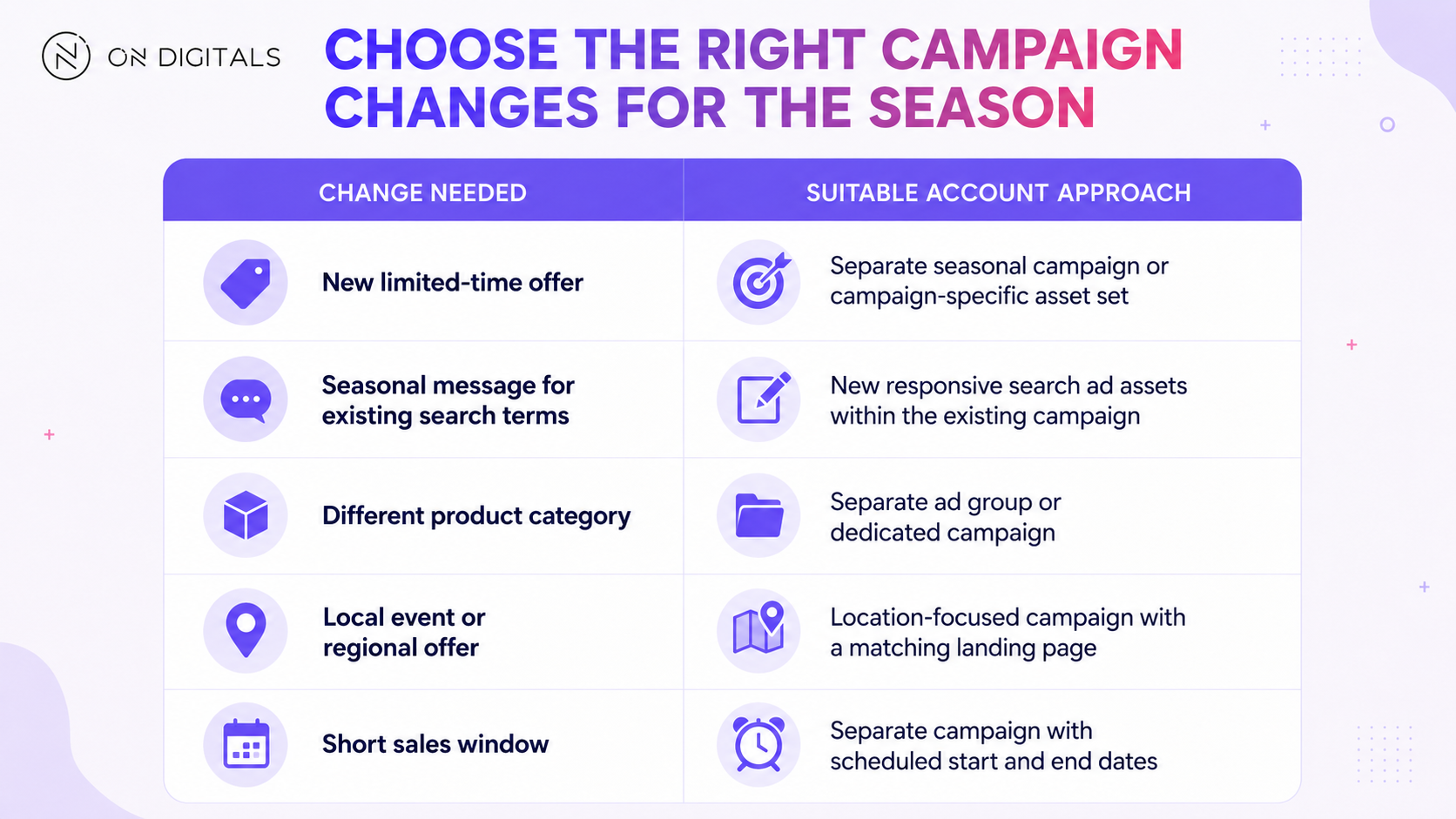 Match seasonal campaign changes to the right account structure, from fresh ad assets to dedicated campaigns.
Refresh ad copy without losing useful history
Seasonal messaging works best when it reflects a genuine customer need. This may be an earlier delivery date, a booking deadline, a limited bundle, or a time-sensitive service outcome.
Build fresh assets around the campaign instead of repeatedly overwriting evergreen messages. This keeps reporting cleaner and makes it easier to compare the seasonal version with usual account performance. It also gives audiences a reason to engage with a new message rather than seeing the same promotion too often, which can contribute to ad fatigue during longer seasonal periods.
Useful assets may include:
- Seasonal headlines
- Promotion assets
- Callouts
- Sitelinks
- Price assets
- Offer-specific visuals
Urgency should be factual. Countdown language only works when the deadline is real and the landing page confirms the same terms.
Adapt keywords, search terms, and negatives
Demand can shift into new language during a seasonal period. Searchers may add terms such as “gift”, “summer”, “last-minute”, “tax deadline”, or “back to school”. Search-term reports can reveal these patterns once the campaign begins.
At the same time, seasonal interest can bring irrelevant traffic. Review search terms more frequently during the peak window and add negatives when queries are clearly outside the offer.
Build remarketing audiences before the peak
Remarketing becomes more useful when the audience already exists. Start collecting qualified visitors before the main seasonal period, especially for products or services with longer decision cycles.
Useful segments can include:
- Product-page visitors
- Previous buyers
- Cart or form abandoners
- High-engagement visitors
- Newsletter subscribers
Early visitors may need education. As the season progresses, later visitors may respond better to reminders about availability, deadlines, or limited appointment slots.
Prepare landing pages, inventory, and conversion operations
A seasonal ad can attract the right click while the landing page loses the conversion. The page should reflect the same offer, product availability, and timing shown in the ad.
Check the following before launch:
|
Readiness area |
What to confirm |
|
Offer consistency |
Headlines, prices, codes, and conditions match the ads |
|
Inventory |
Promoted products remain available for the campaign period |
|
Delivery or booking terms |
Deadlines are visible before checkout or enquiry |
|
Mobile experience |
Pages load quickly and key actions are easy to complete |
|
Tracking |
Conversion actions record correctly before paid traffic increases |
|
Lead handling |
Sales or support teams can respond within an acceptable timeframe |
For lead-generation campaigns, form volume alone is not enough. Review whether calls are answered, enquiries are qualified, and appointments can be scheduled promptly.
Use automation and Smart Bidding carefully
Automation can reduce manual work during predictable windows. Campaign scheduling, budget rules, asset dates, and performance alerts are useful when the conditions are clearly defined. Teams using machine learning for campaign planning can also review how AI in PPC advertising supports tasks such as bid management, creative testing, and performance monitoring.
Smart Bidding can handle many normal shifts in seasonality. Google describes seasonality adjustments as an advanced tool for expected major conversion-rate changes, rather than a default setting for every recurring demand period. Current guidance positions them most clearly for short events of around one to seven days, while use beyond fourteen days may be less effective. Review Google’s seasonality adjustment guidance before applying one.
|
Situation |
Recommended approach |
|
Normal yearly demand rise |
Use historical performance, budgets, and Smart Bidding data |
|
Short sale with a clear expected CVR shift |
Consider a seasonality adjustment if the estimate is reliable |
|
Long seasonal period |
Monitor performance and adjust budgets rather than relying on one adjustment |
|
Sudden performance drop |
Check tracking, landing pages, stock, search terms, and auction changes |
|
Budget depletion risk |
Use alerts and pacing reviews during the live period |
Automation still needs oversight. A scheduled campaign can launch correctly while the landing page is broken, a product is out of stock, or CPC rises faster than expected.
Monitor seasonal PPC during the peak period
Peak-period monitoring should focus on decisions that protect profitability. Daily checks may be appropriate for short promotions. Longer periods may need a weekly rhythm with deeper analysis.
|
Area to monitor |
Why it matters |
|
Budget pacing |
Prevents proven campaigns from running out of spend too early |
|
Conversion rate |
Shows whether the offer and traffic remain aligned |
|
CPC and CPA |
Helps identify auction pressure or falling efficiency |
|
Search terms |
Reveals new demand patterns and irrelevant queries |
|
Impression share |
Indicates whether valuable demand is being missed |
|
Landing-page conversion rate |
Helps separate ad issues from page issues |
|
Stock or lead capacity |
Avoids paying for demand the business cannot fulfil |
Set escalation rules before launch. For example, the team may review a campaign immediately when CPA exceeds the acceptable range for two consecutive days, or when stock drops below a defined threshold.
Measure seasonal PPC by business model
The same metrics do not carry equal weight for every account.
|
Business model |
Priority metrics |
|
Ecommerce |
Revenue, ROAS, margin, average order value, stock availability |
|
Lead generation |
Qualified leads, CPA, booking rate, contact rate, sales capacity |
|
B2B |
Lead quality, pipeline value, cost per opportunity, assisted conversions |
|
Local services |
Calls, appointment rate, location-level demand, response time |
|
Awareness-led campaigns |
Reach, engaged visits, branded search trend, remarketing-pool growth |
ROAS can be useful for ecommerce and revenue-led campaigns, although the right target depends on margin, repeat purchases, fulfilment costs, and the role each channel plays in the buying journey. This guide on what is a good ROAS can help teams set a more realistic benchmark instead of treating one ratio as suitable for every campaign.
Compare performance against a relevant baseline. Year-over-year analysis is useful when the offer, product mix, budget, and tracking model are reasonably similar. Where conditions changed, document the difference so next season’s forecast is based on context rather than a misleading comparison.
Recover value after the peak window
A missed or completed seasonal period can still provide useful opportunities. Late buyers may respond to follow-up messaging. Remaining inventory may support a clearance campaign. Visitors who did not convert can enter a remarketing sequence with a different message.
Archive the lessons while they are still clear:
- Best-performing search themes
- Offer response
- Budget pacing
- Landing-page conversion behaviour
- Negative keywords
- Stock or lead-capacity issues
- Creative assets worth reusing
This record gives the next seasonal campaign a stronger starting point than a blank annual plan.
FAQs about seasonal PPC advertising
How early should seasonal PPC campaigns launch?
Launch timing depends on the buying cycle. Retail demand may build weeks before the purchase period, while a short promotion can need a tighter window. Historical search data, sales patterns, and audience-list readiness should guide the final date.
Should I create a separate campaign for a seasonal promotion?
A separate campaign is useful when the promotion has its own budget, keywords, landing page, or reporting requirement. Smaller changes may work within an existing campaign through new ad assets and focused ad groups.
When should I use a Google Ads seasonality adjustment?
Consider it when a short event is expected to create a major conversion-rate shift that Smart Bidding may not anticipate in time. Google positions the tool for limited periods rather than long seasonal demand cycles.
How much should I increase my seasonal PPC budget?
The right amount depends on expected CPC, conversion rate, target CPA or ROAS, margin, and business capacity. Forecast scenarios are safer than a universal percentage increase.
What happens when CPC rises but conversion rate does not?
Review auction pressure, search terms, offer strength, targeting, and landing-page performance. Budget may need to move toward more efficient campaigns until the economics improve.
Can B2B businesses benefit from seasonal PPC advertising?
Yes. B2B demand can follow budgeting cycles, procurement deadlines, industry events, or planning periods. Lower search volume does not always mean lower value, especially when buyer intent becomes more focused.
Conclusion
Seasonal PPC advertising performs best when campaign changes follow real demand rather than a generic holiday calendar. Historical data, commercial capacity, landing-page readiness, and clear profitability targets should shape the plan before spend increases.
Teams that forecast carefully can use peak periods to capture higher-intent demand while keeping control of budget, conversion quality, and operational readiness. Businesses that need support managing seasonal search campaigns, Smart Bidding, and budget pacing can explore Google Ads services from On Digitals.

NEWEST POSTS
- Advertising Industry In Vietnam: The 2026 Trends, Channels and Market-Entry Strategy
- Best SEO Company in Vietnam: Latest Shortlist For Businesses
- How To Leverage Social Media For Customer Service Like A Pro?
- Social Media Post Tips – 8 Ways To Boost Engagement
- How To Use Social Media for Sales – In-depth Beginner Guide
Read more