
PPC Platforms: Which Channel Fits Your Campaign?
Vincent
24/07/2025
11
PPC platforms can help businesses reach people who are ready to search, discover, compare, or buy. Some channels capture demand that already exists. Others introduce an offer before a customer starts researching. The right choice starts with where demand begins. Then review the page that receives traffic, the creative your team can sustain, and the conversion action that represents commercial value.
Google Ads, Meta Ads, LinkedIn Ads, Amazon Ads, TikTok Ads, and niche paid channels each solve different campaign problems. This guide helps you identify a sensible first platform, prepare the campaign properly, and decide whether the results justify a larger budget.
What are PPC platforms and why do they matter?
PPC platforms give advertisers a way to reach potential customers through paid placements. Search platforms can capture active demand. Social platforms can create product discovery. Marketplace ads can influence shoppers closer to purchase. Professional networks can support campaigns aimed at defined business audiences.
Each platform creates a different campaign environment. It affects the audience available to you, the creative format required, the destination page that needs to perform, and the type of result used to assess performance.
Emergency plumbing is usually search-led because customers look for help at the moment a problem occurs. By contrast, a new skincare product often needs visual education before its category becomes a search query. For B2B software, professional targeting can create early awareness among relevant job roles before those prospects begin comparing providers.
A simple definition
PPC stands for pay-per-click. In its strictest form, an advertiser pays when someone clicks an ad. Google Search campaigns are a familiar example because advertisers bid to appear for relevant searches.
The term “PPC platforms” is also used more broadly to describe paid advertising channels. These may include search advertising, paid social, retail media, video campaigns, and community placements. Campaigns can optimise toward clicks, video views, leads, purchases, app actions, or another defined objective. Billing methods can also vary by campaign type.
That distinction matters when selecting a platform. A low-cost click may generate little commercial value when the visitor has weak intent. A higher-cost click can still be worthwhile when it reaches the right buyer and the destination page answers the next question clearly.
How PPC platforms help businesses grow
Paid media can support different stages of the buyer journey. The role of each platform depends on whether people already know what they need or still need to discover why an offer matters.
|
Business need |
Platform role |
Example |
What should be ready |
|
Capture active demand |
Search advertising |
A user searches for a local service or product category |
Intent-led landing page plus conversion tracking |
|
Create early awareness |
Social or video advertising |
A new product needs explanation before buyers search |
Strong creative supply plus a clear offer |
|
Re-engage warm visitors |
Retargeting |
A visitor views a product page but does not enquire |
A relevant message based on page behaviour |
|
Reach professional buyers |
B2B paid media |
A software company wants to reach operations leaders |
Defined job-role criteria plus CRM feedback |
|
Support marketplace purchases |
Retail media |
A seller needs visibility inside a shopping environment |
In-stock products plus complete product detail pages |
For local services, Google Ads often offers the clearest starting point because customers may already be searching for a solution. New consumer products tend to need Meta Ads or TikTok Ads earlier in the journey, when buyers still need to see the offer before they search. In B2B, LinkedIn can introduce a high-value offer to relevant professional audiences, while search campaigns capture later research demand.
The strongest platform choice comes from the commercial situation rather than from a channel’s popularity.
Top PPC platforms to know and when to use them
Each PPC platform has a different demand environment. Google Ads can capture searches. Meta Ads can create visual discovery. LinkedIn Ads can reach audiences through professional attributes. Amazon Ads can support marketplace purchases. Start with the buyer’s context, then assess whether your team can support the required page, creative, tracking, and reporting work.
Start here: which PPC platform should you test first?
This matrix offers a starting point. It does not rank platforms or guarantee campaign performance. Market conditions, offer strength, creative quality, landing-page readiness, and conversion data still shape the result.
|
Business situation |
First platform to consider |
Why it may fit |
Prepare before launch |
|
Local service with active search demand |
Google Ads |
Buyers may already search for a solution |
Service page, call tracking, form tracking, negative-keyword process |
|
B2B with defined job roles |
LinkedIn Ads plus Google Ads |
Professional targeting can build early interest while search captures active research |
Clear offer, lead qualification rules, sales follow-up process |
|
DTC product with visual proof |
Meta Ads or TikTok Ads |
Creative can build demand before search begins |
Asset pipeline, product page, creative refresh process |
|
Marketplace seller |
Amazon Ads |
Shoppers are already browsing inside the marketplace |
In-stock products, strong detail pages, margin visibility |
|
App promotion |
Apple Search Ads or app-focused placements |
Users are already in an app-discovery environment |
Store listing, measurement setup, retention signal |
|
Niche community product |
Reddit Ads or selected community placements |
Context can matter more than broad reach |
Community research, value-led message, moderation awareness |
Google Ads: best for capturing active search demand
Google Ads is often a practical starting point when people already search for the product, service, category, or problem you solve. Search campaigns can place an offer in front of users who are comparing providers, looking for pricing, or trying to solve an immediate need.
This platform can work well for local services, ecommerce categories, high-consideration B2B solutions, and businesses with established search demand. Someone searching for “accounting software for construction companies” has different intent from someone scrolling through social content. That difference changes the message, destination page, and likely conversion path.
Use it when:
People already search for a relevant product, service, problem, or comparison.
Prepare before launch:
Build a landing page that matches search intent. Set up meaningful conversion actions. Create a process for reviewing search terms and excluding irrelevant traffic.
Google Ads conversion goals organise conversion actions around advertising objectives. A campaign can optimize toward a relevant lead, purchase, or another defined action when the conversion setup reflects the commercial outcome you actually value. Review Google Ads’ conversion-goal guidance before deciding which actions should guide bidding.
A clinic may receive calls from a search campaign. The page owner still needs to keep service details, location information, booking options, and contact paths accurate. A paid-media specialist can improve keyword targeting, while the business needs to make the destination page useful after the click.
Search campaigns can become expensive in competitive categories. That does not automatically make Google Ads a poor fit. The more relevant question is whether qualified leads, sales value, or margin contribution can justify the cost.
Meta Ads: best for visual discovery and retargeting
Meta Ads can help businesses create demand through visual storytelling, product education, offer testing, and retargeting. Facebook and Instagram give brands several ways to reach audiences through feed placements, Stories, short-form video, Messenger, and other available formats.
A strong Meta campaign usually needs more than one polished image. It needs a repeatable creative process. A brand may use product demonstrations. It may use customer-led content. It may also use creator-style video or a new offer angle. Each route needs a message that remains relevant as campaign frequency rises.
Use it when:
The product benefits from visual explanation, social proof, lifestyle context, or retargeting.
Prepare before launch:
Create enough asset variation to support testing. Match the ad promise to the product page. Assign a content owner who can refresh weak creative without delaying the campaign.
Meta Ads can support consumer brands, but the platform is not limited to B2C activity. A B2B company may use Meta for remarketing, webinar promotion, employer branding, or lead generation. The fit depends on the offer and audience behaviour rather than a simple industry label.
Creative fatigue deserves attention early. A campaign can lose efficiency when the same message keeps reaching the same people. A structured ad-fatigue review can help the team decide whether the next change should sit in creative, targeting, or the offer itself.
Microsoft Ads: useful for incremental search coverage
Microsoft Ads can extend search coverage beyond Google across Microsoft-owned search experiences and partner placements. It may suit businesses that already have a disciplined search structure and want to test additional demand without treating the platform as a direct copy of Google Ads.
The opportunity becomes more useful when the business has an established search programme, clear conversion tracking, and enough capacity to compare results by platform. A team that cannot maintain one search account carefully should resolve that operating issue before expanding into another.
Use it when:
Search demand matters and the campaign already has a reliable Google Ads foundation.
Prepare before launch:
Review campaign settings, bids, match types, extensions, audience settings, and reporting separately. Treat imported campaigns as a starting point for setup rather than a finished optimisation strategy.
Microsoft Advertising supports importing campaigns from Google Ads. The import process can save time, while the account still needs platform-specific review after launch. See Microsoft Advertising’s Google Ads import guidance for the current workflow.
A campaign that performs well in Google may still require different bidding decisions or budget levels in Microsoft Ads. The final decision should follow qualified outcomes rather than the convenience of an import.
LinkedIn Ads: best for professional targeting and B2B demand generation
LinkedIn Ads can help B2B businesses reach people through professional attributes such as job title or company. This makes the platform useful when the buying committee is identifiable and the offer has enough value to justify a more deliberate lead-generation path.
The channel can support demand generation before a buyer searches. A cybersecurity company may promote a research guide to IT leaders. A consulting firm may invite operations directors to a workshop. A software provider may use a problem-led report to begin a conversation with a defined account list.
Use it when:
The buyer can be described through professional attributes and the business can follow up on leads quickly.
Prepare before launch:
Define the offer. Agree on lead-quality rules. Ensure the sales or CRM owner can report whether submitted leads become relevant conversations.
LinkedIn’s advertising tools use member-generated professional data, including company, job title, industry, and seniority. LinkedIn’s targeting guidance explains how these attributes can support audience selection.
Higher click costs can be acceptable when the campaign reaches a valuable audience and the business can measure downstream quality. A cheap lead form that produces poor-fit contacts does not create a stronger result than a higher-cost campaign that produces useful sales conversations.
This issue appears regularly in B2B accounts. A campaign may generate high form volume while sales rejects most contacts. The next priority may involve refining qualification questions, improving the offer, or tightening audience criteria. More budget can amplify the wrong result when those foundations remain weak.
Amazon Ads: best for marketplace-ready product sellers
Amazon Ads can help sellers reach shoppers inside Amazon’s buying environment. Sponsored Products campaigns appear where people compare products and can lead shoppers directly to a product detail page. That gives Amazon Ads a different role from Google Search or social discovery.
The platform fits businesses that already sell through Amazon and have enough operational control over availability, detail-page quality, pricing, reviews, and margin. Ads can increase visibility, while the product page still needs to earn the conversion.
Use it when:
The product is actively available on Amazon and the marketplace is a meaningful sales channel.
Prepare before launch:
Check stock availability. Improve product detail pages. Review images, product titles, descriptions, pricing, reviews, and margin before increasing media spend.
Amazon explains that Sponsored Products direct shoppers to product detail pages and that advertised items need to remain in stock to appear. Its Sponsored Products best-practice guidance also highlights the importance of the product page after the click.
Marketplace advertising can become inefficient when stock is unreliable or product content is incomplete. A campaign may attract qualified shoppers, while weak information or low availability prevents the buyer from completing the purchase.
TikTok Ads: best for native short-form creative and product discovery
TikTok Ads can support discovery when the brand has a product, message, or story that works in short-form video. The platform is often associated with younger audiences, yet age alone should not decide whether a business uses TikTok. Creative readiness, offer fit, product category, and mobile destination quality carry more weight.
TikTok campaigns usually need a production rhythm. A brand may use founder-led product demos. It may use customer footage. Creator content can also work when it feels credible in the feed. Each format needs a clear opening and a message that users can understand quickly.
Use it when:
The team can produce native video content repeatedly and the offer can be understood quickly on mobile.
Prepare before launch:
Set up a vertical-video workflow. Assign a content owner. Build a mobile-first page. Create a refresh plan before fatigue becomes visible.
TikTok’s own creative guidance emphasises native video structure, authentic presentation, and scalable creative production. TikTok Creative Codes provide practical principles for building ads that suit the platform.
A campaign may deliver strong view metrics while creating weak commercial outcomes if the page cannot continue the message. A video may promise a simple solution, while the product page opens with technical language, unclear pricing, or a slow checkout. The page template then becomes part of the campaign problem.
Niche and emerging PPC platforms
Niche platforms can be useful when audience behaviour fits a specific environment. They work best when the business has a clear reason to use the channel rather than treating it as a low-cost substitute for Google or Meta.
|
Platform or channel |
Consider it when |
Main constraint |
|
Pinterest Ads |
The product benefits from inspiration, planning, home, fashion, food, travel, or visual search behaviour |
Creative needs to fit aspirational browsing |
|
Reddit Ads |
The offer has relevance to a defined interest community or discussion topic |
Community context requires careful message framing |
|
Apple Search Ads |
The business promotes an app and needs visibility within App Store search |
Store listing quality and retention matter after install |
|
X Ads |
The campaign depends on timely conversation, live events, or fast-moving commentary |
Audience relevance can shift quickly |
|
Retargeting platforms |
Website visitors need a follow-up message after meaningful page behaviour |
Audience size and page-event quality can limit scale |
|
Native advertising networks |
Content-led offers need discovery outside major social feeds |
The landing page must provide genuine editorial value |
The selection should still return to the buyer journey. A visually rich home product may fit Pinterest. A technical product with a dedicated community may fit Reddit. An app can benefit from App Store search. Each option needs a purpose that connects directly to commercial value.
Choosing the right PPC platform: what to consider first
Platform selection becomes clearer when the business starts with demand source, conversion path, creative capacity, and operational ownership. The first question is rarely “Which platform has the lowest CPC?” A stronger question asks where the buyer is in the journey and whether the team can support the campaign after a person clicks.
Define your audience and ad goals
Audience definition should go beyond age, location, and interests. Consider how the buyer encounters the problem. Some people search for an answer immediately. Others discover a product through a video, a professional insight, or a marketplace recommendation.
|
Buyer situation |
Likely platform direction |
Key question |
|
The buyer actively searches for a solution |
Google Ads or Microsoft Ads |
Which search terms show commercial intent? |
|
The buyer needs to discover the product first |
Meta Ads or TikTok Ads |
Can creative explain why the product matters quickly? |
|
The buyer holds a defined professional role |
LinkedIn Ads |
Can sales identify qualified leads after capture? |
|
The buyer compares products inside a marketplace |
Amazon Ads |
Is the product detail page ready to convert? |
|
The buyer participates in a focused interest community |
Reddit Ads or another niche channel |
Does the message provide useful value in that context? |
Urgent plumbing searches tend to make Google Ads the clearest starting point. For wellness products entering a new category, Meta Ads or TikTok Ads can create visual discovery before demand becomes search-led. In B2B software, LinkedIn can put a problem-led offer in front of relevant roles, while Google Search can capture later category research.
Market-entry campaigns need one further layer of context. Before choosing a first paid channel for Vietnam, review the wider Vietnam ad market and assess how local audience behaviour may affect the campaign’s channel role, message, and destination page.
The campaign objective should be equally specific. “More awareness” gives limited direction. A stronger objective identifies the desired user action, the page that supports it, and the person responsible for approving changes.
Budget matters, but business value matters more
CPC can be useful as a cost signal. It cannot determine platform quality by itself. A low CPC may simply indicate that the campaign reached users with weak buying intent. Meanwhile, a high CPC may still be commercially sound when the audience has strong potential value and the business can track that value through the sales process.
Use metrics that reflect the campaign’s intended business outcome.
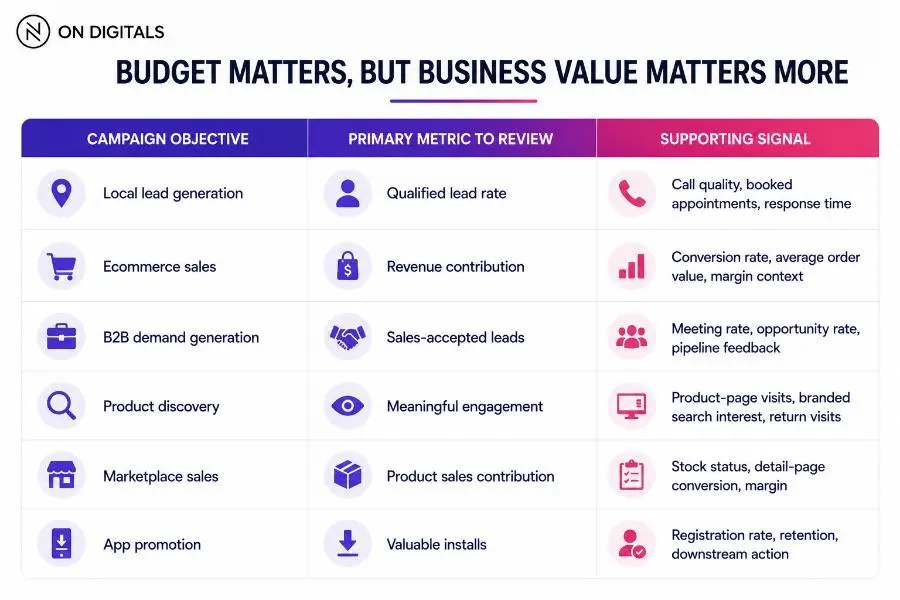 Match each campaign objective with the metrics that best reflect its commercial value.
For ecommerce activity, a profitable ROAS can provide a useful guardrail when conversion value is reliable. Margin, returns, and repeat-purchase behaviour still need consideration before ROAS becomes the basis for a scale decision.
A campaign report should help the business decide what to change next. Clicks and impressions matter as diagnostics. They rarely provide the final commercial answer.
Consider a campaign with strong click-through rate and weak form completion. The issue may sit in the landing page rather than the media account. Another campaign may have low lead cost, while sales finds that most contacts are outside the target profile. Audience definition or lead qualification needs attention before the team expands spend.
Know your industry and funnel stage
Industry affects the buying journey, although platform selection should not rely on broad stereotypes. A local service, a B2B SaaS company, a DTC brand, and a marketplace seller each face different demand patterns.
|
Business type |
Starting platform direction |
Why |
|
Local service |
Google Ads |
Users often search when they have an immediate need |
|
B2B SaaS |
LinkedIn Ads plus Google Ads |
Professional targeting can create early demand while search can capture active research |
|
DTC brand |
Meta Ads or TikTok Ads |
Visual creative can build product awareness before category search begins |
|
Marketplace seller |
Amazon Ads |
The shopper is already comparing products inside the marketplace |
|
Mobile app |
Apple Search Ads or app campaigns |
The user is already in an app-discovery path |
|
Specialist product |
Reddit Ads or niche communities |
The buyer may rely on community knowledge before considering a purchase |
Funnel stage changes the role of each platform. Search often supports high-intent capture. Social video can introduce a product earlier in the journey. Retargeting can support people who have already visited a key page. A platform can support more than one stage, while the message and success metric should change as the user moves forward.
Demand patterns should also shape the test window. A retailer testing a new channel during a major promotion should avoid judging performance against a quiet-month baseline. Planning around seasonal PPC helps the team separate a temporary peak from a channel that can perform throughout the year.
What needs to be ready before you test a platform?
A platform test needs an operating foundation. Paid media can create traffic quickly, while delays in the destination page, creative process, or tracking layer can prevent the business from learning anything useful.
|
Readiness area |
What to check |
Responsible owner |
|
Offer clarity |
The customer benefit, price context, proof, and next step are clear |
Commercial owner |
|
Landing page |
The page matches the ad promise and supports the intended conversion |
Page owner |
|
Conversion tracking |
Relevant actions are measured and validated before budget increases |
PPC owner plus technical owner |
|
Creative supply |
The team can produce, refresh, or approve assets at the required pace |
Content owner |
|
CRM feedback |
Sales can identify which leads are qualified |
Sales or CRM owner |
|
Reporting |
A recurring review connects platform data with business outcomes |
Marketing lead |
For a lead-generation campaign, the affected template may be a service page with a short enquiry form. A technical owner needs to confirm that form submissions are tracked correctly. The commercial owner needs to decide which enquiries are valuable. The PPC owner then uses those signals to optimise the account responsibly.
Creative readiness changes by channel. Google Search may rely on strong ad copy and a relevant page. Meta Ads may need several visual variations. TikTok may need a steady vertical-video workflow. LinkedIn may need a professional offer that gives the buyer a clear reason to share contact details.
Campaign execution may involve owners in different markets. When the commercial team, technical owner, and paid-media specialist work across locations, a documented time-zone workflow helps set approval windows, escalation routes, and reporting expectations before spend begins.
How to run a controlled 30-day platform test
A 30-day test does not guarantee enough time for every campaign to mature. It provides a disciplined review point. The purpose is to confirm whether the platform, audience, page, and measurement model are producing credible learning.
|
Test stage |
What to check |
Primary owner |
Business impact |
|
Before launch |
Demand source, campaign objective, landing page, conversion event |
Marketing lead |
Prevents spend against an unclear user path |
|
Week one |
Delivery issues, tracking accuracy, keyword relevance, audience relevance |
PPC owner |
Reduces false performance signals |
|
Weeks two to three |
Creative response, search-term quality, page friction, lead quality |
PPC owner plus page owner |
Shows whether the issue sits in media or on the destination page |
|
Day 30 review |
Qualified outcomes, cost trend, budget fit, next test |
Commercial owner |
Supports a scale, redesign, or stop decision |
The review should answer a few practical questions. Did the platform reach the intended audience? Did the page continue the ad message? Did the conversion event represent value to the business? Can the team make the next improvement without waiting weeks for approval?
Automation can support the review process by surfacing unusual delivery patterns, identifying weaker creative, or reducing repetitive account work. Human review still needs to connect those signals with the offer, landing page, and sales feedback. See how AI in PPC can support account review without replacing commercial judgment.
Some teams have the in-house capacity to run this process. Others need specialist support for tracking, campaign structure, or daily account management. Teams weighing that option can consider whether to outsource PPC before handing over account work.
When the result remains unclear, more budget rarely fixes the underlying issue. A revised offer, a stronger page, a better qualification rule, or a new creative route may provide a more useful next test.
Frequently asked questions about PPC platforms
Should I start with Google Ads or Meta Ads?
Google Ads is often a better starting point when people already search for the product, service, or problem you solve. Meanwhile, Meta Ads can be a stronger first test when the product needs visual discovery, social proof, or retargeting. Review demand source, landing-page readiness, and creative supply before using budget size alone to make the decision.
Which PPC platform is best for B2B lead generation?
LinkedIn Ads can support B2B demand generation when the buyer can be targeted through professional attributes and the business has a valuable offer. Google Ads can capture later-stage research when prospects actively search for a solution. Many B2B teams use both platforms for different roles, then assess success through sales-qualified leads rather than form volume alone.
Does a lower CPC mean a PPC platform is better?
A lower CPC only shows that each click costs less. It does not confirm that the traffic has commercial intent or that sales will accept the resulting leads. Review qualified lead rate, conversion value, pipeline feedback, or margin context alongside click cost. A higher CPC can still support stronger commercial outcomes.
Can a small business test more than one PPC platform at once?
A small business can test more than one platform when it has enough budget, creative capacity, and time to interpret results. One controlled platform test is usually easier to manage when resources are limited. Add a second channel after the first campaign has reliable tracking, a working page, and a clear review process.
What should be ready before launching ads on a new platform?
The business should have a clear offer, a relevant landing page, a defined conversion action, and an owner for technical or content changes. Social and video platforms also need an asset pipeline. B2B campaigns need feedback from sales or CRM. Marketplace advertising needs accurate product content plus reliable stock availability.
Conclusion
The right PPC platform supports the way customers discover, compare, and act on your offer. Search platforms can capture demand that already exists. Social platforms can create attention before search begins. Marketplace channels can support shoppers close to purchase. B2B platforms can connect a specialist offer with a defined professional audience.
Start with one platform that fits the business situation. Prepare the destination page and conversion tracking before launch. Assign clear owners for creative, technical fixes, and commercial feedback. The next budget decision can then rest on useful evidence instead of channel preference alone.
For businesses that need support turning a platform decision into an accountable paid-media programme, explore PPC management from On Digitals.

NEWEST POSTS
- Advertising Industry In Vietnam: The 2026 Trends, Channels and Market-Entry Strategy
- Best SEO Company in Vietnam: Latest Shortlist For Businesses
- How To Leverage Social Media For Customer Service Like A Pro?
- Social Media Post Tips – 8 Ways To Boost Engagement
- How To Use Social Media for Sales – In-depth Beginner Guide
Read more