
How to Overcome Ad Fatigue and Improve Campaign Efficiency
Vincent
01/10/2025
31
Ad fatigue happens when people see the same advertising message often enough that they stop responding to it. Click-through rate may decline, conversion quality can weaken, and cost per action may rise. To overcome ad fatigue, start by identifying whether the decline comes from creative repetition, audience saturation, changing demand, or another campaign issue.
The pattern can look different across ad platforms, since search, social, display, and remarketing campaigns use different formats and delivery controls. A strong response combines fresh creative, better audience decisions, and regular performance review.
What is ad fatigue?
Ad fatigue is a gradual loss of audience interest caused by repeated exposure to the same ad message or creative concept. It often appears when a campaign continues serving similar headlines, visuals, offers, or video hooks to a limited audience for too long.
This issue can affect social campaigns, display activity, remarketing, video advertising, and even search campaigns when the message no longer matches what users need. The impact varies by platform. A broad awareness campaign may tolerate repeated exposure for longer, while a narrow retargeting audience can become saturated much sooner.
An ad may perform well when it is new, then become less effective as the audience grows familiar with it. The challenge is recognising when the message has reached its useful limit and whether fatigue is actually the reason behind weaker results.
How to spot ad fatigue in ad campaigns
Performance declines can point to ad fatigue, although they may also reflect a landing-page issue, a pricing change, stronger competition, or a shift in demand. Reviewing several signals together helps teams avoid applying the wrong fix.
Is it ad fatigue or another performance issue?
|
Signal |
Ad fatigue may be involved when… |
Check before changing creative |
|
CTR declines |
Frequency rises while targeting and offer remain stable |
Seasonality, audience changes, competitor activity |
|
CPA rises |
Engagement and conversion rate weaken together |
Landing-page speed, tracking, pricing, stock, sales follow-up |
|
Engagement falls |
Comments, video retention, saves, or shares drop over time |
Content relevance, audience stage, format trends |
|
Frequency rises |
The audience pool is narrow and the same creative keeps running |
Remarketing overlap, exclusions, campaign objective |
|
Conversion rate falls |
Users still click but stop taking action |
Offer clarity, checkout friction, booking availability, website errors |
Creative-performance platforms often recommend reviewing the creative, targeting, seasonality, and competitive environment together before blaming fatigue alone.
Before refreshing an asset, also consider whether seasonal PPC changes have shifted search behaviour, purchase timing, or the audience’s immediate priorities.
Decreased click-through rate
A falling CTR can be an early sign that the creative has lost its ability to attract attention. Compare it with the campaign’s own baseline instead of relying on a universal benchmark. CTR varies widely by platform, objective, audience, industry, and format.
A useful pattern to watch is rising frequency paired with a declining CTR across the same audience segment while the creative remains unchanged. This combination suggests people may be seeing the message too often.
Decreased conversion rate
Clicks can remain stable while conversions fall. In this situation, the ad may still attract interest, but the message may no longer create enough motivation to act.
Check the full journey before refreshing the asset. A landing page may have slowed down, an offer may have changed, or stock may be limited. Lead-generation campaigns should also review response time and lead quality. A form submission has less value when the sales team cannot contact the prospect promptly.
Increased cost per action
CPA may increase when engagement weakens and conversion quality falls at the same time. It can also rise because auction competition becomes more expensive, even when the creative is still relevant.
Look for changes across several metrics before moving budget. A sudden CPA increase with stable CTR may point toward a conversion or landing-page issue. Rising CPA combined with higher frequency and weaker engagement is more consistent with fatigue.
Reduced engagement and negative feedback
Social campaigns can reveal fatigue through fewer comments, lower video retention, reduced shares, negative reactions, or ad hides. These signals matter because they show how the audience is responding to the message itself.
Beyond click metrics, watch for falling engagement, weaker conversion activity, higher cost, and negative audience feedback. Together, these signals can show whether the message is losing relevance for the audience.
Why ad fatigue affects campaign performance
Repeated messaging can reduce the value of every impression. The audience becomes more familiar with the creative, which makes it easier to ignore. As response falls, platforms may need more spend to generate the same number of meaningful actions.
The commercial impact can include:
- Lower CTR or weaker video engagement
- Higher CPM, CPC, or CPA
- Reduced conversion quality
- Lower return on ad spend
- Negative brand perception among heavily exposed users
A campaign does not need to be paused at the first sign of decline. Diagnose the source first, then apply the smallest change that can restore performance.
Common causes of ad fatigue
Creative repetition is a major cause, especially when the same visual, hook, or value proposition runs for an extended period. Audience saturation can accelerate the problem when the campaign targets a small or highly specific group.
Other causes include:
- A message that does not match the audience’s stage of awareness
- Platform delivery concentrating spend on one winning asset for too long
- Campaigns running through a seasonal shift without adapting
- Limited creative variety during a long promotion
- Retargeting audiences repeatedly seeing the same offer
- Weak exclusions after a user has already converted
Frequency alone does not cause fatigue in every situation. A relevant message may remain useful across several touchpoints. Friction increases when people repeatedly see an offer that does not fit their needs or stage in the journey.
Effective ways to overcome ad fatigue
Refresh creative content strategically
Changing every element at once makes it hard to understand what restored performance. A better process refreshes the most fatigue-prone element first, then moves toward larger changes if results do not recover.
Use a creative refresh ladder
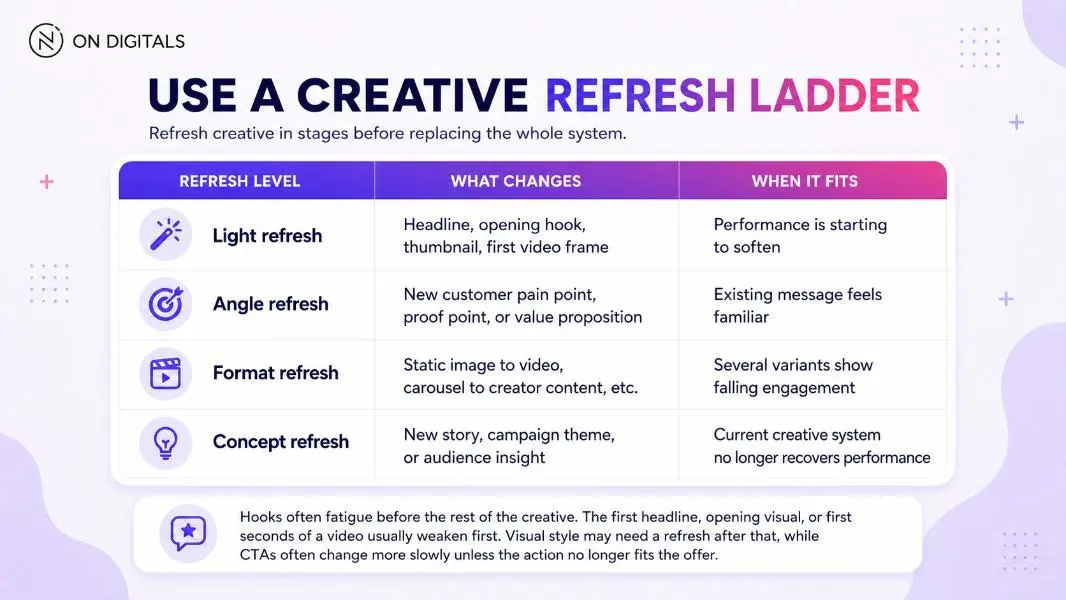 Refresh creative in stages, from light updates to full concept changes, as engagement and performance start to decline.
Hooks often fatigue before the rest of the creative. The first headline, opening visual, or first seconds of a video determine whether users continue engaging. Visual style may need a refresh after that. CTAs usually change more slowly, unless the current action no longer fits the offer.
Test creative modules instead of guessing
Modular testing helps teams identify the element that is losing impact. Keep most of the message stable, then test one component at a time.
|
Creative module |
Example test |
|
Hook |
“Save time” versus “avoid costly mistakes” |
|
Proof |
Customer testimonial versus product demonstration |
|
Visual |
Product close-up versus lifestyle context |
|
Offer |
Free consultation versus limited bundle |
|
CTA |
Get a quote versus see how it works |
This method gives the team clearer learning. When every element changes at once, performance may improve without revealing why.
Match creative to audience stage
Audience size is only part of the targeting decision. The message also needs to reflect how familiar people are with the brand.
|
Audience stage |
Creative focus |
|
New audience |
Problem awareness, education, category context |
|
Engaged visitor |
Product explanation, proof, use case, comparison |
|
High-intent prospect |
Offer details, testimonials, product demo, consultation |
|
Existing customer |
Retention message, complementary product, loyalty benefit |
People who are new to the brand often need a clear explanation of the problem being solved. Returning visitors may respond better to proof that the offer fits their needs, whether through product detail or a clearer reason to act. Messaging that reflects this level of awareness makes repeat exposure feel more relevant.
Optimise your audience without overexpanding
Audience expansion can reduce pressure on a small group, while broader targeting should still make commercial sense. Add new segments carefully and review lead quality or conversion value after the change.
Useful actions include:
- Exclude people who have already converted
- Separate recent visitors from older remarketing pools
- Create different creative for high-intent and low-intent segments
- Test lookalike or similar audiences where the platform supports them
- Review overlap between remarketing campaigns
A smaller audience may need more frequent creative rotation. Larger audiences often allow a longer testing window, although the right schedule depends on spend, objective, and platform behaviour.
Allocate budget after diagnosis
Budget shifts can help protect efficiency, but they should follow diagnosis rather than replace it. Moving spend away from a weak campaign makes sense when the decline is confirmed. A broader market change may require a different response.
For revenue-led campaigns, check whether the account is still meeting a good ROAS before treating a weak creative result as the sole reason to reduce spend.
For example, a campaign with rising frequency, lower CTR, and higher CPA may justify a gradual budget reduction while fresh creative is tested. If CTR is stable but conversion rate falls, investigate the landing page or offer before reducing media investment.
Use platform features with clear guardrails
Advertising platforms offer dynamic creative, automated delivery, campaign recommendations, and bidding tools that can reduce manual work. These features can also create risk when delivery concentrates around a small group of winning assets.
Use automation as an alert system and a testing assistant rather than a set-and-forget solution.
Before enabling automated features, confirm:
- Budget limits are defined
- Conversion tracking reflects genuine business value
- Generated assets are reviewed before launch
- Frequency controls are available and suitable for the campaign
- Search terms or placement reports are checked regularly
- Creative performance is reviewed by audience segment
Teams can also use AI in PPC to spot declining creative response, group performance patterns, and prepare early variations for review. The final decision should still consider brand fit, lead quality, and the commercial value behind each conversion.
Build campaigns that resist fatigue from the start
A fatigue-resistant campaign is built around regular creative testing instead of waiting for results to collapse. A simple weekly review can keep teams ahead of obvious performance decline.
Use a weekly creative and media review
Set aside 15 to 30 minutes each week to review:
- Frequency trends
- CTR and conversion rate movement
- CPA or ROAS changes
- Search terms or placement quality
- Engagement by creative variation
- Audience-level performance
- Signs of seasonal or competitive changes
After the review, choose one action:
- Keep the current creative
- Apply a light refresh
- Test a new message angle
- Pause a fatigued asset
- Investigate landing-page or tracking issues
This process gives media buyers and creative teams a shared view of what is happening. It also reduces the chance of replacing ads based on instinct alone.
FAQs about how to overcome ad fatigue
Does a lower CTR always mean ad fatigue?
No. CTR can decline because of competition, audience changes, seasonality, or a weaker offer. Frequency trends, creative engagement, landing-page performance, and conversion data should be reviewed together.
How often should ad creative be refreshed?
There is no universal timing rule. Smaller audiences and fast-moving platforms may need more frequent updates. Larger awareness campaigns can often run longer. Use performance signals and audience response to decide when a refresh is needed.
Can Google Search ads experience ad fatigue?
Yes, although it can appear differently from social creative fatigue. Search campaigns may see weaker response when the same offer, ad message, or asset no longer matches changing user intent. Search terms, auction conditions, and landing-page relevance should be reviewed before replacing ads.
What is the difference between creative fatigue and audience saturation?
Creative fatigue happens when people lose interest in the message or execution. Audience saturation happens when the campaign keeps reaching the same limited group. Both issues can occur together, although they may need different fixes.
Should small audiences use tighter frequency controls?
Small audiences often need closer frequency monitoring because repeated exposure builds quickly. The right control depends on the platform, campaign objective, offer relevance, and available reach.
When should a brand test a new concept instead of refreshing an existing ad?
A new concept is useful when lighter changes no longer restore performance. This may involve a different customer problem, proof point, visual style, or campaign theme.
Can AI help detect ad fatigue early?
AI can help identify performance changes and surface patterns across creative assets. Final decisions still need human review because performance shifts may come from demand, tracking, audience quality, or commercial changes outside the ad itself.
Conclusion
To overcome ad fatigue, teams need to identify whether creative repetition is actually causing the decline before changing campaigns. A more reliable process combines creative refreshes, audience-stage messaging, and regular performance review.
Businesses that need support with creative testing, audience controls, and paid social performance can explore Meta advertising services from On Digitals.

NEWEST POSTS
- Advertising Industry In Vietnam: The 2026 Trends, Channels and Market-Entry Strategy
- Best SEO Company in Vietnam: Latest Shortlist For Businesses
- How To Leverage Social Media For Customer Service Like A Pro?
- Social Media Post Tips – 8 Ways To Boost Engagement
- How To Use Social Media for Sales – In-depth Beginner Guide
Read more