
Domain Authority Score: Check Website Strength Against Competitors
On Digitals
27/01/2026
31
A Domain Authority score is Moz’s 1–100 metric for estimating the relative ranking strength of a domain. It works best when you compare direct search competitors within the same tool. The score reflects patterns in a site’s link profile, which is why valuable backlinks tend to carry more strategic value than a large volume of unrelated references.
Check your Domain Authority score before planning the next SEO move
A Domain Authority score becomes useful after you compare it with the websites competing for your priority queries. Run the same check for your domain and three to five direct competitors, then review the link data behind each result.
The score alone cannot explain why a page ranks. Referring domains, page-level links, search intent, and organic visibility provide the context needed to make a decision.
|
Field to review |
Why it matters |
|
Domain Authority score |
Shows relative strength within Moz’s model |
|
Referring domains |
Indicates the breadth of the link profile |
|
Link-growth trend |
Highlights steady growth or recent loss |
|
Competitor score |
Creates a realistic comparison point |
|
Topic relevance |
Shows whether the benchmark is meaningful |
|
Organic visibility |
Tests whether authority aligns with search performance |
New domains may return limited data at first. A recent launch, a small backlink footprint, or delayed index coverage can all affect the result. In those cases, check Google Search Console, review live links, and compare the search results before treating the score as final.
What does a Domain Authority score mean?
A Domain Authority score estimates the relative ability of a domain to compete in search results. Moz created the metric using its own link index and predictive model, so it should be used as a comparison tool rather than a direct statement of how Google evaluates a website.
Domain Authority is a comparative Moz metric
Moz calculates DA on a logarithmic scale from 1 to 100. Moving from 20 to 30 is usually easier than moving from 70 to 80 because strong domains cluster within a much narrower range near the top.
The best comparison set includes websites targeting similar audiences and competing for similar search demand. A niche B2B website may have a lower score than a global publisher while still performing well for focused industry queries. Moz describes Domain Authority as a comparative prediction metric, which is why competitor context matters more than a standalone number.
Domain Authority is not a Google ranking factor
Google does not publish Domain Authority as a ranking signal. DA belongs to Moz, so a higher score does not directly cause a page to rank better.
Google can use links to discover pages and understand connections between content. Its SEO link best practices explain why crawlable links and descriptive anchor text help search engines understand destinations.
A lower-DA website can still outrank a stronger domain when its page matches search intent more closely. Clearer coverage, better page-level references, and a stronger answer can close a broad domain-level gap for a focused query.
Why your DA can change without major website updates
DA may move when Moz refreshes its index or updates the model behind the score. Competitor movement can also affect the comparison because authority is relative.
Small fluctuations rarely justify an immediate reaction. Instead, compare your trend against the same competitor set. When every domain shifts in a similar direction, the movement may reflect a wider recalculation rather than a problem with your website.
Domain Authority vs Domain Rating vs Authority Score
Domain Authority, Domain Rating, and Authority Score use similar 1–100 scales. Their numbers should not be compared directly because each provider uses a different index, formula, and update process.
|
Metric |
Provider |
Best use |
Important limit |
|
Domain Authority |
Moz |
Comparing domains inside Moz |
It is not a Google metric |
|
Page Authority |
Moz |
Comparing the relative strength of a URL |
It does not describe the full domain |
|
Domain Rating |
Ahrefs |
Reviewing backlink-profile strength |
A DR score cannot equal a DA score |
|
Authority Score |
Semrush |
Broad domain screening |
It uses a different model from Moz |
Use one tool consistently during a benchmark. Switching between platforms can create false conclusions because a score of 50 in one tool has no fixed relationship with a score of 50 in another.
Is your Domain Authority score good enough?
A useful Domain Authority score gives you a realistic view of the websites already winning visibility for your target queries. Fixed score bands can be misleading because a DA of 25 may be competitive in one niche while a DA of 60 may still struggle in another.
Start by reviewing direct search competitors. Include domains that rank regularly for your priority topics. Leave out major publishers that only overlap on one broad term, since they can distort the benchmark.
Use the DA gap to choose a practical next step
|
Your position against competitors |
What it may indicate |
Recommended next action |
|
Similar DA |
Domain strength may not be the main issue |
Improve search intent match and page usefulness |
|
Lower DA, narrow topic |
A focused page can still compete |
Target long-tail variations with clearer intent |
|
Much lower DA |
Broad head terms may be difficult now |
Build linkable resources and focused topic clusters |
|
Higher DA, weak rankings |
The page has another limitation |
Review indexation, content depth, and page-level authority |
|
Sudden DA decline |
The change may be external or technical |
Compare trends before taking action |
A lower score should not stop a content plan. Smaller websites can win focused queries when the page answers the user’s need more clearly than larger competitors.
Build a simple competitor benchmark
Use a spreadsheet to review the same comparison set each quarter.
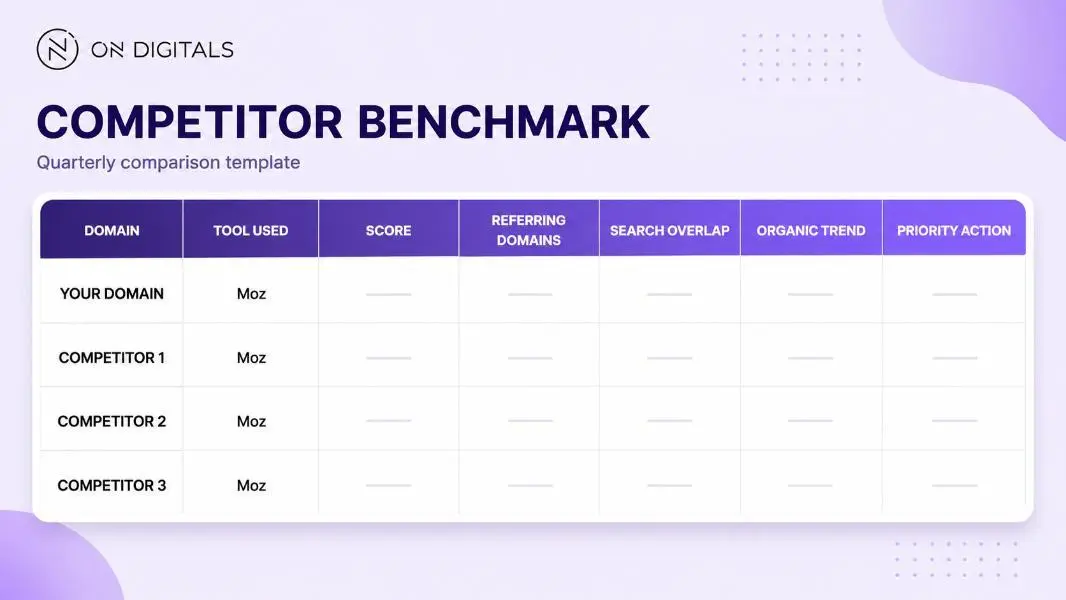 Compare your domain with key competitors each quarter to track score, referring domains, search overlap, organic trends, and the next priority action.
A stable gap can suggest that the next priority is better content or stronger page optimization. A widening gap may justify more investment in digital PR, original research, or relationship-led visibility.
How to use Domain Authority in an SEO strategy
Domain Authority supports SEO planning when it helps you prioritise effort. It should guide decisions rather than become the KPI every activity tries to increase.
Qualify keyword opportunities
Compare your domain with the websites ranking for the query you want to target. Then inspect the ranking pages themselves.
A lower DA does not make a keyword impossible. Look at the SERP closely. Outdated pages, thin coverage, and poor intent alignment can create room for a better result. When competitors have stronger domains and highly developed pages, start with a narrower query that fits your current authority level.
Screen backlink opportunities
DA can work as a first-pass filter during outreach because it highlights websites with stronger domain-level signals. The final choice should still depend on relevance, editorial quality, and audience fit.
Use this quick filter before pursuing a placement:
- Does the website cover a related topic?
- Does its audience overlap with your target market?
- Could the link appear in useful editorial content?
- Does the source page have meaningful visibility?
- Would the reference help readers without SEO involved?
This is why backlinks can support SEO visibility when they come from relevant sources and direct readers toward content that genuinely answers their needs. A well-matched niche publication may be more valuable than a large website with little connection to your market.
Prioritise content that can earn citations
Some content answers a user question. Other assets give writers, journalists, or partners a reason to cite your website.
Useful formats include:
- Original industry data
- Benchmark reports
- Practical templates
- Calculators
- Expert commentary
- Visual explainers
Choose a format that solves a real research need. A standard article may help users, while a benchmark report can also become a source for external publications.
What builds stronger authority signals over time?
A Domain Authority score may improve after your website earns stronger link signals. Sustainable progress usually comes from creating resources worth referencing, then making those resources visible to relevant people.
Earn relevant editorial references
Useful backlinks come from pages with a genuine reason to cite your content. Your research may support an industry article. A case study can explain a working approach. A practical template may help readers complete a task.
Relevance should come before raw score. A link from a recognised yet unrelated site may add less strategic value than a reference from a trusted publication in your industry.
Build page-level linkability
Domain-level authority does not replace page-level strength. Important service pages, pillar pages, and original resources may need external references of their own.
Before starting outreach, decide which URL deserves the link. Sending every backlink to the homepage can leave your priority pages without the support they need to compete.
Use technical SEO to protect earned value
Technical SEO does not directly raise Moz DA. It can still protect the value your website already earns through external references.
For example, a broken URL can waste referral traffic from a strong mention. Redirecting an outdated resource to the closest relevant page helps visitors reach the information they expected. Clear internal links can then guide those visitors towards deeper content.
Avoid private blog networks and scaled schemes
Private blog networks are groups of websites created mainly to place links and influence search rankings. They may offer control over anchor text and placement, yet those patterns can create risk when the links lack editorial value or a genuine audience.
A sustainable profile depends on useful references from real websites. The risks behind private blog networks show why link volume should never become a shortcut to stronger search performance.
How to review a suspicious backlink profile
Low-quality links do not always require immediate action. Most websites collect some irrelevant references over time. Review the pattern before deciding whether it needs escalation.
|
Signal |
What to check |
Recommended response |
|
Sudden link spike |
Source relevance and anchor pattern |
Review manually |
|
Lost valuable link |
Target URL status |
Restore or redirect the page |
|
Foreign-language anchors |
Context and placement |
Investigate repeated patterns |
|
Obvious paid network |
Editorial purpose and site quality |
Avoid further placements |
|
Manual action risk |
Search Console messages |
Escalate to a specialist |
Google describes the disavow tool as an advanced feature. It is generally relevant when a site has many artificial links and there is a manual action, or a clear likelihood of one.
Frequently asked questions about Domain Authority score
Is Domain Authority a Google ranking factor?
No. Domain Authority is a Moz metric used to estimate the relative ranking strength of a domain. Google does not identify DA as a ranking factor. Use it as a comparison point, then assess search intent, page quality, and link context before making decisions.
What is a good Domain Authority score?
A good score depends on the websites you are competing against. Compare your domain with direct search competitors in the same tool. A lower score can still be enough for a focused query, while a higher score may not help when the page misses search intent.
Why did my Domain Authority score drop?
A DA decline may happen after Moz updates its index or model. Lost backlinks can also affect the score. Compare your movement with competitor trends first, then inspect major lost links before assuming that your website has a technical problem.
Does internal linking increase Domain Authority?
Internal linking can improve navigation and help visitors reach relevant pages. It may distribute existing link value across your site. Moz DA does not increase directly because new internal links were added, so treat internal linking as content architecture rather than a score-growth shortcut.
Do nofollow links help Domain Authority?
Nofollow links can bring referral traffic, improve visibility, and lead to later editorial mentions. Their direct effect on a Moz metric may vary. Focus on whether the source is relevant and whether the reference gives users a useful route to your content.
How often should you check Domain Authority?
Quarterly reviews are usually enough for strategic benchmarking. Check more often during active link-building campaigns, while avoid major decisions from small score fluctuations. The direction of your competitor gap matters more than a single monthly number.
Conclusion
A Domain Authority score can help you compare website strength, identify authority gaps, and plan realistic SEO priorities. Its value comes from comparing direct competitors in the same tool, then reviewing the factors a score cannot explain alone.
On Digitals can help businesses turn competitor benchmarks into a practical SEO plan. That work connects content opportunities with stronger link quality and measurable organic visibility.

Read more