
Voice Search Optimization: A Practical Guide for SEO and Business Decisions
Vincent
28/07/2025
35
Voice search optimization helps businesses become easier to find when people ask natural, local, urgent, or decision-led questions aloud. In 2026, it is not a standalone SEO tactic or a shortcut to one spoken answer. It is part of a broader strategy for conversational search, local discovery, mobile experience, and AI-driven visibility.
When someone asks, “Where can I find a reliable electrician nearby today?” or “Which accounting software is best for a small business?”, they expect a clear answer with little effort. Businesses that provide accurate information, useful content, strong local signals, and a fast mobile experience are better positioned to appear across search results, maps, answer features, and AI-assisted discovery.
What does voice search optimization mean and when does it matter?
Voice search optimization is the process of improving your website, local business information, and content so they can better match spoken search queries.
Voice queries often differ from typed searches because they are more conversational, specific, and situational. A user may type “Vietnam SEO agency,” but ask a voice assistant, “What is a reliable SEO agency in Vietnam for a growing B2B company?”
Voice search optimization matters most when your audience frequently searches for:
- Local services and nearby businesses.
- Opening hours, directions, availability, or contact details.
- Urgent support or same-day services.
- Product comparisons and purchase advice.
- How-to guidance or troubleshooting.
- Healthcare, hospitality, retail, travel, food, home services, or appointment-based services.
- Accessibility-friendly ways to search and complete tasks.
It is especially relevant for businesses with physical locations, defined service areas, high mobile usage, or customer journeys that begin with a question and end with a call, booking, visit, or purchase.
Voice search optimization does not replace traditional SEO. It builds on technical SEO, local SEO, content quality, entity consistency, and user experience.
Why voice search optimization affects visibility, user experience, and conversions
Voice queries often reflect immediate intent. A customer may be driving, comparing options, looking for support, or trying to complete a task quickly.
That makes clarity important. Search engines and AI systems need to understand:
- What your business does.
- Where you operate.
- Which customers you serve.
- Whether you are currently open or available.
- What services or products you offer.
- How users can take the next step.
- Whether your website provides a useful answer to the question asked.
A strong voice search optimization strategy can support:
- Visibility for conversational and long-tail searches.
- Local discovery through Google Maps and business profiles.
- Better answerability for question-led content.
- Higher-quality mobile visits.
- More calls, direction requests, bookings, and enquiries.
- Greater brand recognition when your business appears repeatedly during research.
Voice search visibility is not limited to one SERP feature. A business may appear through local results, Google Business Profile information, knowledge panels, featured snippets, People Also Ask, product data, maps, or AI-generated answers.
Audit what AI and search results say about your locations
Before optimising content, check what customers and AI systems can already find about your business.
For multi-location brands, inconsistent information can create confusion across search, maps, review platforms, directory listings, and AI-generated answers. A location may appear with outdated hours, the wrong telephone number, incomplete services, duplicate listings, or inconsistent brand descriptions.
Start with an emergency brand and location audit.
Check each location for:
- Business name.
- Address.
- Telephone number.
- Opening hours.
- Website URL.
- Booking or contact link.
- Primary and secondary categories.
- Service details.
- Accessibility information.
- Reviews and response quality.
- Images and business attributes.
- Local landing-page accuracy.
Then test realistic spoken queries, such as:
- “What time does [brand] open?”
- “Where is the nearest [brand] location?”
- “Does [brand] offer [service] near me?”
- “Best [service category] in [city].”
- “Can I book [service] today?”
Search Engine Journal’s voice-search guidance also highlights the value of checking how location information appears across search, Maps, and AI-driven discovery before building new content. This should be a recurring quality-control process, not a one-time launch task.
For local businesses, voice search optimization should connect naturally with AI for Local SEO. Both depend on accurate entity data, useful location content, reliable reviews, and clear customer actions.
Drive hyper-local foot traffic and sales
Many voice queries have local and immediate intent. Users often want to know where to go, whether a business is open, what it offers, or how quickly they can get help.
That means local conversion can happen without a website visit. A user may call directly from a business listing, request directions, check availability, or make a booking through a platform.
To support hyper-local discovery:
- Keep your Google Business Profile complete and current.
- Maintain consistent business information across important directories.
- Create useful location and service-area pages.
- Include local details that customers genuinely need.
- Use neighbourhoods, landmarks, districts, and service areas naturally.
- Add clear phone, booking, and directions options.
- Encourage genuine customer reviews.
- Respond to reviews accurately and professionally.
- Update seasonal hours, closures, offers, and service availability promptly.
Do not create a separate page for every nearby suburb unless each page has meaningful local value. Strong local pages explain actual coverage, service differences, customer needs, directions, local proof, or useful FAQs.
Improvado’s voice SEO guide correctly links local voice queries with hyper-local discovery and customer actions. The practical lesson is to make every location easy to verify, understand, and contact.
Analyze search results before targeting voice queries
Do not target a conversational keyword until you understand what the search result already rewards.
A voice query may trigger a local pack, map result, product list, Featured Snippet, People Also Ask box, AI Overview, video carousel, shopping module, or ordinary organic results. Each result type indicates a different user need.
For every priority query, review:
- What type of result appears first.
- Whether the search is local, informational, commercial, or transactional.
- Which competitor pages or business listings appear.
- Whether the answer is already satisfied without a click.
- Which follow-up questions appear in People Also Ask.
- Whether users need a quick fact or deeper decision support.
- What content format is missing or weak.
Semrush’s voice search optimization guide recommends analysing SERP features before creating or revising content. This helps teams match the page format to real intent rather than writing generic voice-search content.
For example:
- A query such as “What time does the nearest clinic open?” needs accurate local business information.
- A query such as “How does PRP hair treatment work?” may need a concise definition followed by a deeper expert guide.
- A query such as “Best CRM for a startup under 50 employees” requires comparison, conditions, trade-offs, and decision support.
- A query such as “SEO agency near me” may require a clear service page, local proof, reviews, contact information, and a relevant conversion path.
Create content that answers spoken questions naturally
Voice search optimization works best when content sounds natural when read aloud, but it still needs professional structure and accurate information.
A strong answer-led section should:
- Use a natural question or decision-led heading.
- Give the direct answer in the first one or two sentences.
- Add context, examples, caveats, and next steps.
- Use short paragraphs and descriptive subheadings.
- Include lists only where they make the answer easier to follow.
- Define unfamiliar terms clearly.
- Reflect actual customer language.
- Link to deeper resources when users need more than a summary.
Instead of writing:
Our service provides premium solutions for all customer needs.
Write something specific:
Our SEO service helps businesses improve visibility across Google Search, AI-driven discovery, and high-intent searches by combining technical SEO, content strategy, authority building, and performance measurement.
Use first-party research when possible. Customer support tickets, sales calls, review comments, chatbot logs, internal site-search data, and consultation notes often reveal the real wording customers use.
Digital Marketing Institute’s guide to voice search optimization also treats voice discovery as a customer-experience issue, not simply a keyword-formatting exercise.
Build the technical and entity foundations for voice search
Voice search optimization needs the same technical foundations as strong SEO.
Search systems cannot surface a page or business reliably if the content is inaccessible, slow, unclear, duplicated, or inconsistent.
Prioritise:
- Crawlability and indexability.
- Logical site architecture.
- Strong internal linking.
- Mobile usability.
- Fast page performance.
- Clear heading structure.
- Accurate canonical tags.
- Descriptive image alt text.
- Correct redirects.
- Consistent organisation, service, product, and location information.
- Structured data that matches visible page content.
Use structured data to clarify information that is already visible, such as product details, business locations, articles, breadcrumbs, or services. Structured data does not guarantee voice results, Featured Snippets, or AI citations. It can help search systems interpret relevant content more accurately when implemented correctly.
For a deeper technical guide, see Structured Data for SEO and GEO.
Accessibility also supports voice search readiness. Clear navigation, semantic HTML, readable content, descriptive links, captions, transcripts, and usable forms improve the experience for users relying on voice interaction or assistive technology.
Siteimprove’s voice search SEO guide makes a useful connection between voice search, accessibility, local information, technical quality, and content clarity.
Use voice search optimization as part of AEO, GEO, and AIO
Voice search is one form of conversational search. The same principles also support answer engines and AI-powered discovery.
Answer Engine Optimization (AEO) helps content answer a user’s question directly.
Generative Engine Optimization (GEO) helps brands become easier to understand, trust, and reference in generative AI responses.
AI Optimization (AIO) strengthens semantic clarity, entity context, technical accessibility, and answer-first content across AI-driven discovery.
Voice search optimization supports all three when your content:
- Answers a clear question.
- Uses natural language without keyword stuffing.
- Defines entities, services, products, and locations accurately.
- Gives users context before asking them to convert.
- Includes expert insight or original proof.
- Connects related topics with internal links.
- Supports claims with reliable sources.
- Maintains accurate local and brand information across the web.
This does not guarantee an AI mention or spoken answer. It gives search systems a clearer, more reliable source to assess.
A step-by-step voice search optimization framework
Step 1: Identify high-value spoken-query opportunities
Start with customer questions that relate to local discovery, product comparison, support, bookings, pricing, urgent needs, or business decisions.
Use:
- Google Search Console.
- People Also Ask.
- Google autocomplete.
- Customer reviews.
- Sales and support conversations.
- Chatbot transcripts.
- Internal site-search data.
- Social comments and community discussions.
Step 2: Group queries by intent
Separate queries into:
- Local and immediate.
- Informational.
- Support and troubleshooting.
- Comparison.
- Purchase or booking.
- Branded discovery.
- Post-purchase assistance.
Do not treat every long-tail question as equally valuable. Prioritise the queries that can lead to awareness, qualified leads, visits, bookings, or sales.
Step 3: Audit existing pages before creating new ones
Check whether a current service page, location page, product page, guide, or FAQ can be improved to answer the query.
Avoid creating multiple thin pages for slight wording variations. One strong page can often serve several conversational queries with the same intent.
Step 4: Match content format to the search result
Use:
- Location pages for nearby or service-area queries.
- Product pages for availability, features, and buying questions.
- Service pages for commercial-intent queries.
- Guides for educational or complex topics.
- FAQs for genuine recurring questions.
- Comparison pages for decision-stage research.
- Support content for troubleshooting and post-purchase needs.
Step 5: Improve local and technical trust signals
Review business profiles, directories, author pages, reviews, structured data, page speed, mobile UX, and internal links.
Step 6: Monitor the right outcomes
Voice search attribution is imperfect. Use proxy signals rather than assuming one dashboard will show every voice search visit.
Track:
- Question-led query impressions.
- Mobile organic traffic and conversions.
- Local pack visibility.
- Google Business Profile calls, directions, website clicks, and bookings.
- Featured Snippet or People Also Ask visibility where relevant.
- Branded search growth.
- Customer self-reported discovery.
- Lead quality and assisted conversions.
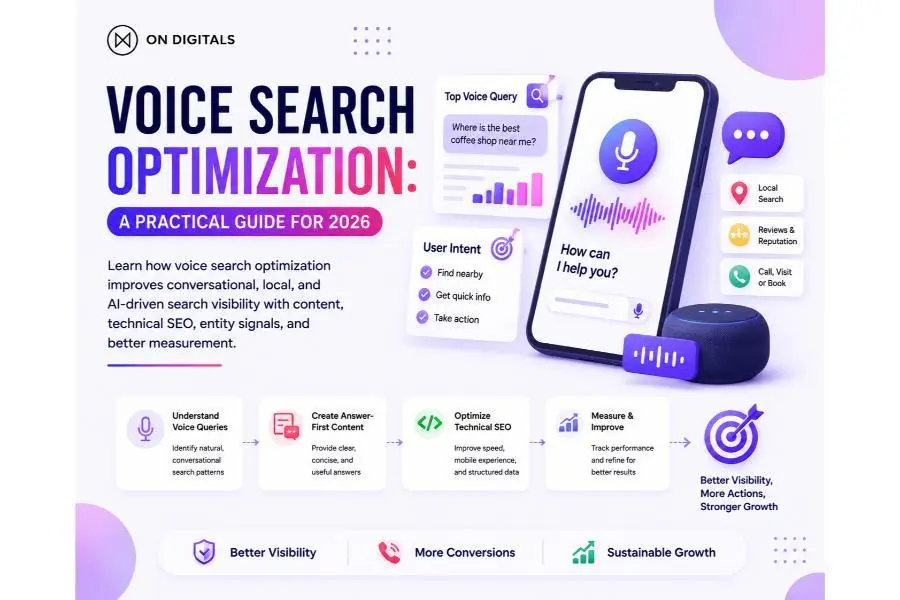
Step-by-step voice search optimization framework showing how to identify queries, create answer-first content, optimize SEO, and measure performance
Common mistakes in voice search optimization
Treating voice search as a separate channel:
Voice search is connected to technical SEO, local SEO, content strategy, accessibility, and AI search. A weak SEO foundation cannot be solved by adding a few question keywords.
Chasing every conversational phrase:
Long-tail queries can be valuable, but not every question deserves a new page. Prioritise by business value, intent, SERP opportunity, and conversion potential.
Using generic or automated FAQs:
FAQs should reflect real user questions and provide accurate answers. Do not create them only to repeat keywords or add markup.
Relying only on Featured Snippets:
Featured Snippets can be useful, but voice visibility may come from local results, maps, knowledge panels, product information, or AI-generated interfaces.
Letting location data become outdated:
Old opening hours, phone numbers, service details, or duplicate listings can damage customer trust and reduce local visibility.
Measuring only rankings and traffic:
For local and voice-led queries, calls, directions, bookings, qualified leads, and branded demand may matter more than a website click.
Tools and checks to review before publishing
Useful tools include:
- Google Search Console for query patterns, impressions, clicks, and indexation.
- Google Analytics 4 for mobile engagement, conversions, and assisted journeys.
- Google Business Profile for calls, directions, bookings, and listing actions.
- Semrush or Ahrefs for keyword research, SERP features, competitor analysis, and local tracking.
- Screaming Frog for internal links, canonicals, mobile issues, and duplicate content.
- PageSpeed Insights for performance and Core Web Vitals.
- ChatGPT or Gemini for research support, question clustering, and content briefs.
- Schema Markup Validator and Google Rich Results Test for structured-data quality checks.
Before publishing, ask:
- Does the opening answer the main question quickly?
- Is the content written in natural language without sounding robotic?
- Does the page match the intent behind the spoken query?
- Are local details accurate and easy to act on?
- Does the page offer deeper value beyond a quick answer?
- Is the content mobile-friendly and technically accessible?
- Does the next step fit the user’s decision stage?
- Are you measuring calls, bookings, leads, or sales where relevant?
FAQ
What is voice search optimization?
Voice search optimization is the process of improving content, local information, technical SEO, and user experience so a business can better match spoken and conversational search queries.
Is voice search optimization still relevant in 2026?
Yes, especially for businesses with local, mobile, urgent, support, product-comparison, or accessibility-related search demand. It should be treated as part of conversational and AI-driven search strategy rather than a separate SEO channel.
Does voice search optimization guarantee Featured Snippets?
No. Clear, answer-first content can improve the chance of matching certain search features, but Google and other platforms decide which results to display.
How does voice search affect local SEO?
Voice queries often involve nearby businesses, opening hours, directions, services, and availability. Accurate Google Business Profile information, reviews, location pages, and consistent business data are important for local visibility.
Should every business create a voice-search FAQ page?
No. Add FAQs only when they answer real customer questions. In many cases, improving an existing service page, support page, product page, or location page is more useful than launching a separate FAQ page.
How can businesses measure voice search optimization?
Use proxy metrics such as mobile organic conversions, question-query impressions, local visibility, Google Business Profile actions, branded search growth, customer feedback, bookings, lead quality, and assisted conversions.
Build a voice search strategy around real customer questions
Voice search optimization is not about writing for devices. It is about making your business easier to understand when customers ask questions naturally, on the move, and with immediate intent.
The strongest strategy combines answer-first content, local accuracy, mobile performance, technical SEO, entity clarity, and measurement that reflects real business outcomes.
Explore SEO Services or Search and AI Marketing to build a search strategy that supports conversational search, local discovery, and AI-driven visibility.

NEWEST POSTS
- Advertising Industry In Vietnam: The 2026 Trends, Channels and Market-Entry Strategy
- Best SEO Company in Vietnam: Latest Shortlist For Businesses
- How To Leverage Social Media For Customer Service Like A Pro?
- Social Media Post Tips – 8 Ways To Boost Engagement
- How To Use Social Media for Sales – In-depth Beginner Guide
Read more